
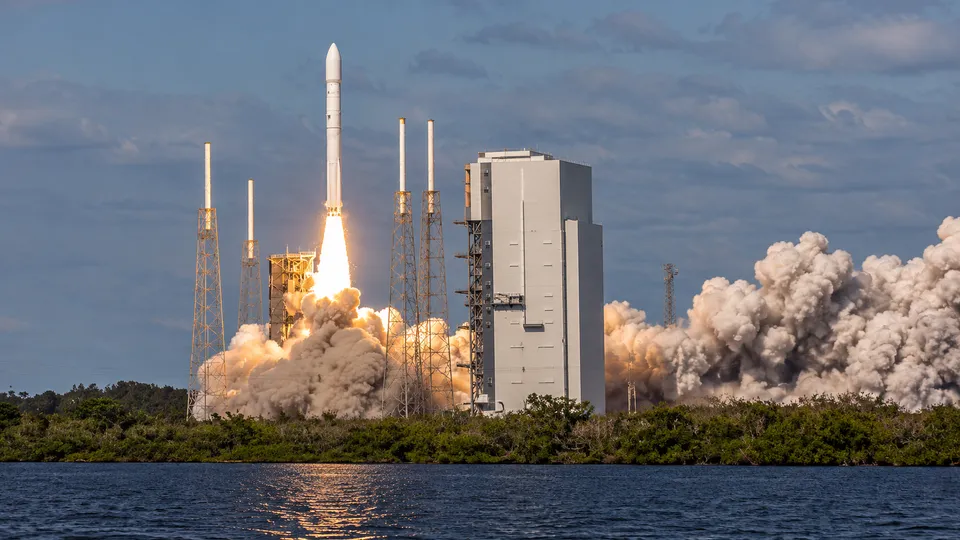
Sunday, November 15, Cape Canaveral Space Force Station. At 12:40 in the afternoon, Eastern time, a Vulcan rocket left the Florida coast carrying 40 satellites for Amazon Leo. About ten minutes later, as Spaceflight Now reported, United Launch Alliance announced an anomaly. The satellites never reached orbit.
It was meant to be a return. Vulcan had been grounded for months, and this was its first flight back, as well as its first mission for Amazon. Instead it became the first complete failure in the company’s history, a history that began in 2006, when Boeing and Lockheed Martin pooled their rockets into one firm. Rews covered the loss itself on the day it happened. What follows is the diagnosis.
The verdict on Wednesday
The company’s account has narrowed day by day. On Tuesday ULA spoke of “low booster performance”, its term for the core first stage, without saying why. On Wednesday, November 18, it went further. According to the statement reported by Via Satellite, preliminary indications show that “the low booster thrust was the result of inadequate fuel supply from the vehicle to the BE-4 engines”, and was “not from the performance of the engines.”
So the engines were not at fault. The rocket failed to feed them. Thrust fell short soon after liftoff, and by the time the stages separated the vehicle was already too low and too slow to reach orbit. Telemetry was lost about ten minutes into the flight.

ULA says every propulsion component appears to have done its job: Aerojet Rocketdyne’s RL10s, Blue Origin’s BE-4s, and Northrop Grumman’s solid boosters, which had been modified after an anomaly on Vulcan’s February flight. The review is still preliminary. The Federal Aviation Administration has opened a mishap review.
There is a quiet irony in all this. The engines, the expensive and much-doubted heart of the machine, come out cleared. What failed, if the early finding holds, is the pipework that carries liquid oxygen and methane to them, the part of a rocket that nobody photographs.
Who breathes easier
The exoneration spreads well beyond Cape Canaveral. Writing in Ars Technica, Eric Berger notes that NASA will be relieved to learn that Vulcan’s upper stage, the Centaur V, played no part in the failure. The agency recently hired ULA to supply the Centaur V as the new upper stage of the Space Launch System, the rocket meant to carry future missions to the Moon.
Blue Origin has more at stake still, because the same BE-4 engines power its own heavy rocket, New Glenn. Its chief executive, Dave Limp, answered with the measured language of a supplier whose product has just been found innocent: “Sunday’s outcome was disappointing for everyone involved. I’m proud of the BE-4 team for their rapid response and support of ULA’s investigation. We’re confident in the team at ULA and look forward to Vulcan’s return to flight.”

New Glenn has had its own troubles. Via Satellite reports that it has been grounded since a pad explosion in late May, which Blue Origin traced to a main oxygen valve in a BE-4, and that the company finished qualifying a modified valve in early November. Even so, Berger judges New Glenn the most tangible source of near-term relief in a worsening American launch shortage. It has commercial and government customers waiting, and NASA is counting on it for several lunar missions over the next two years and for a significant part in landing astronauts on the Moon later this decade.
The long adolescence
For ULA, the news brings no comfort.
Vulcan was supposed to keep the company relevant in an industry now dominated by SpaceX and crowded by newcomers such as Blue Origin. Sunday’s flight was only the rocket’s fifth. Two earlier launches ran into problems with the nozzles of the solid boosters. For three years ULA has been trying to get Vulcan out of its teething phase and into routine service. Had Sunday gone well, Berger writes, the company could have aimed for at least one launch a month next year.

Now the boosters have recovered and the fuel lines have failed. The company, which Berger describes as cash-strapped, faces a new problem in propellant management and in the complicated plumbing that feeds the engines, and he writes that Vulcan will certainly be out of action for several months. Breaking Defense likewise expects a long investigation that could keep the rocket grounded for months, and sees in the failure fresh worries about the American military’s ability to get its payloads into space.
An empire rarely falls in one battle. More often it falls through a series of postponements, each one reasonable on its own terms. ULA was once the all-powerful launch firm, the company the Pentagon turned to almost by habit. Every month Vulcan sits on the ground gives Relativity Space, Rocket Lab and Stoke Space more room to push it aside. The government, for its part, has already begun lending money to rocket makers in the hope of more choice.
The customer moves on
Amazon, the customer whose 40 satellites were lost, had planned 38 Vulcan launches. Sunday’s was the first. The constellation cannot wait for one supplier to fix its plumbing, and the next batch of Amazon Leo satellites is booked on a European Ariane 6, targeted for November 23.
ULA has given no date for Vulcan’s return to flight.