
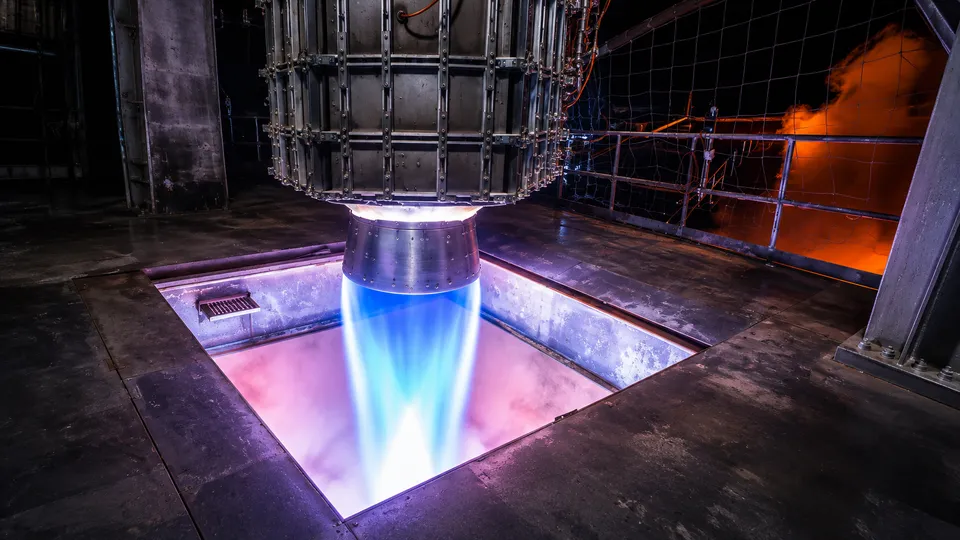
Three loans, $150 million apiece, inside three weeks. That is the Pentagon’s clearest signal yet that it does not expect the commercial launch market to fix its own capacity problem in time. The Department of War’s Office of Strategic Capital (OSC) committed $150 million to Stoke Space on Oct. 27 for a second launch pad at Cape Canaveral, another $150 million to Rocket Lab on Nov. 9 to speed up production of its Neutron rocket, and a third $150 million to the radar firm LeoLabs on Nov. 5 for a satellite-tracking network, as Satnews reported. None of the three has closed. Each is “conditional”: the recipients still have to clear financial, legal, technical and due-diligence review before a dollar moves, as Stephen Clark reported in Ars Technica.
A lending desk inside the Pentagon
OSC is not a grants office. It was created in December 2022 by then-Secretary of Defense Lloyd Austin and now operates under a statutory mandate, 10 U.S.C. § 149, to extend loans rather than subsidies to companies building technology the Pentagon decides it cannot afford to lose. Its FY2025 investment strategy covers 31 technology categories, from microelectronics to synthetic biology, with individual loans running $10 million to $150 million. Space launch is one of the 31. The largest OSC deal to date was $700 million, split between Vulcan Elements and ReElement Technologies for rare-earth processing in November 2025, according to ExecutiveGov; the three rocket and radar loans this month are the first time the office has moved three separate deals in the same sector inside a single month.
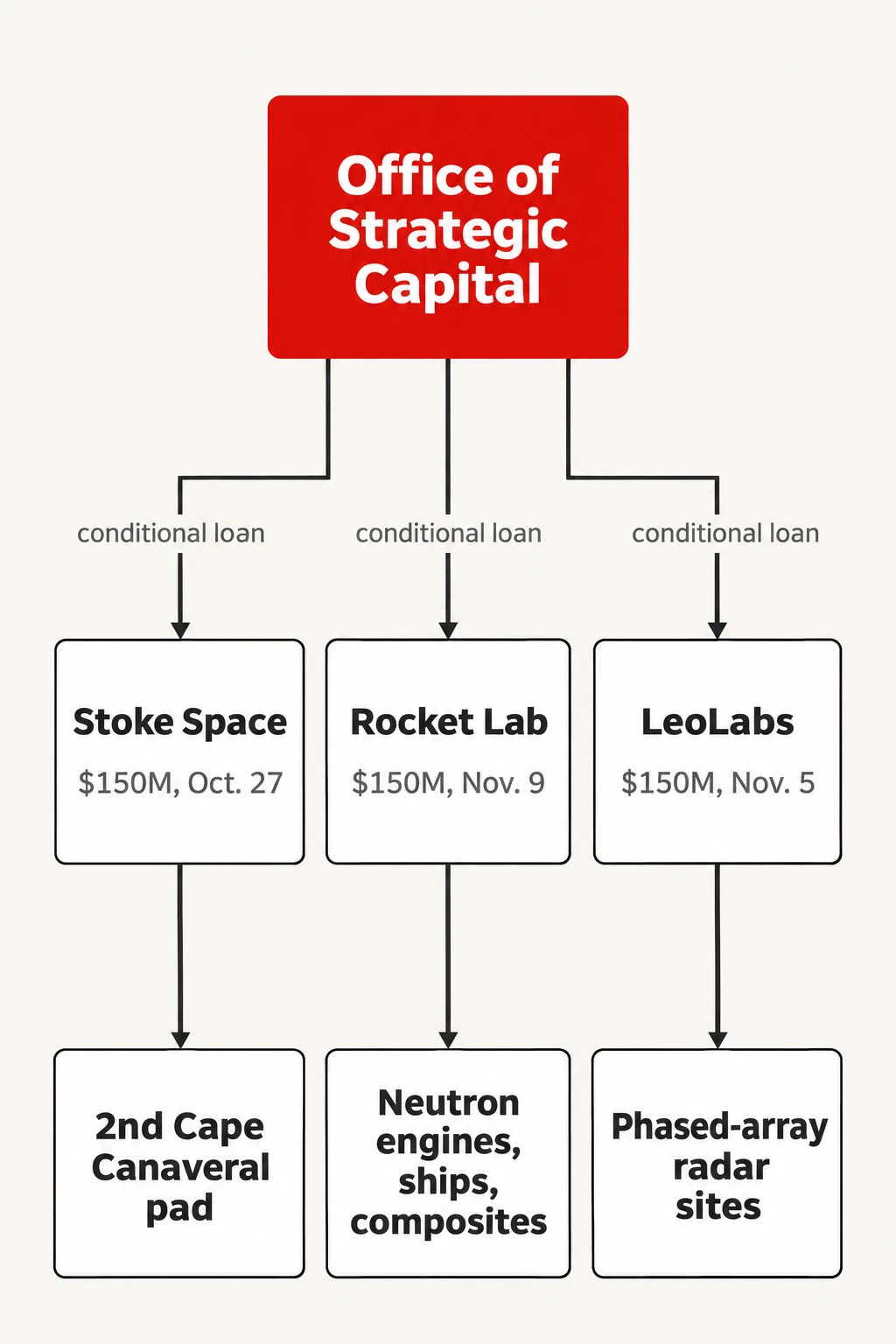
| From | To | How |
|---|---|---|
| Office of Strategic Capital | Stoke Space ($150M, Oct. 27) | conditional loan |
| Office of Strategic Capital | Rocket Lab ($150M, Nov. 9) | conditional loan |
| Office of Strategic Capital | LeoLabs ($150M, Nov. 5) | conditional loan |
| Stoke Space ($150M, Oct. 27) | 2nd Cape Canaveral pad | |
| Rocket Lab ($150M, Nov. 9) | Neutron engines, ships, composites | |
| LeoLabs ($150M, Nov. 5) | Phased-array radar sites |
Jordan Sebold, OSC’s senior managing director for investments, framed the Stoke Space loan as capacity-building rather than charity: “By supporting the construction of additional launch infrastructure, this commitment would enhance the overall capacity and resilience of the commercial space industrial base,” he said, per Ars Technica. Emil Michael, under secretary of war for research and engineering, put the stakes in more strategic terms to ExecutiveGov: the financing “would help provide the robust infrastructure needed to maintain American dominance in the cislunar domain.”
What the money actually buys
The Stoke Space loan pays for a second pad at the company’s existing Cape Canaveral launch complex, next to the one now preparing Nova Pathfinder, Stoke’s first orbital rocket, for a debut currently targeted for early-to-mid 2027 — itself a slip from the 2025 and then early-2026 dates the company once floated, according to GeekWire. The new pad is built for Nova Block 2, a larger version of the rocket not expected to fly before 2029. Stoke raised $1 billion in private capital in September, bringing its total private funding to $2.3 billion; the Pentagon loan followed within two months.
The Rocket Lab loan is narrower and more operational: engine and composite-structure manufacturing, additional maritime recovery vessels for Neutron’s booster, and infrastructure meant to cut the turnaround time between launches once the partially reusable rocket is flying operationally. Neutron is designed to lift 13 metric tons to low Earth orbit on seven methane-fueled Archimedes engines and a carbon-composite airframe. Its first flight has slipped to 2027. Adam Spice, Rocket Lab’s chief financial officer, called the loan’s terms “very attractive” on the company’s third-quarter earnings call and said it “underscores the importance” of the Pentagon’s demand for more launch capacity: “I think this is a helpful indicator, a very positive indicator, about where everyone sees the demand constraint and how it can be unlocked, and capital is certainly a part of that.”

The number that explains the urgency
The reason the Pentagon is suddenly behaving like a venture lender traces back to one vehicle: Falcon 9. SpaceX’s workhorse rocket carried out 165 US orbital launches in 2025 — about 85% of American orbital launches that year, per Scientific American. SpaceX has told customers it has stopped taking new commercial rideshare bookings for flights after 2028 and has begun turning away some dedicated orders for the same period, as the company redirects engineering and manufacturing toward Starship. The Space Force’s own launch contract lets it keep ordering Falcon 9 and Falcon Heavy missions through 2029, with flights continuing as late as 2033, but Starship’s near-term manifest is dominated by SpaceX’s own Starlink and Starmind satellites, not national-security payloads, most of which were never designed to fit it.
A Space Force spokesperson told Scientific American the service has Falcon 9 and Falcon Heavy missions planned through fiscal year 2032 and that as many as six other companies — Blue Origin, Rocket Lab, Stoke Space, Relativity Space, Impulse Space and United Launch Alliance — should be eligible to fly national-security payloads soon. Brig. Gen. Eric Zarybnisky, the service’s acting portfolio acquisition executive for space access, was more guarded: “I wouldn’t say there are missions I’m worried about being able to fly; I would say we’re working through the right way to support those customers.” Of that list, only Blue Origin’s New Glenn has actually flown a vehicle large enough to meet the Space Force’s heavy-lift reference orbits; Neutron, Nova and Relativity’s Terran R, the subject of a recent test-fire, are still pre-flight.

What the backlog says about pricing power
Rocket Lab’s own numbers, disclosed the same day as its loan, show what a tightening launch market does to price. The company raised Neutron’s price for a dedicated launch from $55 million to $70 million, not as a future target but immediately: Spice told analysts on the earnings call “the Neutron pricing isn’t going to $70 million, it’s at $70 million,” adding the company had “already put some in backlog at that price.” Rocket Lab booked eight new Neutron missions in the quarter worth roughly $515 million and chose, in Spice’s telling, to prioritize price over volume — it could have sold more capacity at the old rate. Total company backlog reached $3.57 billion across 117 launches and more than 55 spacecraft, up roughly $1.2 billion, or 52%, from the prior quarter. Peter Beck, Rocket Lab’s founder and chief executive, said the company’s first 16 Neutron launches are already booked and that new customers now face a wait into the 2030s: “Launch is extremely constrained, and that is exactly the situation we predicted.”
Quarterly revenue hit a record $268 million, up 73% year over year, though the net loss widened to $79.7 million from $18 million a year earlier, largely the cost of ramping Neutron production ahead of first flight.
Set against those numbers, three $150 million conditional loans look small: Stoke alone raised more than six times that from private investors two months before its loan, and Rocket Lab’s Neutron backlog grew by roughly $1.2 billion in a single quarter without any government financing at all. What the loans buy the Pentagon is not capacity so much as priority — a lender’s claim on where a cash-constrained startup points its next dollar of capital spending, at a moment when the Space Force is separately scouting a third spaceport because Canaveral itself is running out of room for new pads. Whether $150 million buys enough priority to get a second Cape Canaveral pad built, or a fleet of Neutron recovery ships on the water, before Falcon 9’s order book actually closes in 2028 is the number worth checking again next quarter.