
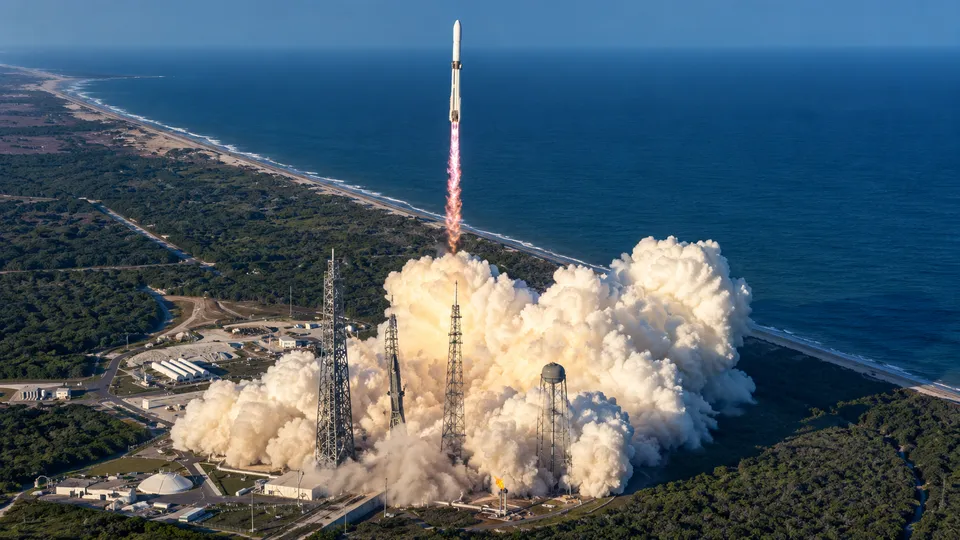
There is a kind of congestion only prosperity produces. On Florida’s Space Coast and at California’s Vandenberg Space Force Base, rockets now queue the way ships once queued outside a silted harbor — and the United States Space Force has concluded that two front doors are no longer enough for the traffic of the heavens.
As Ars Technica reported, a senior commander named Garrant says the service needs a new military spaceport in operation by 2030. The arithmetic behind the urgency is stark: there were 175 orbital launch attempts last year from Cape Canaveral Space Force Station and Kennedy Space Center in Florida together with Vandenberg, and Space Force officials project that the country’s established spaceports will need to support 700 launches a year by 2036.
A third launch site would do two things at once. It would drain off demand now pressing against the limited real estate of the Cape and Vandenberg, and it would supply what Space Force leaders call “geographic resiliency” — insurance against a hurricane or a missile taking one of the great spaceports offline. In the long memory of military installations, this is an old lesson wearing a new uniform: the empire that keeps its fleet in one harbor is one storm away from silence.
Options exist, but none is simple. The federal government already owns a third spaceport at NASA’s Wallops Flight Facility in Virginia, now used for suborbital rocket tests and small- and medium-class satellite launches. The state of Alaska owns the Pacific Spaceport Complex, which can send small rockets up from the far north. And there is the commercial road: asked whether the Space Force might lease property from a privately owned launch base — the expansive spaceport SpaceX plans to build in southern Louisiana, for instance — Garrant left every gate open.
We’ve discussed that we need to consider all of those opportunities: public-private partnership, new federal installation, state land, leveraging commercial land—all of those are possibilities. They all have pros and cons. We haven’t made that decision yet, but we’re not discounting any of those options.
What there is not, yet, is a plan. “It’s going to take a strong partnership with local and state governments,” Garrant said. “As far as decision timelines, we don’t have anything yet.” The generals can count the rockets; they cannot yet name the ground. Meanwhile the launch industry races ahead of its own infrastructure — Blue Origin alone has spoken of 100 Florida launches a year for a rocket that has flown twice — and every pad at the Cape grows more crowded with each manifest. Somewhere between the cadence of commerce and the caution of procurement, a third gate to orbit must be found. The Space Force says the decade will not wait for it.