

Relativity Space said on Friday that the second stage of its Terran R rocket had finished its first integrated hot-fire test, as four U.S. companies race to give satellite operators an alternative to SpaceX’s Falcon 9.
The United States hasn’t debuted a new medium-lift rocket, one that carries 2 to 20 metric tons to orbit, in 13 years. Satellite operators planning launches for 2027 to 2030 don’t know whom to book with, Eric Berger, the senior space editor at Ars Technica, wrote on Tuesday in a guide to the field. The Falcon 9 is no longer for sale. The larger Vulcan and New Glenn rockets have full manifests and are expensive for small and medium satellites.
SpaceX could withdraw the Falcon 9 from commercial service as soon as 2028, Mr. Berger wrote. SpaceX has told several prospective customers that it is no longer taking orders for commercial Falcon 9 launches, Space Intel Report reported. The company hasn’t made a formal announcement. Its successor, Starship, reached orbit for the first time this month, on its 14th test flight.
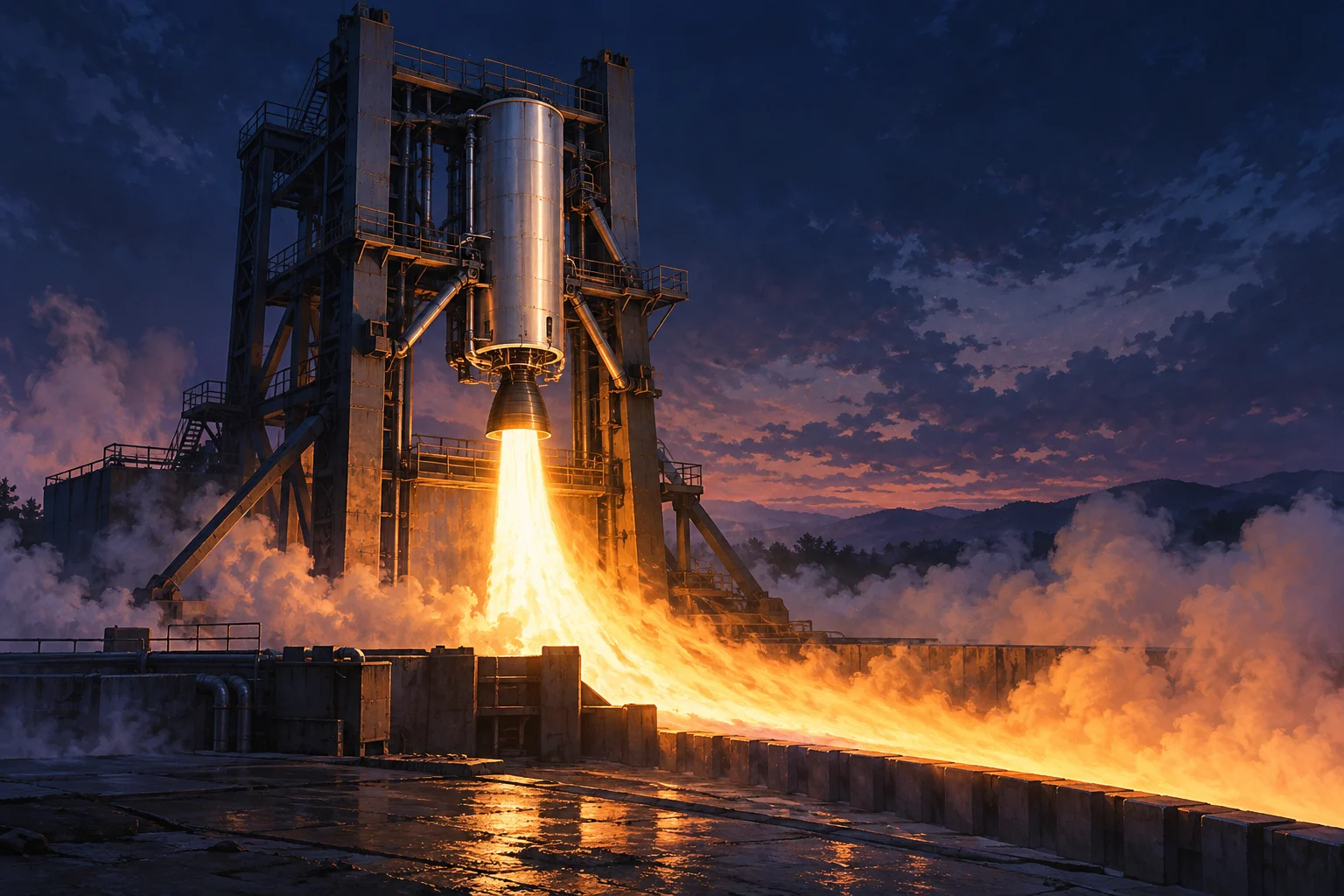
Relativity ran its test at NASA’s Stennis Space Center, on a stand where the stage had been mated and put through cryogenic proof testing over the summer. The company has also finished acceptance testing on all 13 Aeon R engines for the first stage and qualified the first-stage structures.
Relativity advertises up to 33.5 metric tons to low-Earth orbit with Terran R flown fully expendable. With a reusable first stage, which the rocket needs for its economics to work, the figure is closer to 20 tons, Mr. Berger wrote. The Long Beach, Calif., company was close to collapse before Eric Schmidt, the former chief executive of Google, bought it a year and a half ago and put money into it.
Stoke Space is building the smallest of the four. Its Nova rocket is meant to be fully reusable, with a new upper-stage thruster design and heat shield, and is rated at 3 tons reusable and 7 tons expendable. Its first-stage engines use full-flow staged combustion, a hard design for a company’s first engine.
Stoke shipped Nova’s second stage to its test site last week. The first stage is nearly done at the company’s factory in Kent, Wash., and its launch complex at Cape Canaveral, Fla., is nearly finished, according to Mr. Berger, who has covered both companies’ work on neighboring pads at the Cape. Stoke is targeting “early” 2027. Mr. Berger predicted July 2027 for Nova and September 2027 for Terran R, giving the smaller rocket a slight edge.
Rocket Lab once looked likely to be first. Its Neutron rocket, rated at 8.5 to 15 metric tons depending on first-stage reuse and landing site, has run into problems with its Archimedes engine and, more recently, with carbon-fiber domes.
The first stage is the “largest pressurized structure ever made out of carbon composite,” Peter Beck, Rocket Lab’s chief executive, said this month. “Because of its scale, we’ve had to develop new out-of-autoclave processes to build Neutron, and this includes custom cure cycles for the very large pieces, like the forward and aft domes for the propellant tanks on Stage One.”
Rocket Lab’s target is now sometime in 2027. Mr. Berger, citing the lack of visible flight hardware, put Neutron’s debut at January 2028.
The last new entrant, Antares, flew on Soviet-era engines that Aerojet refurbished in the 1990s and a core stage built in Ukraine. It exploded on its fifth launch, in 2014. All four rockets now in development use engines their makers build in the United States.
Northrop Grumman, which acquired Antares’s developer, Orbital Sciences, is building its replacement, Eclipse, with Firefly. Firefly’s work on the Miranda first-stage engines appears to be going well, Mr. Berger wrote, but the companies have said little about the stage hardware, which also uses carbon composites. He put Eclipse’s debut no earlier than 2029. “For now, we’re leaning toward pessimism,” he wrote.