
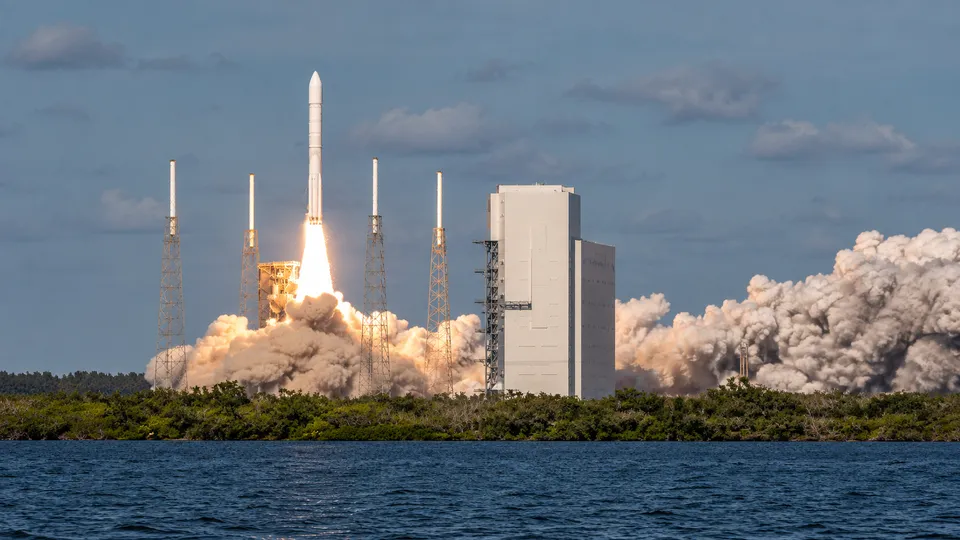
A United Launch Alliance Vulcan rocket carrying 40 Amazon Leo broadband satellites failed about 10 minutes after lifting off from Cape Canaveral on Sunday. It was the first total mission loss in the company’s 20-year history, and the third time in five flights that something has gone wrong on a Vulcan.
The rocket is now grounded for an investigation with no end date. Two customers are waiting on its outcome: the Pentagon, with its most sensitive satellites, and Amazon, with most of its constellation. The rocket meant to back them both up, Blue Origin’s New Glenn, has been grounded since a pad explosion in May, and it runs on the same engine family, the BE-4. That leaves SpaceX as the only American company flying a heavy rocket certified for top-tier national security missions, and SpaceX is retiring its Falcon 9.
Since 2003, federal law has required the government to keep at least two rocket families able to carry any national security payload, so that one failure can never strand a satellite. The rule was already bending before Sunday. Since February the Space Force has moved six missions off Vulcan to SpaceX and given SpaceX all 18 launches in a $1.6 billion missile-defense order. Amazon’s problem comes down to one number. Its license requires 3,232 satellites in orbit by July 30, 2029. It has 396, and the rockets it can count on in the coming year have room for only a fraction of the rest.

What failed on Sunday
It took three tries to launch. A gaseous nitrogen plant that serves several launch companies went down and scrubbed Friday’s attempt, and network trouble between the rocket and ground systems ended Saturday’s. On Sunday, controllers held the count at T-minus 20 seconds for a technical issue ULA has not described. They cleared it and launched at 12:40 p.m., at the very end of the window, CBS News reported. It was Vulcan’s first flight in nine months. Whether the hold had anything to do with what followed is not known.
The part that had kept Vulcan on the ground all year worked. The nozzles on the six Northrop Grumman solid boosters had failed on two earlier flights. This time the boosters burned out and dropped away about 100 seconds into the climb, and Northrop said its preliminary data showed they performed as expected. Then the twin BE-4 engines on the core stage were due to shut down just short of the five-minute mark, and Ars Technica reported that they kept firing for at least 30 more seconds. ULA’s telemetry-driven animation showed the rocket starting to spin after shutdown. The Centaur V upper stage separated late and swiveled its two RL10 engines, apparently trying to steer back on course. The webcast ended without a word about trouble.

The accounts since then put the fault in different places. ULA said the vehicle “suffered an anomaly 10 minutes into the flight,” and CBS, working from ULA’s update, placed the failure during the Centaur’s planned burn of 12 minutes 15 seconds. Ars, citing multiple sources, reported that the anomaly began in the booster stage, not the Centaur or the solids. Its sources couldn’t yet say whether the BE-4s were to blame, the hardware that feeds them propellant or something else. Reuters reported that the trouble appeared to come after stage separation and that the engines’ role was unclear. Ars noted that an overburn can mean a stage is underperforming and burning longer to make up for it. A short-changed first stage would leave the Centaur too much to do, which fits all three accounts. Nobody has confirmed that.
John Gedmark, chief executive of the satellite maker Astranis, posted his own reading of the broadcast that evening. He described himself as a dispassionate observer, and the post was blunt about what a long stand-down would cost the industry.
A few thoughts on today’s Vulcan anomaly--
My notes below are that of a dispassionate observer, but obviously this sucks. The world is much, much worse off without Vulcan as a launch option.
And the impacts could be much bigger than just “one less rocket”, including directly…
About 50 minutes after liftoff, ULA issued a statement that used the phrase describing its reason for existing.
ULA exists to provide assured access to space for our nation and for the customers who depend on us. ... Today, we did not meet that standard.
The two-rocket rule
The policy grew out of a bet the Pentagon nearly lost. In the early 1980s the government planned to fly nearly everything, military satellites included, on the space shuttle. Edward Aldridge, the Air Force secretary, didn’t want to depend on a single vehicle and in 1985 ordered 10 Titan IV rockets from Martin Marietta, according to his biography. Challenger broke apart the next January. The shuttle did not fly again until September 1988, and in that time the Titans kept military payloads moving.
Having two rockets did not make either one reliable. Between August 1998 and April 1999 three Titan IV launches failed, losing a classified reconnaissance satellite, a missile-warning satellite and a Milstar communications satellite. A Defense Department assessment released in December 1999 blamed engineering and workmanship deficiencies and put the losses at nearly $3 billion, according to the Air Force’s release.
Congress wrote the principle into the defense bill signed Nov. 24, 2003. The statute directs the president to sustain “at least two space launch vehicles (or families of space launch vehicles)” able to carry any payload the defense secretary or the director of national intelligence designates as a national security payload.
Three years later the government allowed both rocket families to come under one roof. Boeing’s Delta and Lockheed Martin’s Atlas were the only suppliers of medium and heavy national security launches. The Federal Trade Commission said combining them was “likely to cause significant anticompetitive harm” but let it go ahead because the Defense Department concluded that “the unique national security benefits from the joint venture would exceed any anticompetitive harm,” the commission said. The vote on Oct. 3, 2006, was 5 to 0, Space.com reported. ULA opened on Dec. 1, 2006. Both rockets kept flying, but now one company built them.

SpaceX became the second company in the 2010s, and for a time the setup looked the way the law intended. Vulcan flew its first national security mission in August 2025. Col. Jim Horne III, the Space Force mission director, said then that the service would “continue to maintain our assured access to space with at least two independent rocket service companies,” The Orlando Sentinel reported.
One engine, two rockets
Sunday’s failure tests the word “independent.” ULA chose Blue Origin’s BE-4 for Vulcan’s core stage in 2014 and made it final on Sept. 27, 2018, SpaceNews reported. Congress had moved to end American purchases of the Russian RD-180 that powered the Atlas V. New Glenn flies seven BE-4s on its first stage. So the Pentagon’s second heavy-lift provider and the third one it added in 2025 share an engine maker, and that maker also competes with ULA.
On May 28 a New Glenn exploded during an engine test at Cape Canaveral and wrecked Blue Origin’s only operational pad. On Aug. 5, Dave Limp, Blue Origin’s chief executive, said the anomaly “originated at the main oxygen valve on one of the BE-4 engines,” Space.com reported. He said the company was making small changes to the valve that could be retrofitted quickly to existing engines.
Mark Peller, ULA’s chief executive, made the overlap plain before launch. “That BE-4 engine and main oxidizer valve are common to the BE-4s we fly on Vulcan,” he said, according to Spaceflight Now. In an interview with Aviation Week & Space Technology, which CBS cited, he said Blue Origin had developed a “design improvement” and fitted it to this rocket.
They were down at our facilities probably a couple months ago and implemented that retrofit kit on the engines on this upcoming mission,
Blue Origin, Mr. Peller said, is also working through ULA’s inventory of engines. Sunday’s rocket was the first to fly BE-4s since the explosion. If investigators trace the failure to the engine, Ars reported, New Glenn’s return could be held up too. Mr. Limp told staff around Nov. 5 that the return had slipped to January because the pad rebuild was running late, SpaceNews reported. Reuters reported that Blue Origin is working with ULA on the investigation.
Scott Manley, a widely followed launch commentator, raised the New Glenn question within minutes of the first reports that the trouble was in the booster stage.
It’s worth mentioning that the booster underperforming could be a BE-4 issue which could impact New Glenn’s return to flight.
On Hacker News, a reader worked through the timeline the same way and went a step further.
The booster shut down about 40 seconds later than the expected timeline, which implies that it had an extra 40 seconds of fuel relative to expectations. It is possible that the modifications somehow caused an under-performance of the booster, which would doom the mission.
The reader’s figure is higher than the “at least 30 seconds” Ars reported, and the conclusion goes further than the evidence. An overburn suggests the stage was falling short and burning longer to compensate. It doesn’t say why. Ars’s sources were still weighing the engines, the propellant feed and other causes. Neither ULA nor Blue Origin has linked the failure to the valve change.
The Pentagon’s arithmetic
Vulcan carries a large share of the military’s most demanding work. In April 2025 the Space Force divided Lane 2 of its National Security Space Launch program’s third phase, the tier for the least risk-tolerant payloads, among three companies. SpaceX got about $5.92 billion for an expected 28 missions, ULA about $5.37 billion for 19 and Blue Origin about $2.39 billion for seven, according to Space Systems Command. Ars, which also counts missions still owed under earlier contracts, put Vulcan’s share of national security launches over the next few years at roughly half.
That work stopped on Feb. 12, when a booster nozzle failed for the second time, on the USSF-87 mission. Vulcan still delivered its payloads. Col. Eric Zarybnisky, the Space Force’s portfolio acquisition executive for assured access to space, said national security missions would not fly on Vulcan until the anomaly was solved, Breaking Defense reported. He was frank about how long that would take.
This is going to be a many-months process as we work through the exact technical issue that happened
The missions didn’t wait. The last GPS III satellite moved to SpaceX in March. On Oct. 21, Lt. Gen. Philip Garrant, who leads Space Systems Command, confirmed that six more national security launches had been moved from Vulcan to Falcon 9 and Falcon Heavy, with ULA getting later missions in exchange, SatNews reported. Before that, on July 29, the Space Force had awarded all 18 launches for its Space-Based Sensing and Targeting satellites, part of the Golden Dome missile-defense effort, to SpaceX for $1.6 billion. Seven companies, ULA among them, held contracts that let them compete.
Meanwhile the backup is winding down the rocket the military relies on. Falcon 9 carried 85 percent of U.S. launches in 2025, Scientific American reported on Nov. 4, and SpaceX is phasing it out in favor of Starship. Reuters reported that SpaceX has stopped taking Falcon 9 bookings. In October, Politico reported that the Space Force had tried to book launches for three future satellite missions and that SpaceX declined, according to two people familiar with the missions. No other company offered to take them. SpaceX has not disclosed plans to certify Starship for national security missions, which Ars said would take multiple years.
Kathleen Curlee, who studies space at Georgetown University’s Center for Security and Emerging Technology, told Scientific American she was more surprised that people were shocked.
Whenever you rely on one launch provider, especially one that’s commercial, you’re kind of at their whims.
So far the Pentagon has answered with loans to newer companies. Its Office of Strategic Capital offered Stoke Space a conditional $150 million on Oct. 26 for a second Florida pad, as rews reported. This month it offered Rocket Lab another $150 million to speed up production of Neutron, a rocket that has not yet flown.
ULA itself was already under strain before Sunday. In May, Boeing and Lockheed each agreed to guarantee $500 million of ULA credit lines maturing July 30, 2027, Boeing disclosed in its quarterly filing. “We and Lockheed expect to provide additional financial support and could incur losses” if Vulcan does not resume launches as ULA assumes, Boeing wrote. In February, Mr. Peller, then chief operating officer, said ULA was aiming for 16 to 18 launches this year. Before Sunday, Vulcan had flown once.
Amazon’s clock
Amazon built its launch plan in 2022 to spread the risk. It booked 83 launches from Arianespace, Blue Origin and ULA, 38 of them on Vulcan, and called it the largest commercial procurement of launch vehicles in history. SpaceX was left out. In 2023 a pension fund sued Amazon’s board, arguing that Jeff Bezos’s rivalry with Elon Musk was the reason, CNBC reported. Amazon called the claims “completely without merit” and signed for three Falcon 9 launches that December. The Delaware courts dismissed the case.
The spread hid a correlation. Two of the three providers fly the BE-4, and the company that builds it belongs to Amazon’s founder. Before launch, Melissa Wuerl of Amazon Leo said Vulcan would carry “close to half our first-generation constellation,” making it “our primary workhorse over the next several years,” Spaceflight Now reported.

The Federal Communications Commission’s 2020 license required half the system, 1,616 satellites, in orbit by July 30 of this year. When Amazon asked for relief on Jan. 30, it had 180 in orbit and projected about 700 by the deadline, according to the commission’s order. By its own mission log it reached 396, the last of them on a July 2 Atlas V. Amazon has launched none since. Reuters counts 398 and a goal of 3,236, the figure in the original license. A later change set the total at 3,232.
On June 5 the agency’s Space Bureau, headed by Jay Schwarz, waived the interim milestone rather than extending it. It attached a price. Satellites launched after July 30 lose the spectrum priority Amazon won in earlier filing rounds until March 30, 2028, or until half the constellation is operating. Amazon can bring that date forward to Oct. 30, 2027, but only by certifying that it has built every satellite and bought every launch needed to reach 1,616. SpaceX had asked the commission to send Amazon’s undeployed satellites to the back of the queue, SpaceNews reported. The bureau declined.

The final deadline did not move. The order says the grant “does not affect Amazon Leo’s existing obligation to deploy 100% of its constellation by July 30, 2029.” If Amazon misses that date, its authorization shrinks to the number of satellites operating then.
Without Vulcan and New Glenn, Amazon’s near-term capacity is small. Ten Falcon 9 launches remain on its contract, and its first three Falcon flights carried 24 satellites each, so roughly 240 more. Arianespace has flown three of its 24 Ariane 6 missions for Amazon. The fourth, set for Nov. 23, carries 36. If all 21 remaining flights carried 36, they would add 756. Together that comes to fewer than 1,000 satellites, which would leave Amazon below even the waived 1,616 mark. Vulcan’s 37 remaining flights, at 40 or more satellites each, would carry at least 1,480.
On Hacker News, one reader set out the deadline, and the bind, in two lines.
Amazon had a deadline, now waived, to deploy over 1600 satellites by the end of last July. Now they need to deploy over 3200 satellites by the end of July, 2029. They are so far behind they need to buy RocketLab?
The figures match the order. Another reader replied that Neutron is nowhere near operational, which matches Rocket Lab’s own schedule of a first flight next year. That reader also argued the deadline was “a floating one” because the military wants more than one broadband constellation. The FCC’s order doesn’t support that. It says nothing about military demand and treats 2029 as fixed. Amazon officials had told Ars in October that they had enough satellites in orbit to begin initial service by the end of the year.
The case against alarm
Not everyone reads Sunday as a crisis for the policy. One reader on Hacker News disputed the premise that the country is short of launch companies.
We have that? SpaceX, ULA, Blue Origin, Rocket Lab to name a few I can think of.
The list is real, but today only one company on it can lift a top-tier national security payload. Vulcan is grounded. New Glenn is grounded, and a Pentagon acquisition report this spring said it was not yet eligible for a Lane 2 assignment. Neutron has not flown. ULA’s last six Atlas V rockets are reserved for Boeing’s Starliner. The stronger form of the argument is the Space Force’s own. When Vulcan stopped, the missions moved under contract terms that kept ULA’s revenue. The service says it has Falcon launches planned through fiscal 2032 and that up to six more companies may soon qualify, according to Scientific American. The same official who paused Vulcan told Politico in October that “temporarily, there are some things we’ll need to work through, again, as we get new providers flying.” On that view the policy did its job, because a second family was flying when the first stopped.
The weakness in that view is the law’s verb, “sustain.” The backup that carried the load belongs to a company that is retiring the rocket in question, and the two rockets meant to take over from it share an engine. A reader who described himself as a longtime SpaceX fan worried that ULA itself might not last.
That said, we (the US, the planet) need more than one successful launch provider. ... ULA went conservative with the Vulcan design before it was entirely obvious how good Falcon 9 would end up being.
That reader also suggested Boeing and Lockheed don’t want to invest enough to make ULA competitive again. The filings cut both ways. The owners have put up $1 billion in guarantees this year and say they expect to give more, which does not look like owners walking away. Guarantees keep ULA solvent, though, and they can’t make Vulcan fly. Every Amazon and Space Force mission in ULA’s backlog depends on a rocket that has now had trouble on three of its five flights.
What comes next
ULA has not given a date for a return to flight. It says customers “will have visibility into the investigation process.” Before launch, Mr. Peller said the Space Force wanted ULA “to get through this first commercial flight and they want to review the data before they make a decision” on military payloads. That review now begins with a failure. The Space Force had not said publicly by Monday whether more missions would move.
NASA has its own stake. It recently chose a version of ULA’s Centaur for future flights of the Space Launch System, with crewed lunar missions as soon as 2028, and will want the upper stage cleared. Jared Isaacman, the NASA administrator, replied to ULA’s statement on X within hours.
Appreciate you quickly keeping the public and your partners informed. The team at @NASA is available to assist in all matters related to the investigation and remediation effort. Artemis, Moon Base, and the nation need ULA. We are in your corner and here to help.
The next launch dates are close. Ariane 6 is scheduled to carry 36 Amazon Leo satellites from French Guiana no earlier than Nov. 23, and Blue Origin is aiming to fly New Glenn again in January. Under the FCC’s order, Amazon has until July 30, 2029, to have 3,232 satellites in orbit. It has 396.