
Seven Ukrainian-made unmanned surface vessels hit the Russian corvette Merkury and the cargo ship MV Angara at Benghazi’s naval base in the early hours of November 22. Benghazi is roughly 1,000 miles (1,600 km) from Ukraine’s Black Sea coast by the most commonly cited measure, though one Ukrainian account puts the distance from Odesa at 1,100 miles and others round it to 2,000 km - the kind of spread you get when a government is describing an operation it would rather not fully explain. However you measure it, a drone boat with a stated range of a few hundred miles cannot make that trip under its own power. Ukraine’s security service, the SBU, confirmed why it didn’t have to: the seven craft were carried most of the way aboard a disguised ‘mothership’ and released near the target. It is the first time Kyiv has officially confirmed using that method, which turns the Mediterranean from a sea Russia can treat as a rear area into one where any port hosting its ships is in range.
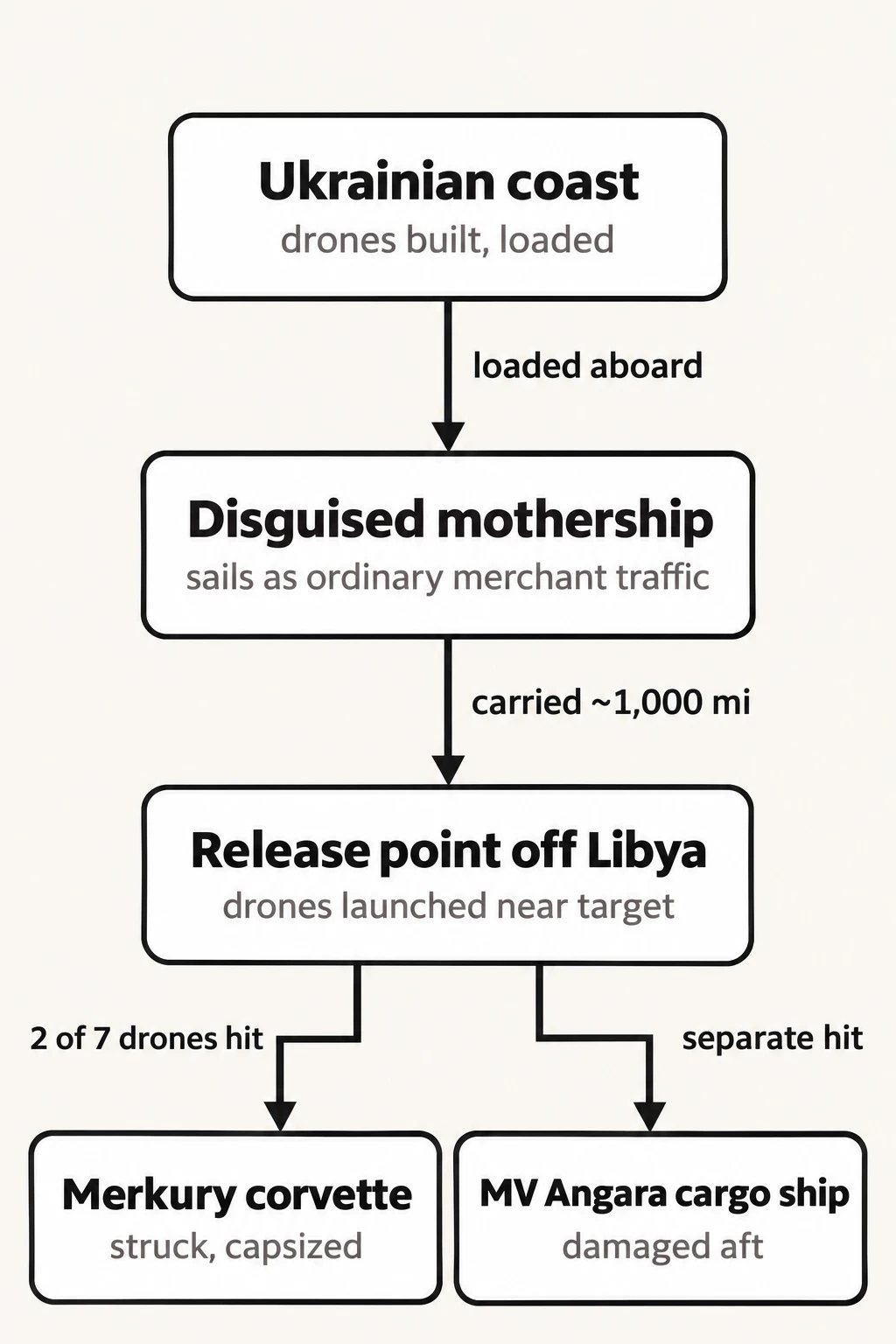
| From | To | How |
|---|---|---|
| Ukrainian coast (drones built, loaded) | Disguised mothership (sails as ordinary merchant traffic) | loaded aboard |
| Disguised mothership (sails as ordinary merchant traffic) | Release point off Libya (drones launched near target) | carried ~1,000 mi |
| Release point off Libya (drones launched near target) | Merkury corvette (struck, capsized) | 2 of 7 drones hit |
| Release point off Libya (drones launched near target) | MV Angara cargo ship (damaged aft) | separate hit |
Based on SBU, via United24 Media
The Merkury is a Steregushchiy-class corvette: 1,800 tonnes standard displacement, 2,200 tonnes full, 104.5 metres long, commissioned 13 May 2023 - one of the newer hulls in Russia’s navy. The SBU says four of the seven drones were intercepted and two struck the ship; satellite imagery reviewed by Al Jazeera showed it capsized with only the bow above the waterline, a Ka-27 helicopter lost with it. Casualty figures diverge by source. Al Jazeera, citing local officials, reported at least ten Libyan and Russian dead within hours of the blast. Libyan military sources quoted elsewhere put the confirmed toll lower, at two Libyan naval officers who died later of their wounds, while Reuters cited medical sources describing roughly ten further casualties as minor injuries. Nobody disputes that people died; nobody agrees on how many.
Who’s minding the target list
The more consequential number from the week is zero: the count of European allies Kyiv told in advance. President Volodymyr Zelensky told the BBC on November 26, discussing the Benghazi strike directly, that “our forces never attack without any coordination with other partners”, calling Merkury an absolutely legitimate target. Italian foreign minister Antonio Tajani publicly disputed that within a day, saying no ally had been informed of an attack inside Libyan territorial waters. By November 27, after a phone call with Italian prime minister Giorgia Meloni, Zelensky had reversed himself in a post on X: “I confirmed that the recent operation in Libya was carried out without prior coordination with our European partners.”

Italian reporting on the call itself was blunter than the diplomatic language that followed it. Pravda.com.ua reported, citing Italian media, that Meloni was furious before the call even started and told Zelensky directly:
I’ve really had enough of this.
Italy’s defence minister, Guido Crosetto, went further, calling Zelensky’s original BBC claim a false statement and saying flatly that the Libya attack had not been agreed with Rome. Meloni said afterward that Italy’s support for Ukraine was unchanged, but that support cannot override the protection of Italy’s own interests - a formulation that reads as a warning about the next strike, not a comment on this one.
A fleet to hit, however far
Benghazi was not an isolated raid. By United24 Media’s count, Ukraine struck five Russian military-linked vessels in the twelve days before and including the Benghazi attack, starting in the Gulf of Finland and ending in the central Mediterranean.
| Vessel | Type | Date | Location |
|---|---|---|---|
| Naro-Fominsk | Buyan-M missile corvette | Nov 11 | Gulf of Finland |
| Sparta II | Cargo ship | Nov 21 | Eastern Gulf of Finland |
| Ambal | Railway ferry | Nov 21 | ~20 nmi north of Ust-Luga |
| Merkury | Steregushchiy corvette | Nov 22 | Benghazi, Libya |
| MV Angara | Sanctioned cargo ship | Nov 22 | Benghazi, Libya |
The Mediterranean leg of that campaign did not start with a mothership. Ukraine first hit a Russian-linked tanker in the sea’s central basin in March 2026, when the LNG carrier MV Arctic Metagaz was struck off Malta by what Kyiv said was a Magura V5 drone launched from Libyan soil near Mellitah - meaning Ukraine already had, or had arranged, a physical launch point on the Libyan coast eight months before Benghazi, a detail that undercuts any claim this was a one-off improvisation. In December 2025 the SBU had already struck the empty shadow-fleet tanker Qendil more than 1,200 miles from Ukraine, calling it an unprecedented special operation at the time. Benghazi is the same trend line extended: more distance, a bigger target, and this time a confirmed mothership rather than a land base.
The diplomatic fallout tracks the same spread. Libya’s eastern, Benghazi-based administration - rival to the internationally recognised government in Tripoli - condemned the strike as a violation of sovereignty while declining to name a perpetrator, saying only that Libya is not a party to the Russian-Ukrainian war. The UN’s support mission in Libya called for an independent investigation, warning that the country “cannot afford and must not become a theatre of foreign conflicts.” Albania denied reports that the drones had launched from its territory. Greek officials, per Newsweek’s reporting, have called for urgent regional consultations after an earlier, unexplained Magura washed up in the Ionian Sea this year. The Kremlin’s Dmitry Peskov described the pattern of Mediterranean and Baltic strikes as a “very dangerous trend” without disputing that they happened.

Ukraine’s sea campaign has already reached from Libya to Finland with a navy that is itself largely drones and intelligence, not surface combatants, and NATO members have been weighing how to reposition their own defences against the same technology turning up in the Black Sea and Baltic. What Benghazi adds is not range - that record was broken in December - but proof that an ally with no veto over the target list can draw a NATO member’s naval base, port authority and foreign ministry into a diplomatic incident inside a third country neither side controls. Meloni’s line about Italy’s own interests is the number to watch: whether it stays rhetoric, or becomes the first condition a European government attaches to continued support for operations it does not get to see in advance.