
The Black Sea runs on a rule written in 1936. The Montreux Convention gives Turkey authority over the straits that lead into it, and under that treaty NATO’s navies have stayed away from military exercises there since Russia’s full-scale invasion of Ukraine in 2022. The same Turkish gatekeeping has kept Moscow from reinforcing or rotating its Black Sea fleet. Large warships from outside cannot come in, and Russia cannot replace what it loses. The sea has been left to the countries on its shores, to merchant hulls and, more and more, to drones.
This October the drones moved toward the coasts of the alliance. Suspected Russian drones have now sunk or damaged five ships near Bulgaria and Romania, and as Jeremy Hsu reports for Ars Technica, NATO officials are weighing whether to move existing anti-drone countermeasures to the region. Diplomats told Politico that the requests came from Bulgaria, Romania and Turkey.
Ten days in October
On October 5 the Turkish-owned Royad Mammadov, loaded with Ukrainian corn, went down off Romania, and two of its crew were killed, according to the Ukrainian agency UNN. President Zelensky blamed Russian drones for that sinking.
A day later Bulgaria’s prime minister, Rumen Radev, said drones had struck two vessels inside Bulgaria’s exclusive economic zone, the first attack on shipping there. The Alfa Watan sank and its crew could not be accounted for. The Able caught fire and two of its sailors were seriously hurt. Both ships were reportedly Turkish-owned, UNITED24 Media reported.
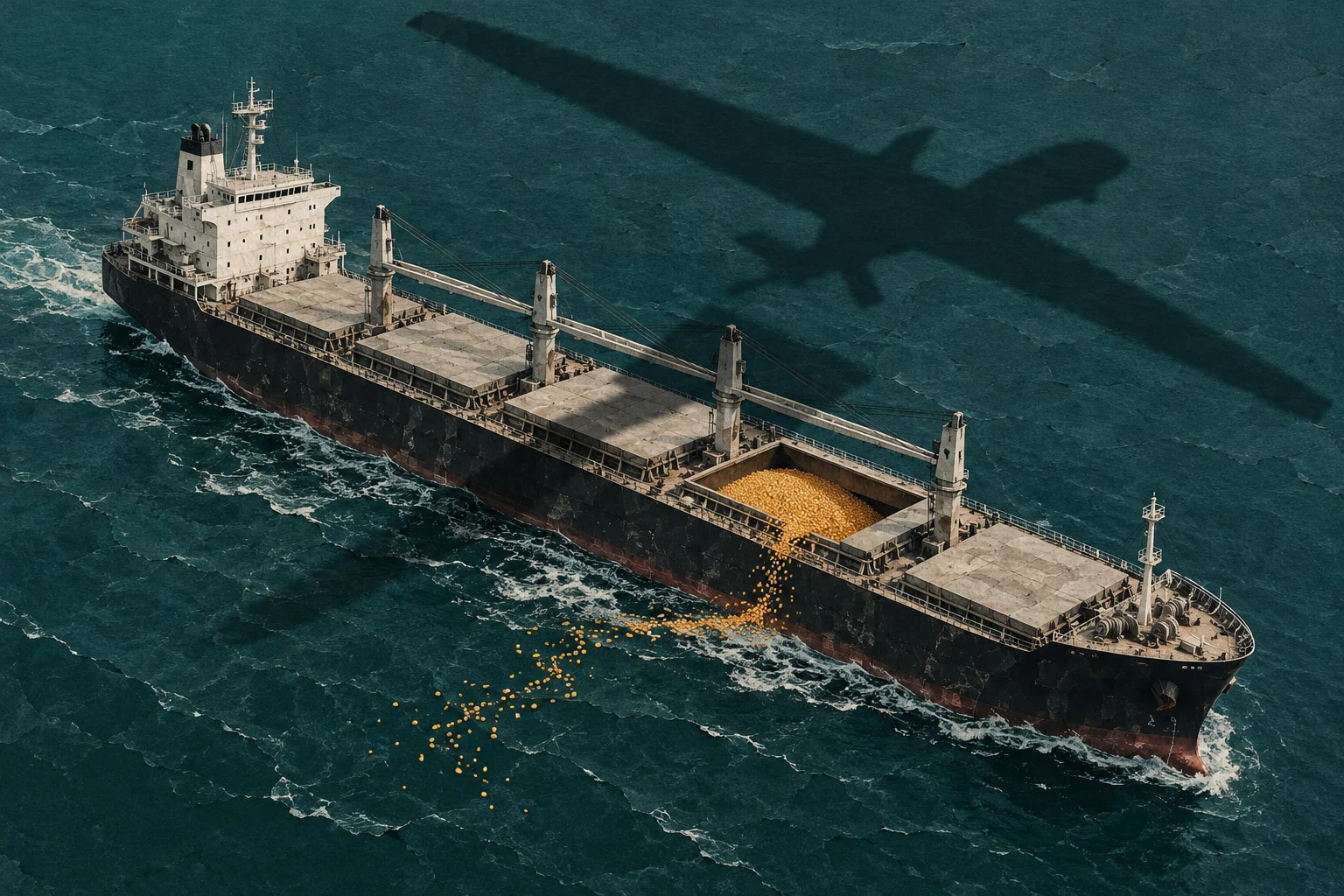
Then came Tuesday, October 13. Three aerial drones hit the Chelsea 3, a Ukrainian-owned freighter registered in Odesa and flying the flag of Malta, about 20 miles off the Bulgarian coast. Radev said Bulgarian responders brought off the whole crew, Stars and Stripes reported. A second cargo ship was hit in a separate strike, also about 20 miles off Bulgaria’s northern coast, and sank. Bulgaria later called off the search for the missing sailors because of strong winds, high waves and poor visibility. UNN counts at least four people killed across the five attacks, several sailors missing and others injured.
Twenty miles out. That is the distance that counts.
Every strike fell outside Bulgarian territorial waters. An exclusive economic zone is not sovereign territory and the ships were commercial, so, as the Foundation for Defense of Democracies notes, the attacks do not clearly trigger NATO’s collective-defense clause. Treaties draw lines on the water, and whoever reads them closely enough can work just beyond those lines.
Who benefits
Sofia has not formally accused anyone. Radev summoned Russia’s ambassador, and he chose his words with care:
We have no clear evidence to make accusations against either side, but logic suggests that the outcome benefits the Russian Federation
Foreign Minister Velislava Petrova asked NATO and the European Union to help investigate “to establish the origin of the drones,” and called for stronger air and sea surveillance. “The security of the Black Sea is inseparable from Europe’s security,” she said. When the Stripes report was published, NATO had said nothing in public. The caution has a reason. Both Ukraine and Russia fly drones over this sea, and some spillover from their war is real.
The grain road
Ukraine has barely any conventional navy, yet with aerial and sea drones it has largely neutralized Russia’s warships and disrupted Russian-linked ports and shipping. Russia has answered with drone strikes on Ukrainian ports and vessels, and at times on ships from other countries in the region.
Since the autumn of 2023, according to the Carnegie Endowment for International Peace, Ukrainian cargo has mostly kept to lanes inside Romanian, Bulgarian or Turkish territorial waters, sheltering in the margins of neutral and allied coasts. Carnegie says the Black Sea carries well over 90 percent of Ukraine’s grain exports. UNN puts the figure at about 95 percent. Now this year’s harvest is being diverted, some of it overland and some up the Danube, Politico reported, while shipping companies rethink their routes and insurers price the new risk. Strikes at sea had already cut Russian and Ukrainian wheat exports by 60 percent.

The attacks are part of a wider pattern attributed to Russian hybrid, or gray-zone, warfare. Other incidents include an attempted explosive-drone attack on Ukrainian cargo aircraft at Leipzig Airport in Germany, and a Russian drone boat packed with explosives found drifting near a Romanian offshore gas platform. Each one stays below the point where an alliance is obliged to fight.
The coastal states
The three countries on NATO’s southern shore are responding in their own ways. Bulgaria, Romania and Turkey are working on a joint initiative to protect freedom of navigation, which Radev plans to present to the EU this week. Bulgaria’s defence minister, Dimitar Stoyanov, said the country expects to join a NATO anti-drone initiative by October 30. Stripes reported that the alliance could send more aircraft to track drones and pass the data to national governments.
Romania’s defence minister, Radu Miruta, has proposed a “joint military command of the NATO coastal states” of the Black Sea. “Romania is willing to take command and host the structure on the Romanian coast of the Black Sea starting in 2028,” he said, as reported by Demócrata.
According to Carnegie, Turkey, Romania and Bulgaria have upgraded their navies and moved closer on maritime security throughout the war, and the new dangers to shipping are likely to speed that up. The date in Miruta’s offer is 2028. The sailors from the October sinkings went missing this month, about 20 miles off the coast of a NATO member.