
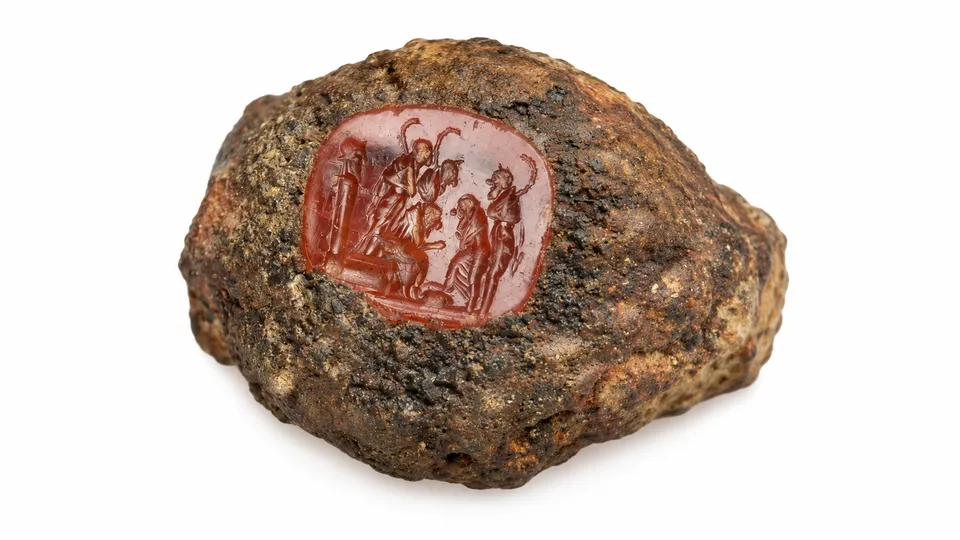
The stone measures 13 millimetres one way and 11 the other. It is a carnelian, reddish, the colour of caramel, and about 2,100 years ago someone carved an entire theatre into it: a poet, a chorus of satyrs, a statue standing for the god Dionysus, and, half hidden behind the statue, a small woman with her arms spread out, who may be a Muse.
The ring that holds the stone is now in the Gaye Çarmıklı Collection of the Ankara Ethnography Museum. On 29 October 2026 two researchers, Melih Arslan and Ahmet Emirhan Bulut, published a study of it in the journal Cedrus, and Leman Altuntaş reported their findings for Arkeonews. The authors date the gem to the first half of the 1st century BC. In their reading it shows a scene from a satyr play, the strange, laughing companion genre of Greek tragedy.
A crowd on a fingertip
The method is intaglio: the figures are cut down into the stone, so that pressed into wax they would rise up in relief. Under magnification the researchers found the marks left by round-tipped drills along the outlines of the bodies, and grooves of different widths where rotary abrasives worked the folds of the clothing. The noses were made with tiny perforations, a single point of the drill for each face.
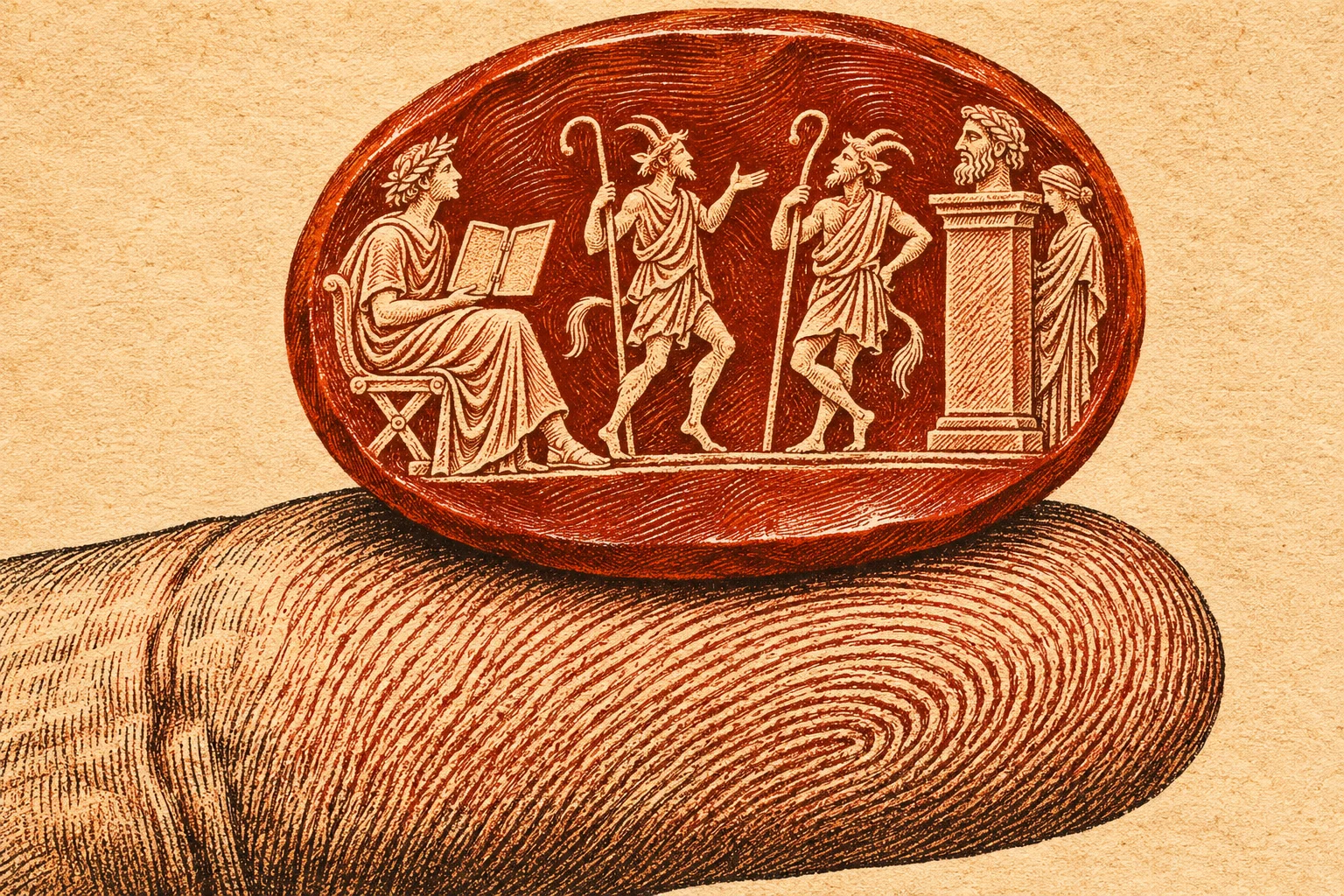
There are five main figures. At the centre a man in a long garment sits and looks at a two-leaf tablet; he may be a poet or a playwright. Facing him another figure stands with one foot raised on a stone, perhaps the leader of the satyr chorus. The rest wear horns and tails and carry curved staffs on their shoulders, the lagobolon or pedum, according to the paper’s abstract on Zenodo. These are the half-animal followers of Dionysus, god of wine and of the stage. Each one stands differently, dresses differently, holds something different. Fitted into a space smaller than a postage stamp, it is a crowded scene.
The woman behind the god
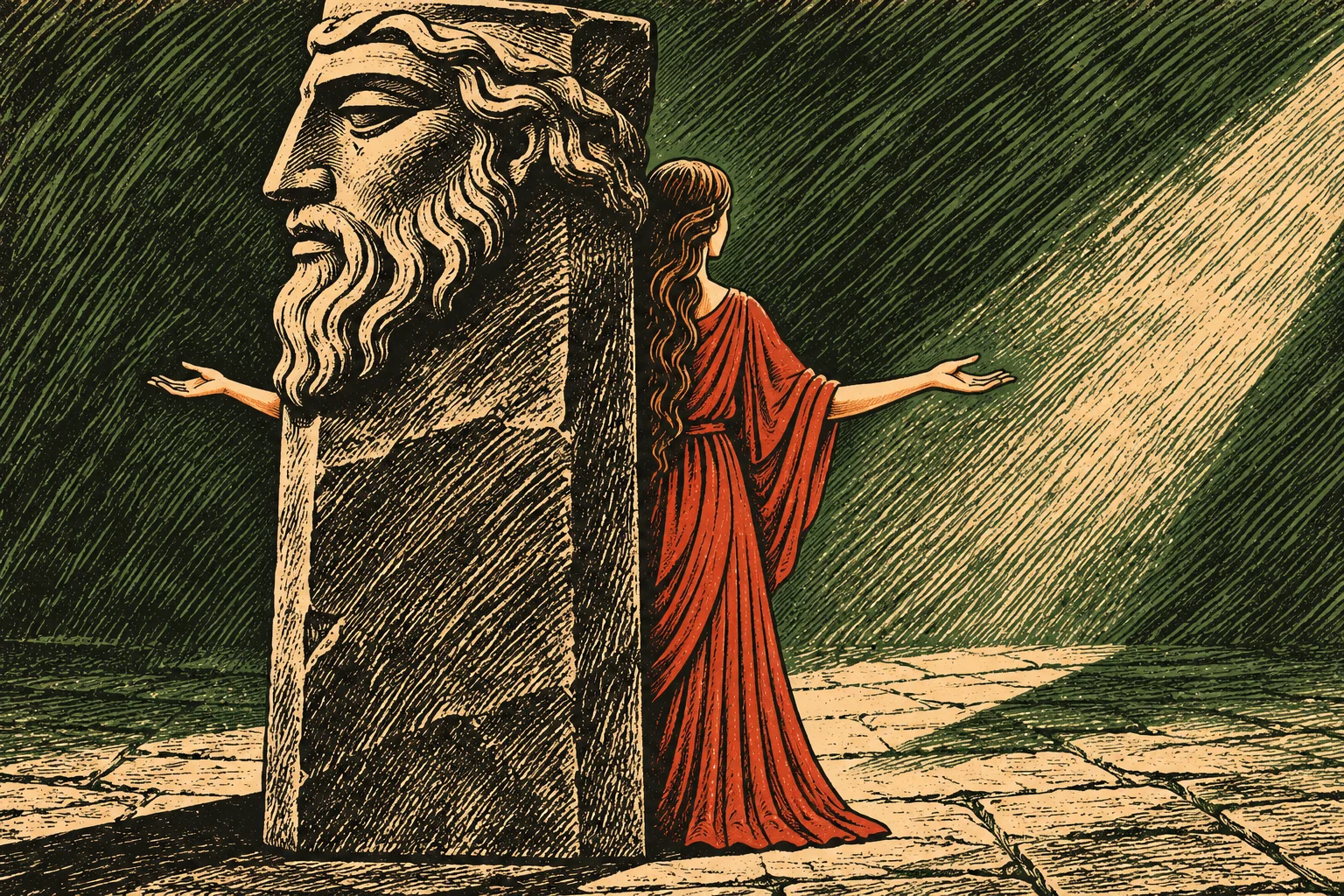
On the left stands a bearded herm, the old form of statue that set a head or bust on a square pillar. This one is linked to Dionysus, and its presence needs no explanation: theatre in Greece grew out of his cult. Behind it the carver added something more. A small female figure, hair falling down her back, arms extended to either side.
Arslan and Bulut suggest she could be Thalia, one of the nine Muses, the one antiquity assigned to comedy and light verse. A Muse of laughter at a satyr play would be a fitting choice. But the researchers do not claim certainty. Her identity is still being weighed against the theme of the scene and against comparable pieces. She may stay unnamed for good.
The play, not the rehearsal
Satyr plays took tragic subjects and let comedy loose inside them, usually through a chorus of satyrs. From the 5th century BC they belonged to the festival programmes of Athens, and later they lived on as performances in their own right. Of all that writing only one complete play has come down to us: Euripides’ Kyklops.
The researchers set the Çarmıklı stone beside related gems in the British Museum and in the Rijksmuseum van Oudheden in Leiden. Those pieces generally show a rehearsal. The actors have pushed their masks up onto their heads, and the poet in the middle studies the text in his hands. The viewer sees men preparing to become satyrs.
The Ankara stone breaks with this. Its carver showed no masks at all. The figures simply are satyrs. Arslan and Bulut argue this may mean the gem depicts the play itself, or the story it tells, rather than actors getting ready. Because such works are so rare, the difference matters: they describe the direct portrayal of satyrs as an approach not documented before among known theatrical reliefs.
One could put it this way, as reflection and no more: the lifted mask is a picture of work, of men and their costumes. Take the mask away and the illusion is complete. Whoever ordered this stone did not want the backstage. He wanted the world the actors promised.
An owner without a name
Who he was, nobody knows. Most of the iron shank is gone, leaving one heavily corroded fragment. The carnelian has two fine cracks and some wear, yet every figure on it can still be read. Two thousand years have done less damage to the satyrs than to the metal that held them.
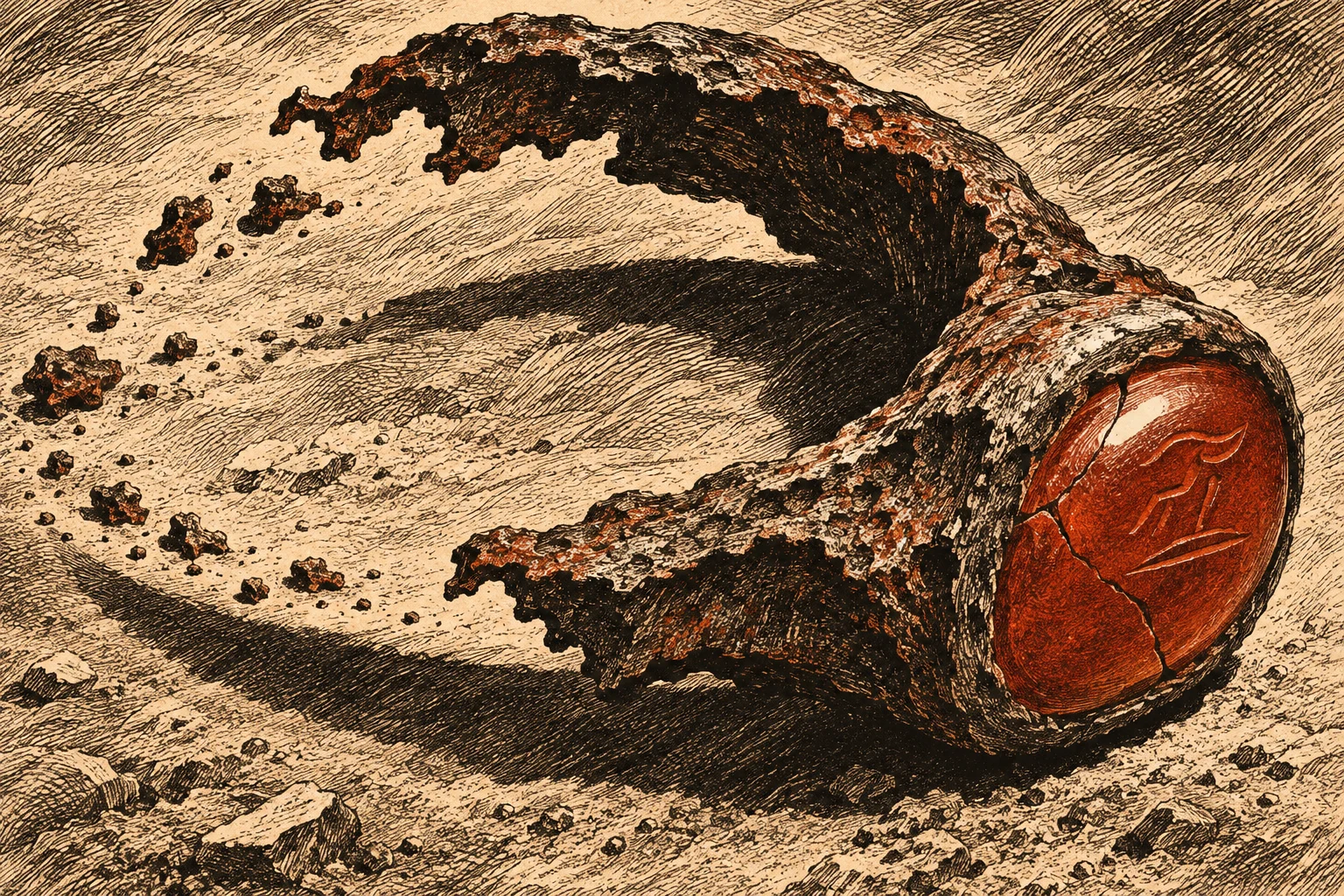
The record is thinner still. The ring did not come from a controlled excavation, so its route is hard to trace. Museum records suggest it may have come from near Sardis, once the capital of Lydia, but the find-spot and the layer it lay in are unknown, and that cannot now be confirmed. Once an object leaves the ground without anyone watching, its history becomes guesswork. The stone survived. What surrounded it did not.
The researchers think the ring might have belonged to a theatre professional, or to someone deeply attached to the stage: jewellery that announced a taste or a trade. They are careful to add that the carving alone cannot prove it. Their date rests on the form of the piece, its technique and its parallels: the small drill marks, the handling of the folds, the stone itself.
There is a quiet irony in where it has ended up. The Ethnography Museum in Ankara, opened in 1930 as one of the first institutions of the young Turkish Republic, was built to hold folk costumes, ornaments and the material life of Anatolia’s villages. Into its keeping, through a private collection, came a Hellenistic actor’s dream of satyrs. The same collection has already produced a study of glass amulets for women in childbirth, small objects that once carried the fears of ordinary people. In the region’s soil the old gods turn up often, sometimes in the form of a wine god’s companion guarding a clay coffin, sometimes in a stone that answered questions with knucklebones.
Here they appear at the scale of a fingertip: a poet bent over his tablet, satyrs with staffs on their shoulders, and behind a stone god a small woman with her arms open, whose name is still in doubt.