
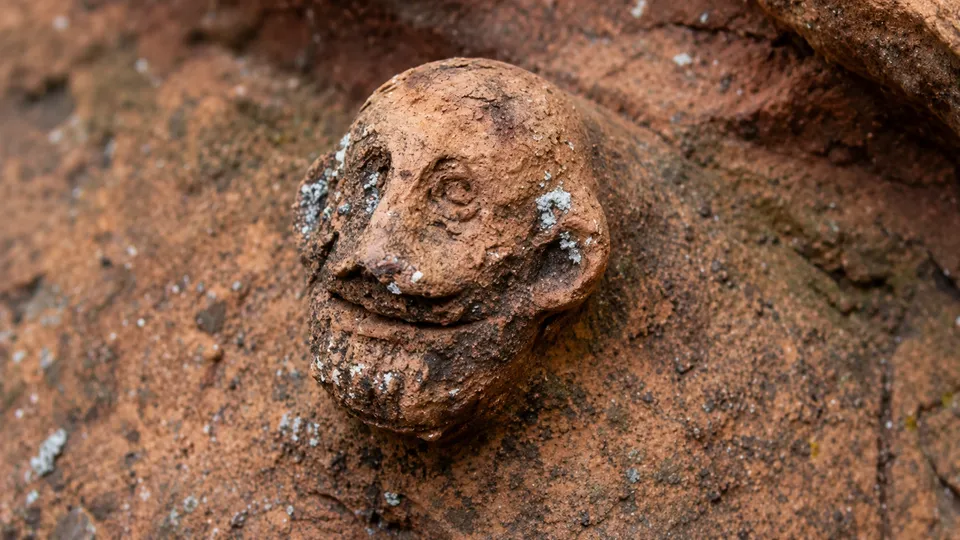
South of an old hill town in western Türkiye lies a stretch of farmland called Musalla. Before any archaeologist walked it, the farming had already been at work. A clay coffin buried there was broken apart, and what was left of it ended up pushed to the edge of the cultivated land, out of the way of the next season’s work.
Surveyors recorded the pieces in 2023. There were six fragments, some from the cylindrical body and some from the lid. They were made of reddish clay with flecks of mica and limestone, and the vessel once measured an estimated 55 to 60 centimetres across. The fragments now sit in the Denizli Museum. One of them carries something no other known cylindrical terracotta sarcophagus in Anatolia has: the face of Silenus, the drunken old tutor of Dionysus.
The find, reported by Leman Altuntaş for Arkeonews, comes from the work of Bilge Yılmaz Kolancı, an associate professor at Pamukkale University. Her study of the lid appears in the peer-reviewed journal Cedrus, volume 14, pages 309 to 322.
A hill among three lands
Attouda stood on a hill that guarded a crossing of borders, near the historical edges of Caria, Phrygia and Lydia. According to the study’s published record, the site lies in the Hisar neighbourhood of Sarayköy district in Denizli Province. Under Roman rule the city did well. The coffin dates from that time, tentatively placed in the first or second century AD.
The town has a deeper past. Last year, Türkiye Today reported that archaeologists had uncovered a sacred precinct of Matar, the Phrygian Mother Goddess, there. Over the centuries Attouda’s gods were added one on top of another, the way its rulers were. The Phrygians gave way to the Greeks, and the Greeks to Rome, which later placed the city in the province of Phrygia Pacatiana.
Four point eight centimetres
The coffin itself was an ordinary object. Cylindrical terracotta sarcophagi like this one, with raised bands and horizontal handles, are known from the nearby cities of Laodikeia, Hierapolis and Trapezopolis. They were probably made in regional workshops, because large, fragile clay burial vessels were hard to carry any distance. Families that could not afford carved stone may have bought this kind of coffin. That is a reflection, not a finding, but empires have always buried most of their subjects in clay.
Someone added a face to this one. The lid fragment measures about 33 by 30.5 centimetres, and on it is a sculpted head only 4.8 centimetres high. It has a bald forehead, round staring eyes, a broad nose, deeply cut lips and a short beard. The features are exaggerated in the way of the Silenus masks found in Greek and Roman art, and they are far livelier than the plain decoration usual on such vessels.
He seems an odd guardian for a grave. Greek myth made Silenus an old bearded drinker, the companion and teacher of the god of wine, festivity and religious ecstasy. But Dionysus and his followers also appeared in funerary art, where they could stand for renewal and the hope of a life after death. A face as grotesque as Silenus’s was also thought able to frighten off harmful forces.
Yılmaz Kolancı reads the little head in this way, as a protector, perhaps set to watch over the person inside. It may have sat above the dead person’s head. The coffin is too damaged to show how its parts were originally arranged, so that position stays a possibility.
One letter
Next to the face, someone carefully cut the Greek letter Beta into the clay, about seven centimetres tall. No one knows what it meant. Yılmaz Kolancı considers whether it marked the workshop or the craftsperson who made the coffin. A cylindrical terracotta sarcophagus from Laodikeia has several incised letters that have been interpreted as workshop marks.
So the lid may hold two traces of a single craftsperson: a signature, if that is what the letter is, and a decision to give a cheap container a face.
A town that knew the god
The people of Attouda would have recognised the face. An earlier find from a tomb in the city’s necropolis is another terracotta head identified as Silenus. Roman-period coins struck at Attouda show Dionysus with his staff and drinking vessel, sometimes with a panther beside him, and inscriptions from the city show ties to his worship. The relief belonged to an established visual tradition. Whoever made it chose from a set of images that was already familiar in the town.
Seen this way, the coffin shows Greek mythology still living in a provincial town under Roman rule, adapted to local workshops and local clay. The study suggests the Silenus image may have meant more than drinking to people who knew it, including renewal, protection and the hope of continuing after death.
The tenant unknown
It is not known who was buried inside. The burial had been disturbed, and no grave goods or other material came out of the ground that could date it independently. The first or second century AD is an estimate drawn from similar coffins in the region.
The dead person’s name, age and status are lost, along with whatever the family said at the graveside. Farming in the field at Musalla scattered the coffin. What survives is a broken lid in a museum in Denizli, with the Silenus face and the letter Beta beside it.