
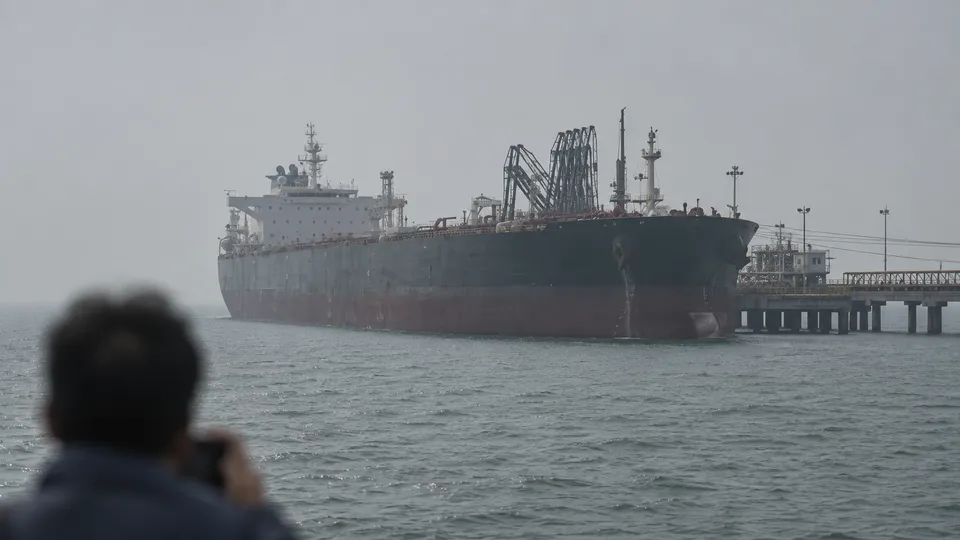
Insuring one commercial ship for one crossing of the Strait of Hormuz now costs $64 million, according to acting US Navy Secretary Hung Cao, who gave the figure at his Senate Armed Services Committee confirmation hearing on November 17. He got there in two tries: asked about the war’s economic toll, Cao first said $54,000, then corrected himself to say that was the pre-war cost, and that the current one is $64 million. Neither number appears in any other account of the strait’s insurance market, as Al Jazeera reported.

What a transit actually costs
War-risk cover on a tanker is not a flat fee. It is an additional war risk premium (AWRP), quoted as a percentage of the ship’s hull value, written for seven-day policies and re-rated as conditions change, so the price of passage is renegotiated on every hull still willing to sail. Michelle Bockmann, an analyst at the maritime intelligence firm Windward, told Al Jazeera that Cao’s number was useless without knowing which cost he meant: “Is he talking about additional premiums for war risk insurance which are set as a percentage of hull value? If so, it depends on the vessel type and the rate paid in order to get proper perspective.” A single dollar figure, without a hull value, a vessel class or a date, is not a rate anyone else in the market can check.
The next-highest published figure is a third of Cao’s. S&P Global’s Platts unit reported on July 22 that the additional war-risk premium had risen to 7.5-10% of hull value, from 1-3% a few weeks earlier, according to Marcus Baker, Marsh’s global head of marine, cargo and logistics. At $77.96 per tonne, insuring a 270,000-tonne crude tanker came to about $21 million. Baker also put a number on market capacity: global war-risk underwriting capacity runs $2.5 billion to $3 billion, against Hormuz-trading tankers mostly valued under $100 million, so the market could in theory place the same risk 25 times over. That is not a market short of capital; it is one pricing fear, not scarcity.
In September, Paul Bradshaw, an executive at Dubai’s Emirates National Oil Company, told Reuters that a round trip’s added costs had climbed into the $10 million to $20 million range, as Business Insurance reported. He broke out the pieces: cargo war-risk cover running up to 10% of a cargo’s value, and separate rates for the vessel itself of “up to five, six percent,” which he said could add “another $10 million on your cargo insurance.” By October, brokers cited in reporting on Marsh’s figures put the additional war-risk premium at 6-10% of hull value, as much as $20 million for a single supertanker voyage, against roughly 0.25% before the war, according to Logistics Middle East. On that pre-war baseline, Marsh’s own 0.25% implies a premium near $250,000 on a $100 million hull — five times Cao’s $54,000 figure for the same period. Even his two reference points, pre-war and current, don’t reconcile with the one broker everyone else is citing. For scale: the Iran-Iraq tanker war of the 1980s, in which more than 450 ships were attacked, ran premiums around 5% of hull value by Lloyd’s List’s accounting. Hormuz rates have touched that level and gone above it more than once since February, without yet matching Cao’s figure at any point.
Why the number was being asked for
Slotkin’s question wasn’t really about insurance brokers. It was about whether the strait is open, and to whom. Iran closed it to most traffic after the February 28 strikes that started the war, then built a two-tier system that lets ships from countries it has exempted, including India, China, Iraq and Qatar, through while treating everyone else’s hull as a target. The UK Maritime Trade Operations office recorded 308 crossings in the week to November 11 (139 outbound, 169 inbound), about 65% below the pre-war baseline of roughly 130-140 daily transits, per its weekly voluntary-reporting-area bulletin. That was an improvement on the week before, when seven tankers were attacked in the strait and the wider Arabian Gulf against eleven the prior week, three of which sank. Since the war began, 163 maritime incidents tied to the conflict have been logged, 141 of them involving damage to a vessel, per the same bulletin. None of that reconciles cleanly with a strait that is, by Washington’s preferred description, open.
The diplomacy hasn’t closed the gap either. Iran’s foreign minister met his Omani counterpart in Muscat on November 17 over a two-day plan to reopen the strait that Tehran says still lacks binding US commitments, while Qatari mediators ran a parallel track the same day. The talks produced nothing before Tuesday’s fighting: Iran’s armed forces said three tankers struck mines east of Hormuz, the US said it swept the main shipping lanes clear, and US fighter jets then struck an IRGC missile site on Qeshm Island after Iranian drones targeted a US radar installation in Bahrain, according to Al Jazeera. Iranian officials said the strike caused no damage to infrastructure. That is the backdrop Cao was testifying against when he produced a number three times higher than anyone else’s.
The rest of the hearing
The insurance figure wasn’t the only count on which Cao’s arithmetic drew pushback. Pressed by Sen. Kirsten Gillibrand on eight suicide attempts aboard the USS Abraham Lincoln strike group during its extended Middle East deployment, Cao told the committee, “You see as eight suicide attempts, I see eight suicide mitigations,” since none was completed, according to military.com. On a separate incident in which a sailor went overboard, Cao said the sailor “was not trying to kill himself and he admitted that,” prompting Gillibrand to ask what he was trying to do and call the characterization inhumane. Sen. Mark Kelly pressed him on reports that sailors had lost up to 45 pounds on reduced carrier rations, after Cao compared the complaints to his children raiding the refrigerator. Sen. Tammy Duckworth said she would not back his confirmation, telling him he would be “another yes-man,” after he declined to say whether he had urged Defense Secretary Pete Hegseth to end the war on readiness grounds. Even Republican Sen. Mike Rounds pressed Cao on why classified briefings had, on multiple occasions, excluded Democratic committee members, according to HuffPost; the hearing also covered the Navy’s failure to tell Congress promptly after removing three senior officers from the USS South Dakota.
None of that settles what $64 million is a price for. Cao’s office has not published a methodology, a vessel class or a hull value behind the figure, and no other broker, insurer or shipper has matched it in nine months of reporting on a market that is, by every other account, transparent enough to quote to the decimal point. The number to watch is whichever one the Pentagon puts in writing, if it ever does.