
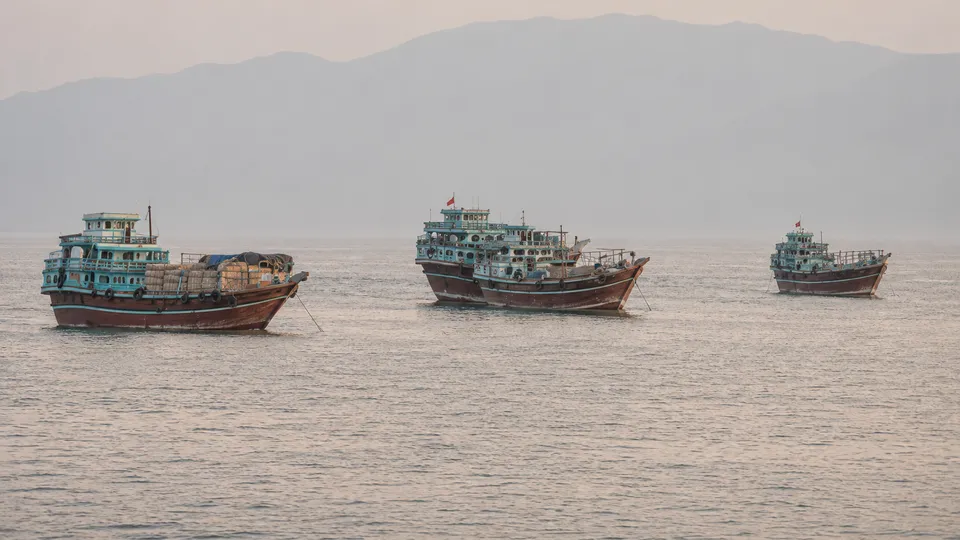
Iran has exempted ships from India, China, Iraq and Qatar from its restrictions on the Strait of Hormuz, a senior Iranian lawmaker said on Tuesday, naming the four countries whose vessels Tehran now lets through.
“Ships from these countries pass freely, and the Americans do not intercept them either,” Amir Hayat Moqaddam, deputy chairman of the Iranian parliament’s National Security and Foreign Policy Committee, told the Iranian Students’ News Agency, as Al Jazeera reported. Some outlets spell his name Hayat-Moghaddam.
Passing freely doesn’t mean passing for free. Indian and Chinese ships still pay transit fees, while Qatari ships cross at no charge, Mr. Moqaddam said, according to Anadolu Agency, which cited the same ISNA interview. He didn’t say what Iraqi ships pay. It was not clear whether the exemption covers foreign-flagged tankers carrying cargo to the four countries or only ships sailing under their flags.
His claim that U.S. forces leave those ships alone could not be independently verified. Washington and Tehran have each been enforcing their own rules in the strait, and ships that break either set have been hit.
The list puts on paper a practice that started early in the war. In March, Foreign Minister Abbas Araghchi said Iran had allowed India and other friendly nations, among them China and Russia, to use the strait for commercial shipping, according to All India Radio. That month, Al Jazeera tracked which countries’ ships had been granted safe passage.
Qatar’s place on the list stands out. Last month, Doha joined France in calling for Hormuz to reopen without fees or limits for everyone. Its own ships now cross without paying. Indian and Chinese ships still pay.
Tehran also leaned on another partner this week. Russia agreed in 2024 to supply Iran with 90 advanced missile launchers, the Financial Times reported on Friday, citing documents from a major Russian defense manufacturer, Al Jazeera reported. The report came as Mohsen Rezaei, a top Iranian security official, met President Vladimir Putin at the Kremlin to discuss a strategic cooperation treaty between the two countries.
The manufacturer was Vympel, according to the FT’s account, as summarized by Iran International. Vympel pressed another Russian defense bureau, KBM, to speed up components for two helicopter-mounted launchers. One delivery schedule listed 192 APU-305 launchers for China and 90 APU-L launchers for a buyer called only “K-10,” which Rosoboronexport, Russia’s state arms exporter, uses as its code for Iran, the FT reported, citing a person familiar with the matter and internal Russian documents.
The launchers carry Russia’s LMUR guided missile, which can strike moving targets, entered service in 2022 and has been used widely by Russian forces in Ukraine. They are built for the Mi-28 attack helicopter, a model Iran already flies.
Al Jazeera’s report said Russia had supplied the launchers. The documents the FT described set out an order and a production timeline for 2024 and 2025, and it was not clear whether any of the launchers bound for Iran were delivered. The Kremlin said in a statement that the visit by Mr. Rezaei was aimed at the “further development of bilateral cooperation.”