
The Strait of Hormuz currently has two sets of traffic rules. They are written by two governments that are at war with each other, and each one enforces its version by breaking ships.
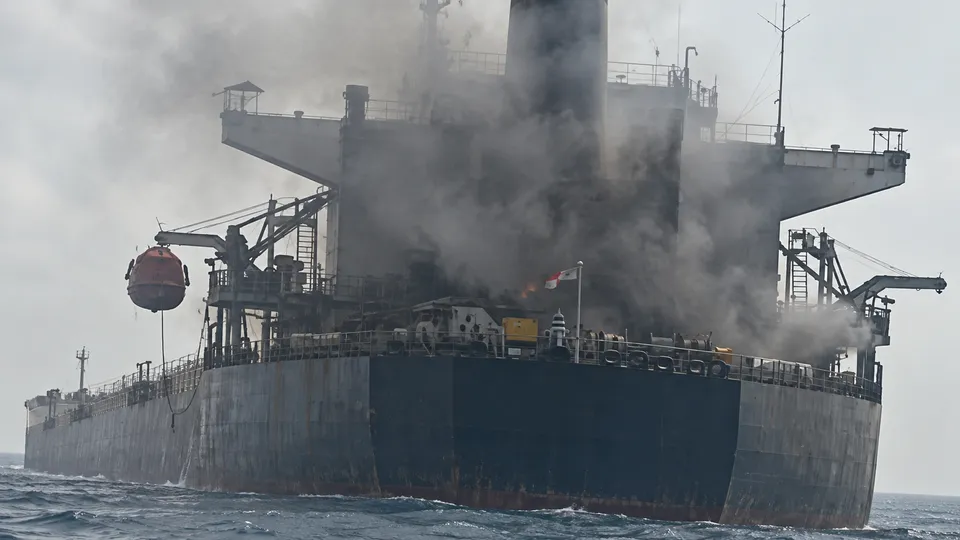
Start with Iran’s. Al Jazeera’s Maziar Motamedi reported from Tehran that the navy of the Islamic Revolutionary Guard Corps said on Saturday night that an unnamed crude oil supertanker had struck a naval mine and caught fire badly. The IRGC said the tanker was using an “unauthorised route” with its navigation systems switched off. Its statement then warned that the same thing could happen to any oil tanker that “wishes to ignore the security and rules” of the strait, which in peacetime carries about a fifth of the world’s oil and gas. The mine claim comes from the IRGC and Iranian state media, and nobody has confirmed it independently. Separately, the UAE said its coastguard rescued 22 crew members after a fire on an unnamed tanker near its coast. It gave no cause, and it isn’t clear whether that was the same ship.
Look at how the IRGC framed it. It isn’t saying that it attacked a tanker. It’s saying a tanker went somewhere it wasn’t supposed to go, with its transponder off, and ran into a mine. A mine is a very passive way to enforce a rule. It doesn’t fire at anyone. It just sits off the approved route, and the statement turns an explosion into a lesson about compliance. “Security and rules” means: take the route we authorise, stay visible to us, and you’ll be fine. Leave the route and you won’t.
Now America’s version. On Saturday, US Central Command said that “a U.S. military fighter jet struck the stern of Panama-flagged M/V Ocean Molica (also known as the ‘Arika Sun’) with a precision munition, fully disabling the ship’s propulsion without harming the crew,” as The Hill reported. According to CENTCOM, the large cargo ship had left an Iranian port and was in the Gulf of Oman, and its crew “ignored repeated warnings” and “attempted to run the ongoing naval blockade against Iran.” CENTCOM also released video of the strike on the ship’s stern.
CENTCOM keeps a scoreboard. Since the blockade resumed on July 14, it says US forces have disabled four commercial vessels and turned back 135. They have also destroyed 10 tankers linked to what CENTCOM calls the IRGC’s “multibillion-dollar shadow network.” Washington says no Iranian oil has crossed the blockade line. Its rule is simple: nothing goes into or out of Iranian ports. Iran’s rule is also simple: nothing goes through the strait except by Iran’s route. The two rules are close to mirror images, and both are enforced by aiming at the back of the ship, where the propulsion and steering are.
Here’s a hypothetical to show the incentives. Imagine you own a tanker loading crude somewhere in the Gulf. If you take the Iranian-authorised route, you’re doing what the IRGC wants, which may not be comfortable while the US Navy is at war with the IRGC. If you take another route with your navigation systems off, so nobody can track you, Iran says you may meet a mine. If you started at an Iranian port, a fighter jet may meet you instead. The cheapest way to obey both rulebooks is to stay where you are.
That seems to be roughly what’s happening. Flows through the strait had climbed above pre-war levels in early October. As recently as late September they were near 80% of pre-war levels. The attacks appear to have cut that back. Kpler data cited by CNBC put average crude transit at 8.5 million barrels a day for the week ending October 7, about 40% below normal. That implies a normal of a bit over 14 million barrels a day, so something like 5.7 million barrels a day went missing. At least 12 ships were attacked in the week ending October 5, the most in any week since the US and Israel attacked Iran on February 28. One of them was hit off Qatar’s north coast. On Sunday, the UK Maritime Trade Operations centre said an unidentified projectile had hit an outbound tanker in the strait. Overnight, UKMTO said, ships near Ras al-Khaimah in the UAE had been told by radio to leave their anchorages.
Iran’s army chief of staff, Habibollah Sayyari, explained his side’s position: “We have struck blows against enemy vessels. If anything else happens against Iran, we will strike them again.”
The negotiation is over who writes the rules
Mediators are still passing messages, but the talks are stuck. Iran wants to go back to the memorandum of understanding from June, which collapsed. It also wants US backing for a deal between Iran and Oman that would set temporary, coordinated routes through the strait. That’s the “authorised route” again, made formal: Tehran wants Washington to sign off on its rulebook. It fits Iran’s earlier demands for a say over who gets through a reopened Hormuz. Nobody expects a breakthrough before Israel’s election on October 27 or the US midterms on November 3. Both governments apparently have voters to answer to before they have shipowners to answer to.
There has been one small move. US Vice President JD Vance said Iran must make a “meaningful” cut to its uranium enrichment. That suggests Washington may be backing away from its demand for zero enrichment, since “meaningful” is a word you can negotiate over and “zero” is not. Tehran says diluting its highly enriched uranium could come up in later talks, but it won’t give up enrichment. Mohammad Eslami, Iran’s nuclear chief, said that “the achievements of our indigenous nuclear industry cannot be stopped.” He pointed to electricity generation and criticised the International Atomic Energy Agency for not condemning US threats to bomb Iran’s nuclear sites again. Behrouz Kamalvandi, spokesman for the Atomic Energy Organization of Iran, said Iran would use both diplomacy and force to protect its gains: “if not, we will secure them in the field of battle.”
So both sides agree the strait should have rules and ships should follow them. What they’re fighting over is whose name goes on the rules. Until that’s settled, the safest move for a tanker is to sit at anchor, unless it’s near Ras al-Khaimah, where someone has just radioed to say it can’t do that either.