
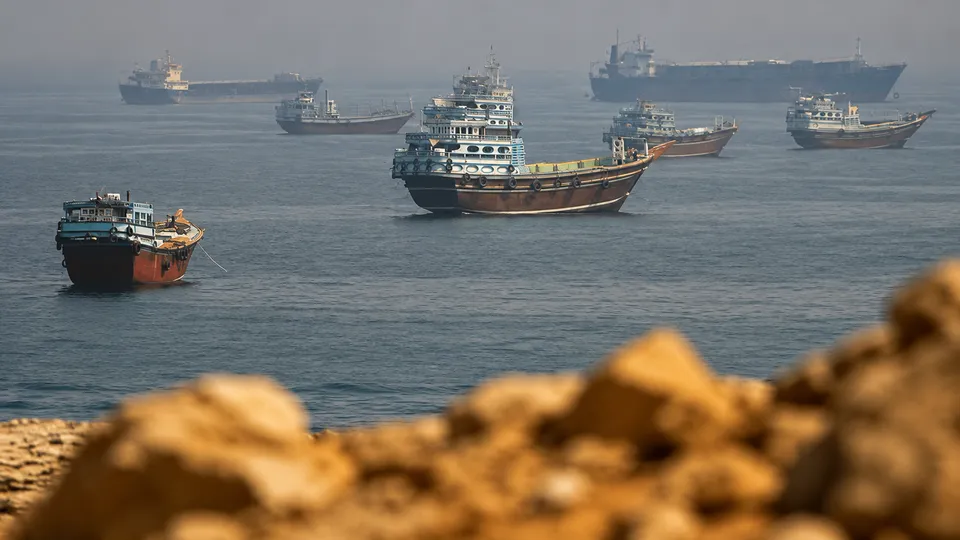
Iran on Tuesday set out the price of reopening the Strait of Hormuz and ending nearly seven months of war with the United States, pairing a seven-day ceasefire plan with demands by its Revolutionary Guards that hostilities in Yemen also stop and that Washington change course.
Foreign Minister Abbas Araghchi left New York on Tuesday after telling state-run Islamic Republic of Iran Broadcasting that he expects an official response to Tehran’s proposal by the end of the day. The plan, first passed to Washington through Qatari mediators last week, was presented on the sidelines of the United Nations General Assembly.
According to Tehran’s presentation, the plan calls for a seven-day cessation of hostilities across the region, including Lebanon; the release of at least $12bn in frozen Iranian assets; the lifting of sanctions on Iranian oil; and an end to the US naval blockade. In return, the strait, through which roughly a fifth of the world’s oil and a similar share of its gas passes, would reopen through a new route determined by Iran and Oman.
Some reports say Araghchi went further. They say he gave US envoys a written document a day before announcing the seven-day plan, setting out a region-wide ceasefire lasting up to 60 days alongside a gradual reopening of the strait, and demanding the release of about $24bn in frozen funds and a halt to enforcement of the blockade on the Houthis. No open source has reported the existence of such a separate document, and it remains unclear whether the formal proposal includes Yemen.
Hossein Mohebbi, a spokesperson for the Islamic Revolutionary Guard Corps who oversees Iran’s Yemen portfolio, told the AFP news agency that ending hostilities in Yemen was among Tehran’s demands. Speaking later at a press conference with foreign media, Mohebi called President Donald Trump “a big liar” and said US forces must leave the Middle East.
“We are constantly designing new weapons, upgrading existing ones and mass-producing armaments to defend ourselves,” Mohebi said. “If the confrontations take on a different shape, we will certainly bring new weapons into the field.”
/ In a separate open letter released on Tuesday, the IRGC appealed directly to American voters, telling them to “wake up” and “wrest control back from corrupt politicians”, and saying the government under Trump “must be changed”. The letter accused Trump of lying to Americans about the state of the war.
Parliament speaker Mohammad Bagher Ghalibaf warned against any obstruction to Iranian energy exports. “If Iran cannot sell its oil, no one in the region will sell oil, and if our security is not guaranteed, no infrastructure will be safe,” he said in an online parliamentary session, cautioning Washington against “miscalculations”.
Ebrahim Azizi, head of parliament’s National Security Committee, said separately that Iran was fully prepared for a conflict more intense than what he described as the “40-day war”. On nuclear matters, Mohebi rejected claims that Iran is weeks away from a nuclear weapon as “the same lie that has been propagated for 25 years”. The International Atomic Energy Agency has not reached an agreement with Tehran on redeploying inspectors.
Washington unmoved
Washington is refusing to accept Tehran’s conditions over Hormuz. The administration has said it will not return to the terms of a memorandum of understanding signed remotely by Trump and President Masoud Pezeshkian on June 17, which aimed to consolidate a ceasefire and reach a final agreement within 60 days. Trump has declared the ceasefire over, and his administration has treated the memorandum as an agreement Iran violated. Araghchi, by contrast, has publicly called for a return to that understanding and welcomed China’s efforts to revive it.
The Wall Street Journal reported that Trump rejected an Iranian offer conveyed through intermediaries under which Iran would reopen the strait and resume nuclear talks in exchange for an end to the blockade of Iranian ports. The newspaper cited officials familiar with the matter as saying Washington had told Tehran and the mediators it had no plans to lift the blockade, a stance consistent with earlier reporting on the rejected seven-day plan. One US official indicated Washington was in no hurry, given its advantage in the strait.
Tehran has made no secret that it is watching the US political calendar, signalling it would prefer an agreement before the November midterm elections, when rising energy prices are putting pressure on American consumers and the administration.
Yemen’s renewed fighting
The Tehran-allied Houthis, also known as Ansar Allah, have made strategic advances in the war against Yemen’s internationally recognised government. According to recent US media reports, the IRGC helped direct an offensive in western Yemen that solidified Houthi control over the Bab al-Mandeb strait and the port city of Mocha. Tehran denies involvement in the recent Houthi victories.
The renewed fighting, after four years of relative calm, has disrupted roads and ports and deepened a humanitarian crisis, with displacement rising and thousands in camps. In the Jabal Habashi district of Taiz, Houthi rebels are attempting to advance into government-held areas, leaving civilians afraid to move around their homes and farms.
Gulf states have reacted coolly to Tehran’s diplomacy. Anwar Gargash, diplomatic adviser to the president of the United Arab Emirates, said recently in Dubai that while relations with Tehran should continue, trust damaged by attacks in the Gulf since the US-Israeli strikes on Iran in late February would take years to rebuild.
Mohebi said US military bases were “the only source of insecurity” in the region and cited “long-standing bonds” with 15 neighbouring countries. Tehran already requires ships to obtain prior authorisation before passing through the strait, and vessels that refuse are targeted. Araghchi said he expects Washington’s official answer by the end of Tuesday.