
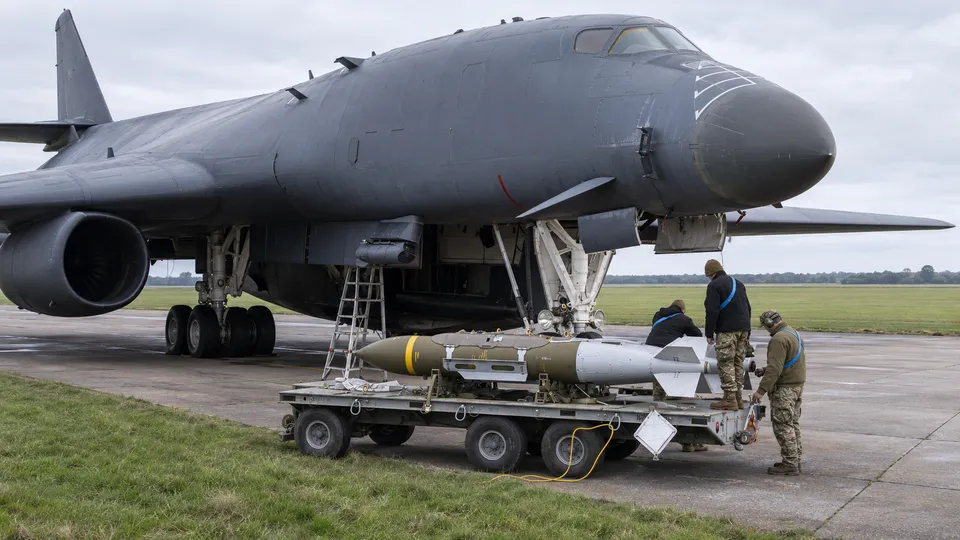
Twice in six weeks the US Air Force has emptied every aircraft off a British base because of a threat traced to Iran. On October 4 it pulled all 12 B-1B Lancer bombers out of RAF Fairford in Gloucestershire, a fleet valued at roughly $3.8 billion and about a quarter of the US B-1 inventory, days after British police arrested men suspected of plotting an attack on the base, as Al Jazeera’s Caolán Magee reported in the piece this account draws most heavily on. On November 9 and 10 the Air Force moved at least 15 aircraft, including eight KC-135 tankers and three V-22 Osprey tiltrotors, out of RAF Mildenhall in Suffolk to bases in Germany and Spain, after both Mildenhall and the neighbouring RAF Lakenheath were raised to FPCON Charlie, the second-highest US force-protection level, one step below an attack judged imminent, as NBC News reported.
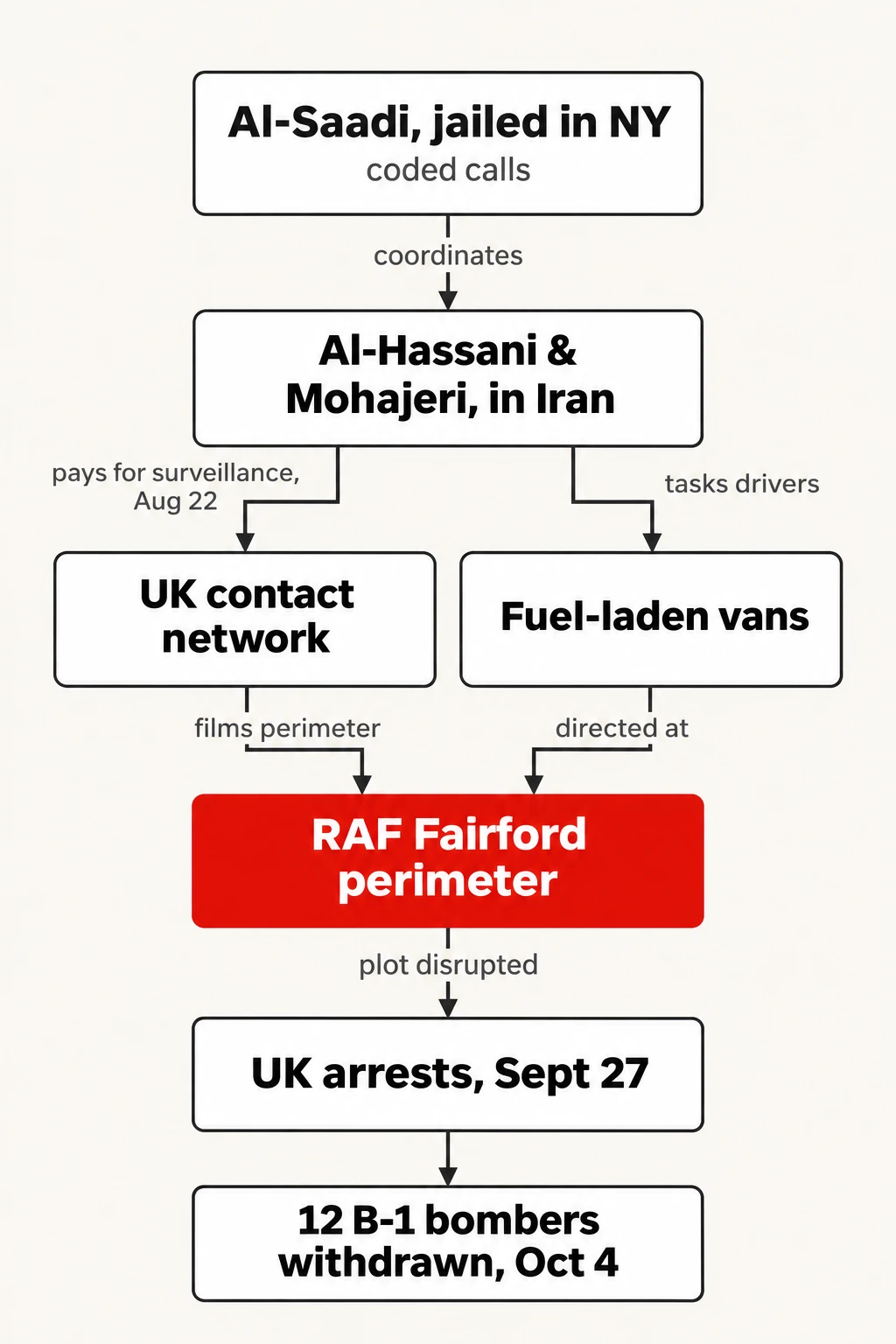
The mechanism behind the first withdrawal is now on the public record. The US Department of Justice unsealed an eight-count indictment on November 11 against three men it calls Iranian-backed operatives, tied to roughly 20 attacks and attempted attacks across the US and Europe. Two of them, Mohsen Mohajeri and Mohammad Ali al-Hassani, are accused of directing the Fairford plot from Iran: paying a UK contact on August 22 to film the base’s perimeter, then tasking associates to drive three vans, some loaded with fuel barrels, toward it in September, according to the Department of Justice’s press release. The third defendant, Mohammad Baqer Saad Dawood al-Saadi, already jailed in New York on separate terrorism charges, allegedly passed coded instructions from his cell. UK police separately charged two London men with national security offences over the same incident, one with spying for Iran.
This eight-count indictment shows the determination of Iran to commit terrorist attacks in Europe and the U.S., including one plot that was recently prevented at RAF Fairford, a British Royal Air Force Base where American forces were stationed.
| From | To | How |
|---|---|---|
| Al-Saadi, jailed in NY (coded calls) | Al-Hassani & Mohajeri, in Iran | coordinates |
| Al-Hassani & Mohajeri, in Iran | UK contact network | pays for surveillance, Aug 22 |
| UK contact network | RAF Fairford perimeter | films perimeter |
| Al-Hassani & Mohajeri, in Iran | Fuel-laden vans | tasks drivers |
| Fuel-laden vans | RAF Fairford perimeter | directed at |
| RAF Fairford perimeter | UK arrests, Sept 27 | plot disrupted |
| UK arrests, Sept 27 | 12 B-1 bombers withdrawn, Oct 4 |
Based on US Department of Justice
What the war already did to Gulf bases
Fairford and Mildenhall are the UK end of a pattern that started in the Gulf. The war, a joint US-Israeli campaign launched February 28, had by the Pentagon’s own count cost $33.4 billion as of June 29, according to the first quarterly watchdog report on the operation, filed by the Defense Department’s inspector general on September 14 after Senator Tammy Duckworth pushed Congress to mandate it. Iranian strikes damaged or destroyed hundreds of buildings and structures at US installations across Kuwait, Bahrain, Qatar, the UAE, Saudi Arabia, Iraq, Oman and Jordan in the war’s first four months alone. Diplomatic facilities took roughly $184 million in damage across Iraq, Kuwait, Saudi Arabia and the UAE; Iraq, hit in more than 600 separate attacks, absorbed the costliest share, about $157 million. A later Congressional Research Service tally, updated October 5, put total US aircraft losses and damage at 81, including 12 F-15E Strike Eagles, two A-10s, seven KC-135 tankers and one E-3 Sentry.
The human cost came first. On March 1, an Iranian drone struck a makeshift operations centre at the Port of Shuaiba, a commercial harbour in Kuwait the US military also uses as a logistics hub, killing six soldiers from the Army Reserve’s 103rd Expeditionary Sustainment Command and wounding at least 18. Two of three witnesses told CBS News they did not recall hearing the warning sirens, according to Yahoo News’ account. It was the first American combat death of the war. Five KC-135 tankers were damaged on the ground at Prince Sultan Air Base in Saudi Arabia in a March 16 missile strike, Military Times reported; a sixth was lost on March 12 when two tankers collided over western Iraq, killing six crew, in an incident CENTCOM attributed to neither hostile nor friendly fire. An E-3 Sentry hit on the Prince Sultan taxiway on March 27 is listed as damaged by the inspector general but as destroyed, with a $500 million replacement cost, by the Congressional Budget Office. Al Udeid’s early-warning radar in Qatar and the Fifth Fleet’s communications equipment in Bahrain were also hit.
Cheap drones against expensive hardware
The asymmetry driving all of this is cost, not just range. Iran’s missile and drone arsenal is built to be cheap and plentiful, forcing a defender to fire interceptor missiles that cost far more than the thing they are shooting down, or accept that some fraction will get through to a runway, a radar dish or a fuel line. A single attack does not have to destroy a base to make it less useful: it has to cost more to defend than it costs to attack, and keep doing that until the defender moves. Mark Hilborne of King’s College London’s Defence Studies Department told Al Jazeera that drones, alongside “fairly cheap ballistic missiles,” are what has made large bases easier to target. Urban Coningham of the Royal United Services Institute added that the attacker pool has widened too: “Anyone can manufacture a drone in a basement … people looking to create mischief or mayhem can recruit organised criminals, making attacks harder to attribute.”
Bulgaria supplied a smaller-scale version of the same calculation. Its parliament approved hosting up to eight US KC-135 tankers at Bezmer airbase on July 22; two arrived July 31. Iran’s foreign ministry had warned that Bulgarian “decision-makers must bear responsibility,” and the tankers flew no mission south during their stay, Defense News reported. They left on August 21, three weeks in and more than five weeks before the authorisation to stay until October 1 expired. Bulgaria’s defence minister and president both framed the early exit as the mission simply being complete, not a retreat.

Why Washington is talking about moving west
The Pentagon’s own planners are now discussing a reduction in the roughly 40,000 US troops CENTCOM has long kept scattered across close to 20 sites between Jordan and Oman, shifting units toward Jordan, Israel and Saudi Arabia’s Red Sea coast and swapping large fixed bases for small, hardened positions, according to reporting cited by Middle East Eye. The appeal is distance and air-defence quality, not sentiment. Camp Arifjan in Kuwait sits 62 miles from Iran, the US naval base in Bahrain about 128 miles, Al Udeid in Qatar 170 miles; Israel is roughly 1,100 miles away, according to figures compiled for the Council on Foreign Relations by Elliott Abrams. The Combined Air Operations Center that runs US airpower in the region has already moved to Ben Gurion Airport and Ramon Air Base in Israel. Retired general Frank McKenzie, who ran CENTCOM until 2022, says he made this case to the Biden administration four years before the war and was turned down; his successor, Admiral Bradley Cooper, is reportedly open to it now. Former CIA and CENTCOM chief David Petraeus put the shift in blunter terms to Bloomberg in May: “We are not as inclined to occupy these bases now that we have seen what the Iranians can throw at them.”
That arithmetic has a hole in it. Al Udeid cost $1 billion to $2 billion to build in 1996 and more than $6 billion to maintain since, per the same CFR figures; a comparable Negev base, the option reportedly on the table, would start from zero. Distance also buys warning time against ballistic missiles, which is real, but it does nothing against the kind of plot the Fairford indictment describes, which needs a van and a few people with local knowledge, not a missile with Iranian range. Iran has in any case just discarded the 2,000-kilometre cap it had informally held its own ballistic missiles to, a move examined in an earlier account of that decision, and its naval blockade of the Strait of Hormuz, the subject of an earlier dispatch on that leverage, has not fully lifted even as President Trump said on Monday that further strikes were unnecessary for now. Moving CENTCOM’s headquarters functions nearer Israel does not remove US forces from a war Israel started alongside Washington on February 28; it moves them into the country most central to that war.
What happens to the roughly 20 sites CENTCOM would thin out, and whether Gulf governments that never voted for this war now start setting conditions on hosting the forces that drew fire onto their territory, is still open. So is the identity of whoever triggered the Mildenhall alert on November 9: as of this week, US officials had not said whether it traces back to Iran at all, or to something else entirely.