
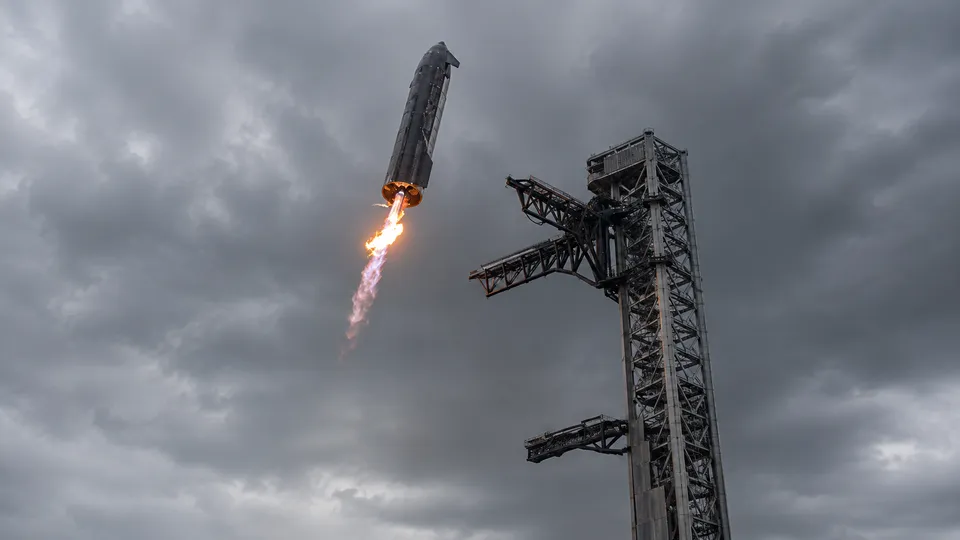
Ship 42 flew for 22.5 hours, orbited Earth 14 times, deployed 26 Starlink V3 satellites, and came back to Starbase to be caught by the launch tower’s hydraulic arms on November 14. It is the first time SpaceX has recovered a Starship upper stage this way, after nine successful booster catches since Flight 5 in October 2024, according to the tally in Wikipedia’s maintained record of every Starship flight test. Writing in Ars Technica after the catch, Eric Berger asked the obvious next question: when do people actually fly on this thing? His answer, after laying out the record, is that it depends which ‘fly on Starship’ you mean, and that any date SpaceX or NASA gives you should be discounted heavily, because every Starship date so far has been wrong.
There are two separate crewed-Starship timelines, and they do not converge. One runs through NASA and the Orion capsule, for a lunar landing. The other runs through SpaceX alone, for anyone who boards a Starship on Earth and expects to land on Earth. The first has a government contract, a budget line and an inspector general watching it. The second has none of that, by design.
The NASA path: four stops, one capsule swap
NASA awarded SpaceX $2.89 billion in April 2021 for the Human Landing System contract, covering one uncrewed demo landing and one crewed landing, originally targeted for as early as 2025, as CNN reported at the time. SpaceX was the sole winner; Blue Origin’s and Dynetics’ protests to the Government Accountability Office were denied, and a follow-on lawsuit was dismissed that November. SpaceX later picked up a second HLS award, worth $1.15 billion, for the Artemis IV landing in 2022, and in 2023 NASA added Blue Origin’s Blue Moon as a second, competing lander.
The 2025 target slipped repeatedly and NASA rebuilt the program in February 2026. Under the revised plan, Artemis III is now an Earth-orbit demonstration flight, not a crewed landing, targeted no earlier than June 2027, as Space.com reported. The first crewed landing moved to Artemis IV, penciled in for early 2028. NASA also changed how Orion and Starship meet: instead of rendezvousing in lunar orbit as originally planned, a fully fueled Starship will now dock with Orion in Earth orbit and push the combined stack toward the Moon, according to Space.com’s account of NASA’s October 23 briefing. NASA has not committed to whether Starship HLS or Blue Moon lands first; it says it expects both to put crews on the surface by the end of 2028.
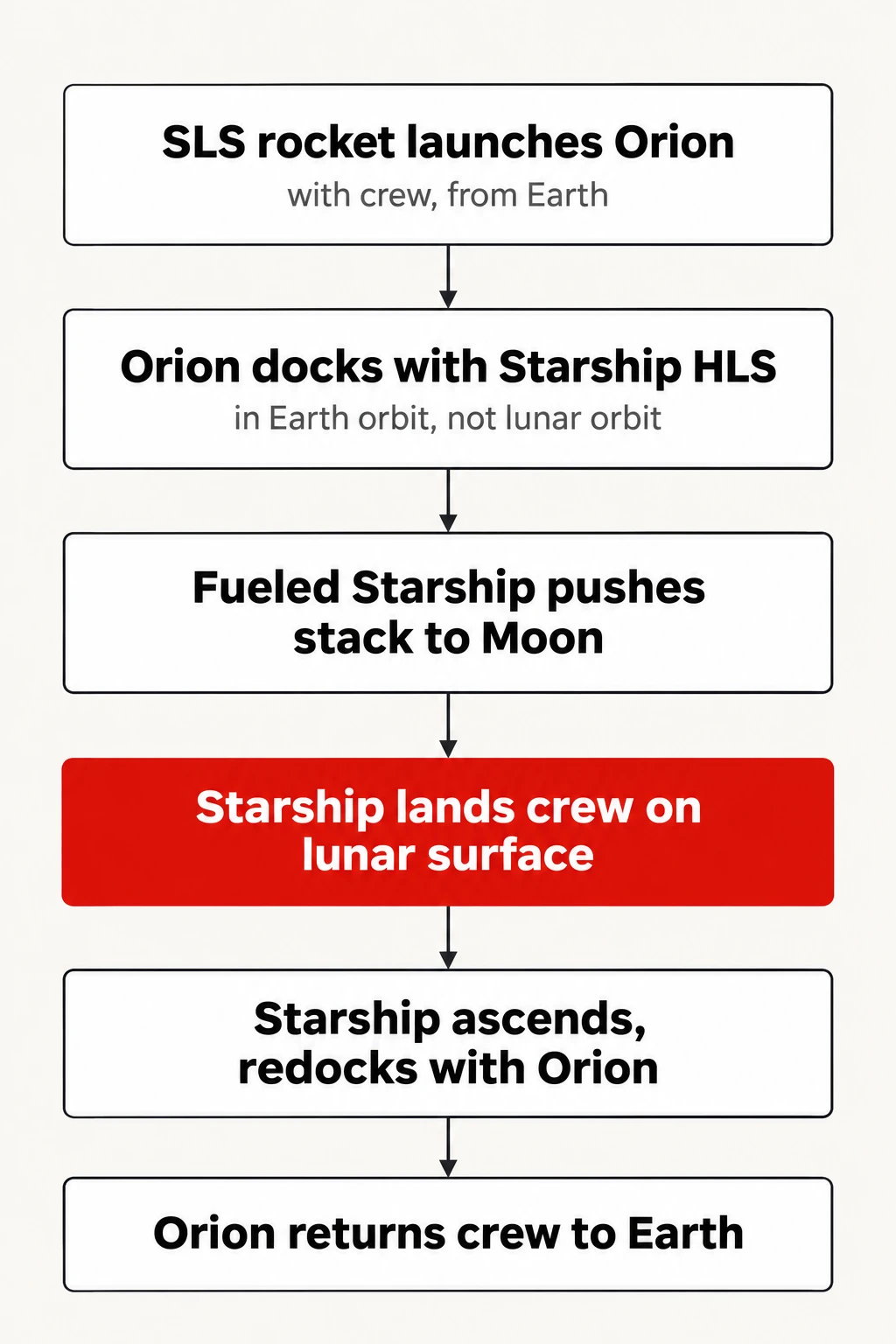
| From | To | How |
|---|---|---|
| SLS rocket launches Orion (with crew, from Earth) | Orion docks with Starship HLS (in Earth orbit, not lunar orbit) | |
| Orion docks with Starship HLS (in Earth orbit, not lunar orbit) | Fueled Starship pushes stack to Moon | |
| Fueled Starship pushes stack to Moon | Starship lands crew on lunar surface | |
| Starship lands crew on lunar surface | Starship ascends, redocks with Orion | |
| Starship ascends, redocks with Orion | Orion returns crew to Earth |
Based on NASA, as reported by Space.com
NASA’s inspector general has been tracking the slippage directly: a March 2026 audit of the Human Landing System contracts flagged schedule and oversight problems in the program’s management, according to the NASA Office of Inspector General’s report. None of that audit required Starship itself to fly successfully; it did not.
Flying, more than landing
Before Starship lands anyone, it has to fly reliably. Across 15 integrated flight tests since April 2023, Starship has succeeded 10 times and failed 5, by Wikipedia’s count, with three consecutive failures (Flights 7, 8 and 9) between January and May 2025 before the program stabilized. SpaceX’s Starship reached orbit for the first time only on Flight 14, in September. The November 14 ship catch came one flight later.
Reaching lunar-mission cadence needs more than one good flight. NASA’s architecture calls for propellant-transfer flights and tanker launches ahead of any crewed landing, and SpaceX is seeking FAA clearance for as many as 456 Starship launches a year from Starbase and Florida combined, a rate it has not come close to and that depends on rapid, repeated reuse of both stages, not a single catch.
No launch abort, no human-rating, no regulation
Starship carries no launch escape system: no separate rocket motor that can pull a crew module away from an exploding booster, the way Dragon’s SuperDraco thrusters or Starliner’s abort engines can. NASA requires one for astronauts flying its own missions, applying human-rating standards to any vehicle carrying its crew. The FAA imposes nothing comparable on anyone else. Under the Commercial Space Launch Amendments Act of 2004, Congress barred the FAA from writing occupant-safety regulations for commercial human spaceflight, a moratorium extended repeatedly and now running through January 1, 2028, according to the Congressional Research Service’s summary of the law. In its place, operators must disclose the vehicle’s safety record in writing, state plainly that the government has not certified it, and obtain signed informed consent from every passenger. That is the entire federal safety regime for anyone who is not a NASA astronaut.
Once the moratorium lifts, the FAA may propose occupant-safety rules; it is not required to, and the agency’s own 2023 advisory committee was formed to prepare for that possibility without committing to it. A parallel federal indemnification scheme for commercial spaceflight participants is set to expire September 30, 2028, adding a second regulatory deadline inside the same window SpaceX is targeting for lunar landings.
The paying-customer flight that already fell through once
Starship’s first privately booked crewed flight, Yusaku Maezawa’s dearMoon circumlunar trip, collapsed in June 2024 after the Japanese billionaire concluded Starship’s schedule, slipping since his 2018 contract assumed a 2023 launch, had become unworkable, as Space.com reported at the time. SpaceX has since lined up a replacement customer, the entrepreneur Chun Wang, for what it describes as Starship’s first commercial circumlunar mission, with no firm launch date attached.
SpaceX’s near-term incentives point elsewhere. On the company’s third-quarter earnings call on October 20, reported revenue reached $14.6 billion, up 161 percent year over year, and the company swung from a $1.1 billion net loss a year earlier to $4.4 billion in net income, according to the earnings transcript. Musk told investors the full stage recovery attempted on Flight 15 was “a profound technology milestone in the history of civilization,” language about reusability, not about crew. SpaceX’s next declared use for a fully reusable Starship is Starlink and Starmind, the orbital AI-data-center satellite constellation it has filed with the FCC for up to 1 million satellites, with a first prototype, carrying 72 Nvidia Rubin GPUs on a 210-kilowatt solar array, slated for early 2027, according to [Wikipedia’s entry on the project](https://en.wikipedia.org/wiki/Starmind_(satellite)).
Should SpaceX reach the point where it can launch Starship reliably, it will have the confidence it needs to press forward with human flights.
That line, from Berger’s piece, is the whole argument: reliability, not regulation, is the binding constraint on SpaceX’s own crewed flights, because the FAA imposes none. NASA’s binding constraint is the opposite: a fixed human-rating bar and a 2028 date that has already moved once. Ten successes in fifteen flights, one tower catch of one stage, and zero propellant-transfer demonstrations is the current state of the hardware both timelines depend on. The number to watch is not a date on a press release; it is how many of the next fifteen flights come back clean.