
SpaceX’s five-year credit default swap spread hit 194 basis points on Wednesday, October 7, a record for the company, according to the Financial Times, flagged in Eric Berger’s Rocket Report at Ars Technica. That’s up from about 110 basis points in June, when SpaceX priced its first bond sale. A credit default swap is insurance against a default; the spread is the annual premium, in basis points of the insured amount. At 194 points, insuring $1 million of SpaceX debt for five years now costs $19,400 a year, against roughly $11,000 in June. ICE Data Services logged an intraday peak near 197.6 basis points the same day.
The trigger: a report from the Financial Times, confirmed by Bloomberg, that SpaceX is negotiating $40 billion in new debt — about $10 billion in bank loans, $30 billion in investment-grade bonds — to pay for Nvidia chips for its data centers. Apollo Global Management is expected to lead the placement, with Pimco among the lenders in talks, and the deal is targeted to close in 2027, CNBC reported. Add that to the $86 billion SpaceX raised in its June IPO and the $25 billion bond sale two weeks later, and the company will have raised or sought roughly $151 billion in four months, CNBC reported when the bond sale priced.
| Amount ($bn) | |
|---|---|
| IPO (June) | 86 |
| Bond sale (June) | 25 |
| Nvidia chip debt (proposed) | 40 |
Source: CNBC, Financial Times. The $40bn Nvidia-chip financing was reported as being in talks and targeted to close in 2027; not yet finalized

SpaceX still holds an investment-grade rating; a widening spread signals rising perceived risk, not imminent default. But the direction holds across the sector: the spread on SpaceX’s 2056 bond over Treasuries widened to 2.36 percentage points from 1.75 at issuance in June. Nvidia’s own five-year CDS rose to 81 basis points from 45 in early July; Oracle’s rose 40 basis points to 244, above levels seen in the 2008 crisis. Morgan Stanley estimates the AI buildout needs $1.5 trillion of external financing by 2028, and analysts at Lombard Odier warn that borrowing at that scale now competes with government debt for the same pool of capital. Morgan Stanley’s Adam Jonas added a SpaceX-specific doubt: whether the company can succeed as a leading AI model provider, the business the Nvidia chips are for.
A Rarer Problem on the Pad
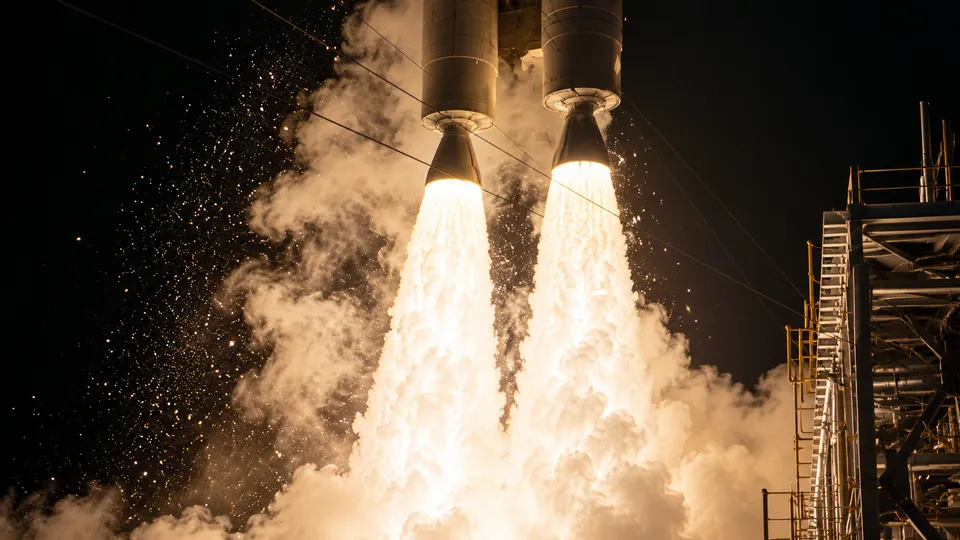
The hardware had a rougher week than the balance sheet. A Falcon 9 carrying 21 satellites for the Space Development Agency’s Tranche 1 Transport Layer A mission aborted 58 seconds before liftoff on October 5, mid-sequence in its automated startup, Spaceflight Now reported. SpaceX gave no public reason. Booster B1103, on its sixth flight, then slipped through three more dates before SpaceX set Saturday, October 10, from Vandenberg’s Space Launch Complex 4E. A Falcon 9 abort this late in a countdown is rare enough that Ars Technica flagged it by name — notable for a booster SpaceX has said it plans to retire once Starship and a Dragon successor are ready, a transition that gained urgency once Starship reached orbit for the first time on its 14th test flight.
Vulcan’s Return, Finally Dated
ULA’s Vulcan has a return date for the first time since a solid rocket booster nozzle failed on the USSF-87 mission on February 12, grounding it from national-security launches — the second Northrop Grumman GEM 63XL nozzle failure on Vulcan since its October 2024 certification flight, and one that rolled the rocket more than intended before the booster separated, according to Venture Atlas. ULA now targets no earlier than October 29 for the return-to-flight mission, the first of 38 planned Vulcan launches for Amazon Leo, with a second Amazon Leo flight and an Arianespace launch to follow this year. Space Systems Command will run its own review of that mission’s data before clearing Vulcan for national-security payloads again — a gate layered on top of ULA’s own process. Amazon Leo vice president Rajeev Badyal told Ars the redundancy was deliberate:
From day one we decided to go with a diverse set of partners to supply us with rockets... We knew there was risk, but we had to get heavy lift vehicles.
ULA’s infrastructure now lets it process two Vulcans at once, with both vehicle integration facilities carrying a vertical rocket.
Lasers Over the Cape
Cape Canaveral Space Force Station is getting laser weapons to shoot down drones straying into its 25 square miles of restricted airspace, The War Zone reported. Col. Brian Chatman, who commands Space Launch Delta 45, described the system to Florida Today:
Bringing on a directed-energy system that can do a kinetic kill against UASs that are coming into the area that are having nefarious intent.
Lasers beat jammers here because the pad is full of sensitive avionics: “if you start blasting a bunch of RF energy you run into potential challenges,” Chatman told Florida Today — jamming that disables a cheap drone can just as easily disrupt the spacecraft nearby. Port Canaveral next door logged more than 500 drone incursions in 2025, already a felony under Florida law. The laser is one layer of a wider build-out that includes Lattice, an AI system fusing military radar and sensor feeds, a multimillion-dollar RF jammer installed last winter, and more gear coming from the Pentagon’s Joint Interagency Task Force 401. The Space Force hasn’t named the laser’s manufacturer, model, or activation date.
Elsewhere in the Industry
South Korea’s Nuri rocket flew its fifth mission on October 7, lifting 15 satellites — its heaviest payload yet, about 1,071 kilograms versus roughly 960 on flight four, Korea JoongAng Daily reported. It released five NEONSAT microsatellites around 576 kilometers, the first time Korea has put five primary satellites into orbit on one launch, and nine of ten CubeSats, with Quaternion’s PERSAT-02 failing to separate. Four successes in five flights since the rocket’s 2021 debut failure puts cumulative success at 80 percent, up from 75 percent after flight four. Hanwha Aerospace now runs launch operations under government oversight through 2028, with a fully private-led model due in 2029.
Europe’s Themis reusable-rocket demonstrator still hasn’t flown. The European Commission pushed the deadline for the €42.8 million SALTO project, which funds Themis’s first two low-altitude hop tests, to December 31, 2026 — the latest in a string of extensions from an original November 2025 target, European Spaceflight reported. ESA’s own “highlights for 2026” page, last updated September 21, still lists the first hop test as completed in the second quarter. It wasn’t. A hot-fire test of the vehicle’s single Prometheus engine is next, before any hop.
German startup HyImpulse pushed the second flight of its SR75 suborbital rocket from “end of 2026” to spring 2027, citing SaxaVord’s licensing requirements and Scottish winter weather rather than the vehicle — its first European flight and first with commercial payloads, after a May 2024 debut from Australia. At Rocket Factory Augsburg, the supervisory board replaced CEO Indulis Kalnins with Alexander Dahm, a 30-year aerospace veteran who worked on the Ariane 5 program and most recently ran production at HENSOLDT Sensors, the company announced. The company still hasn’t reached orbit after losing a first stage in a 2024 static-fire test and an unresolved tank anomaly now grounding RFA ONE, against a €186.9 million European Launcher Challenge contract from ESA that requires an orbital flight before 2028, Tech Times reported.
Three dates are now on the calendar worth watching: October 10 for Falcon 9’s next try at Vandenberg, October 29 for Vulcan’s return to flight, and sometime in 2027 for SpaceX’s $40 billion Nvidia loan — if it closes at the terms on the table now, rather than the wider spread the market is already pricing in.