
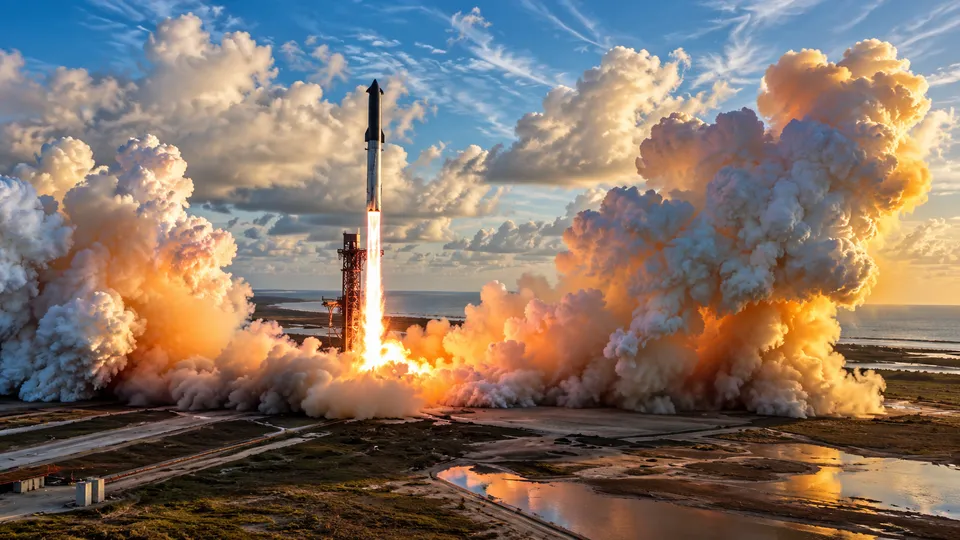
A Falcon 9 rocket lifted off from Cape Canaveral at 11:10 a.m. on Thursday with four astronauts in a Crew Dragon capsule named Grace. It was the 13th crew rotation SpaceX has flown to the International Space Station for NASA, and one of the last few it plans to fly.
Three days earlier, Starship reached orbit for the first time and released 26 working Starlink satellites. At a news conference that afternoon, the NASA administrator, Jared Isaacman, said something the industry had been planning around for months: “I do not think it’s a secret that SpaceX intends to sunset older platforms like Falcon and Dragon as they concentrate on their next generation capability, Starship,” CNN reported.
The dates are now close. Ars Technica reported that SpaceX will fly NASA crews through 2030 and then retire Crew Dragon, and that it has told the companies building private space stations they cannot book the capsule. Satellite operators say SpaceX has stopped taking rideshare reservations for flights after late 2028. The only other American capsule, Boeing’s Starliner, hasn’t carried anyone since a 2024 test that ended with its two astronauts riding home on a Dragon. Its next crewed flight is targeted for mid-2028. Once the last six Atlas V rockets are gone, every Starliner will need a Vulcan, and Vulcan has been grounded since February.
So the list of who gets a ride after 2029 is short. It includes the U.S. government, which holds contracts SpaceX says it will honor, and the satellite companies that booked early. Everyone else will be waiting for rockets that have yet to fly often. Starship, the vehicle SpaceX is betting the company on, isn’t on that list for astronauts: SpaceX is not prioritizing crewed flights to Earth orbit on it, Ars reported.
What SpaceX has said
Gwynne Shotwell, SpaceX’s president and chief operating officer, set out the reasoning at the All-In Summit this month. “We’re not retiring it today, for sure,” she said of Dragon, but SpaceX wants “to move from the older technology to the newer technology,” according to David Kerley, who writes the spaceflight newsletter Full Throttle. Elon Musk’s goal of a city on Mars, she said, requires Starship.
A Falcon 9 with a Dragon capsule on top is like a minivan ... The road trip to Mars is six months, so you don’t want to be in a minivan.
Asked about NASA’s reliance on the minivan, Ms. Shotwell pointed at Boeing. “Boeing has been paid, I think, probably more than we have been paid, to develop their human capsule,” she said. “So we’re just going to let them have some business.” The room laughed, CNN reported. On Wednesday, William Gerstenmaier, a SpaceX vice president, again gave no retirement date. “We’re going to continue to support these near-term things, and then we’ll see what the future brings,” he said, as quoted by Swarajya.
The rest of the timeline comes from Ars Technica’s Sept. 29 report, which cited industry sources. According to Tech Times, Ars reported that SpaceX told Axiom Space, Voyager Space and Vast they would not be able to order Crew Dragon missions for their future stations. NASA spent about $3.1 billion developing and certifying the capsule, Ars reported, but that does not oblige SpaceX to keep flying it.
NASA has already bought the flights it needs for the station’s last years. On Sept. 18 it added Crew-15, Crew-16 and Crew-17 for $946 million, bringing SpaceX’s commercial crew contract to 17 missions and $5.92 billion, according to GovConWire. The price covers cargo, recovery and a lifeboat role at the station as well as seats. Divided across 12 seats, it comes to about $78.8 million each. In 2019, NASA’s inspector general had estimated a Dragon seat at $55 million.
The books help explain the hurry. In SpaceX’s first quarterly report as a public company, filed in August, the space segment, which includes Falcon, Dragon and Starship, took in $962 million in the second quarter and lost $542 million from operations. Research and development spending, mostly on Starship, was $1.08 billion. In the same three months, the Starlink connectivity business earned $1.66 billion from operations. The filing said Starship is expected to “reduce the cost to orbit by 99% or more relative to the historical average.”
An old plan
Mr. Musk announced the idea in Adelaide, Australia, in September 2017, when Starship was still called BFR and was meant to replace Falcon 9, Falcon Heavy and Dragon. “If we can do that, then all the resources that are used for Falcon 9, Falcon Heavy and Dragon can be applied to this system,” he said, according to SpaceX’s transcript. “That’s really fundamental.” He said he was “fairly confident” of a first flight within five years. The first full test came in April 2023. Orbit took nine years.
Ms. Shotwell put a rough date on it at the Baron Investment Conference in New York in November 2024. “Starship obsoletes Falcon 9 and the Dragon capsule,” she said, but SpaceX would keep flying both “for six to eight more years,” Space Explored reported. Counted from that talk, six to eight years runs to late 2030 through late 2032.
Flight 14 showed how close Starship is and how far it still has to go. It lifted off from SpaceX’s Starbase site in South Texas at 8:48 a.m. Eastern on Sept. 28, and one of the ship’s six engines shut down early on the climb, Payload Space reported. The webcast host, Dan Huot, told viewers the team had decided not to commit to orbit. Then the control room reversed itself, and a single Raptor engine fired for about 19 seconds to finish the job, according to Teslarati. The ship released 26 Starlink V3 satellites over about 30 minutes. Mr. Musk posted that all of them were working.
All 26 Starlink V3 operational satellites deployed and operating nominally
The rest of the mission was cut short. SpaceX had planned nearly 10 hours in orbit but brought the ship down early, after just under two orbits, and did not give a reason, Payload Space reported. The ship splashed down north of Hawaii and broke apart. On its way down, the Super Heavy booster again failed to relight all its engines. SpaceX has tried to fix that recurring problem with hardware and software changes.
The biggest issue is payload. Right now they’re launching with very light payloads, way less than the Saturn V or even the Falcon. Definitely short of their goals.
That objection, from a reader on Hacker News, partly holds up. SpaceX has not published how much mass Flight 14 carried, and Payload Space reported that future flights can carry up to 60 of the V3 satellites, more than twice this load. A full Starship payload has not yet flown to orbit.
The last gap
The United States has been without its own crew vehicle before. After the space shuttle retired in 2011, NASA had no American way to put astronauts in orbit for nine years and bought seats on Russia’s Soyuz instead. By the end, a seat cost NASA as much as $86 million, according to the agency’s inspector general.
NASA’s answer was to pay two companies. In 2014 it awarded Boeing $4.2 billion and SpaceX $2.6 billion, on the theory that two different spacecraft, “dissimilar redundancy” in NASA’s phrase, would keep the station crewed if one was grounded. NASA repeated the point in a November 2025 contract update, saying it still needed that redundancy to meet its goals and international obligations. NASA has not had it. In September 2024 the inspector general reported that Starliner’s delays had forced NASA to speed up SpaceX flights at an extra cost of $17 million, and that the backups’ delays “heighten the risks associated with a single launch provider for cargo and crew,” SpacePolicyOnline reported.
Russia remains a partial hedge. NASA and Roscosmos trade seats so that at least one American and one Russian are always aboard the station. In July, Dmitry Bakanov, Roscosmos’s director general, agreed to keep the station running and the swaps going through 2030, SpacePolicyOnline reported. The arrangement covers Soyuz and Dragon, not Starliner, and it ends when the station does.
Starliner’s record
Starliner’s problems go back almost seven years. Software errors nearly ended its first uncrewed test in December 2019 in disaster. In August 2021, 13 stuck propulsion valves scrubbed a second attempt two hours before launch, and that test finally succeeded in 2022. The crewed flight then slipped in July 2023, when engineers found parachute lines below safety margins and flammable tape on wiring harnesses, according to SpacePolicyOnline.
The crewed test came in June 2024. Thrusters failed and helium leaked, and NASA decided not to bring Butch Wilmore and Suni Williams home on the capsule. They spent 286 days on the station on a mission planned for eight, Scientific American reported. In February, Mr. Isaacman classified the flight as a Type A mishap, NASA’s most serious category, and released an investigation report that found “NASA’s limited-touch acquisition and management posture left the agency without the systems knowledge” it needed.
The plan announced on Sept. 28 starts over with an empty capsule. Starliner-1, an uncrewed flight to the station, is targeted no earlier than December and could slip to January. Starliner-2, commanded by the NASA astronaut Woody Hoburg, would follow in 2028. John Mulholland, Boeing’s commercial crew program manager, said the target was mid-2028. Dana Weigel, who runs NASA’s low Earth orbit program, said the thruster fixes and the Vulcan certification would cost NASA $359 million. NASA is restoring the fifth and sixth Starliner flights it dropped in 2025, and “those actually stayed at the exact same pricing,” she said, Talk of Titusville reported.
As SpaceX has publicly stated, the Dragon and the Falcon won’t be around forever. Certifying Boeing’s Starliner is important for both supporting ISS and also for follow-on future commercial destinations.
The root problem is a valve part called a poppet, which gets pushed out of position under heat and mechanical load. Boeing has added thermal shunts and barriers. The mechanical fix needs a redesign that is only beginning. “On the mechanical side, we’re not able to address that with the current design,” Ms. Weigel said. Mr. Hoburg, who flew to the station on a Dragon in 2023, called Starliner “a pilot’s spacecraft” and said “there’s a lot that’s right with this vehicle.”

The rocket is a separate problem. Only six Atlas V rockets remain, all reserved for Starliner, and Atlas is out of production. Vulcan, its replacement, has been on hold since Feb. 12, when a nozzle on one of its Northrop Grumman solid boosters failed in flight for the second time in four launches. The Space Force halted national security launches on Vulcan until the cause is fixed. Return to flight is expected in late 2026 or early 2027.
Ms. Shotwell’s jab at Boeing is accurate about development money. Boeing’s 2014 award was $4.2 billion against SpaceX’s $2.6 billion. Since then, though, SpaceX’s contract has grown to $5.92 billion for 17 flights, while Boeing’s stands at $4.82 billion with four mandatory flights. Boeing has absorbed more than $2 billion in Starliner losses under its fixed-price deal.
Who rides after 2030
The station is to be deorbited in 2030, and NASA won’t build another. It plans to rent space on commercial stations instead, and those stations need a way to get crews up. Vast’s first station, Haven-1, is set to launch in 2027 on a Falcon 9, and its first crew is to arrive on a Dragon. That falls inside SpaceX’s window. Anything later doesn’t.
The other options are thin. Blue Origin’s crew vehicle isn’t expected to carry people before the early 2030s, Tech Times reported, and Sierra Space’s Dream Chaser is a cargo craft for now. Soyuz flies Russians on Russian terms. Starship is a different kind of vehicle: the ship alone is 171 feet tall, while Dragon is a capsule 13 feet wide that carries about four people. CNN reported that it was not clear whether Starship could take over any of Dragon’s work.
In public, NASA’s leadership has stayed upbeat. On X, Mr. Isaacman congratulated SpaceX after the orbital flight and said NASA was eager for Starship missions to become routine.
Congrats @SpaceX! Gorgeous launch, getting Ship to orbit and managing every step in a safe, responsible, and especially inspirational way. @NASA, along with the rest of the interested public, is excited to help where we can and for Starship missions to become routine!
At the news conference he described the two capsule makers with less enthusiasm. “One of them is serving our needs very well,” Mr. Isaacman said. “The other one we’ve been committed to getting operational.” Mr. Kerley argued before the briefing that SpaceX’s exit was what saved Starliner. “It appears that a SpaceX decision to move on, might give Boeing’s troubled capsule new life,” he wrote. NASA’s recent actions fit that reading: Starliner got two flights back and a $359 million fix just as SpaceX signaled it was moving on. NASA is now leaning on Boeing more than at any point since the 2024 test.
Is nobody concerned about putting things in a ship that explodes every other time they launch it
That reader’s worry, posted on Hacker News during the flight, points at the wrong vehicle for crews. Starship’s test history includes vehicles lost in flight, and Flight 14 lost an engine on each stage. But nobody has proposed flying astronauts to Earth orbit on it. The bet on crew safety after 2030 is a bet on Starliner, and Starliner has carried people exactly once.
The satellite queue
The cargo side of the problem is larger. Falcon 9 flew a record 165 times in 2025, Space.com reported, about half of all orbital launch attempts worldwide. China managed 92 attempts that year, Russia 17 and Europe eight. In the first half of 2026, Falcon rockets launched 77 times, more than twice as often as China’s Long March family, according to regulatory filings cited by CNN. SpaceX’s filing shows 17 of its launches in that period carried outside customers, down from 21 a year earlier.
At least nine SpaceX partners and customers told SpaceNews in July that the company was not accepting Transporter rideshare reservations beyond late 2028 or early 2029. SpaceX did not respond to SpaceNews’s questions. Transporter-18 left Vandenberg Space Force Base on Thursday, the same day as Crew-13, with 130 payloads, among them a prototype Google A.I. satellite.
In order to raise money, startups need to show they have a viable path to orbit. They have to move quickly.
Mr. Henry told CNN that most of the remaining Falcon 9 capacity had already been sold and that flights after early 2029 may be reserved for the U.S. government. Anik Joshi, writing in Foreign Policy on Thursday, put the cutoff a little earlier: “the last train from SpaceX leaves in 2028.” After that, he wrote, buying directly from SpaceX goes through the Pentagon’s Defense Priorities and Allocations System, which ranks orders for national defense first. Mr. Henry traced the squeeze to 2022, when the invasion of Ukraine took Soyuz and Proton off the commercial market and Amazon bought more than 100 launches for its broadband network.
Prices have already been moving. SpaceX started rideshare at $5,000 a kilogram in 2019, then raised it to $5,500 in 2022 and $6,500 in 2023, Payload Space reported. A person familiar with customer negotiations, who spoke to CNN on condition of anonymity to discuss sensitive industry dealings, put the market rate at $7,500 to $10,000 a kilogram, slightly higher than a decade ago. Robert Sproles, chief executive of the launch broker Exolaunch, said that might be low.
Prices are going up, and I expect they will continue to go up
The rockets meant to take up the slack have all slipped. Ariane 6 has flown nine times since July 2024, four of them this year, and its maximum is about 10 flights a year, NASASpaceflight reported. Iceye, which has launched on Falcon 9 more than a dozen times, signed a nonbinding memorandum with Arianespace on Sept. 9. Eric Jensen, Iceye’s chief operating officer, told CNN, “We’ve taken proactive steps long in advance of this conversation.” Rocket Lab’s Neutron hasn’t flown, and its chief executive, Peter Beck, said in August that the window for a launch this year was narrowing. Blue Origin’s New Glenn exploded during a test on May 28, wrecking its only launch pad. “If both of those rocket programs were going smoothly, I think the industry would be more relaxed,” said Micah Walter-Range, a space analyst, referring to New Glenn and Vulcan. “But they’re not.”
Starship’s commercial viability rests almost entirely on whether it can orbit Starlink satellites more cheaply than Falcon. Falcon is around $3000/kg, Starship was promised at $100/kg, I doubt even Elon believes that number...
That Hacker News reader frames the question from SpaceX’s side of the ledger, and it is the right frame for the company. Outside customers see something else. The person familiar with negotiations told CNN that SpaceX’s internal costs are falling while “the market price of launch has been increasing for the past 10 years.” The filing’s claim of a 99 percent cut is a forecast. No Starship upper stage has yet been recovered and flown again. SpaceX has also said nothing about whether it will sell rides on Starship to outside operators, when, or at what price.
The case against alarm
Some people who have been in the business longest are calm. “If we rewind the clock 10 years ago, it was normal to book a launch two years, three years out in the future,” Mr. Sproles told CNN, and it was normal for that launch to slip 18 months. Spire, which flies more than 100 small satellites, has launches booked through at least 2028, said Theresa Condor, its chief executive. Some customers told SpaceNews they expect SpaceX to extend Falcon 9 rideshares if Starship comes online more slowly than the company’s leaders expect.
On crew, NASA’s own exposure is smaller than the headlines suggest. Dragon flights are contracted through 2030, the same year the station is due to come down. The people most at risk are the companies selling seats on private stations in the 2030s, and they would depend on a single capsule that has never flown an operational mission.
The deeper doubt is about Starship itself. Maciej Cegłowski, the Pinboard founder, who writes about spaceflight on Substack, argued in May that SpaceX’s public filing showed where the company’s priorities lie.
SpaceX is suddenly an AI company with a small sideline in rockets, claiming a $2 trillion valuation on mostly vibes.
For NASA’s moon program, Starship’s schedule has already slipped. In March, NASA’s inspector general reported that each lunar landing would need more than 10 tanker flights, starting more than 200 days before the crew launches. It also said SpaceX had not yet shown the 12- to 24-day pad turnaround that pace requires. The report said the ship-to-ship propellant transfer test had slipped to August 2026. Starship had not reached orbit by then.
It needs a launch cadence fast enough so that refueling doesn’t take 15 separate starship tankers. Currently it would take years to refuel one single starship to make a one-way trip to the moon.
That reader’s tanker count fits the inspector general’s figures, and the cadence problem is real. But it concerns the moon. On the question of getting into Earth orbit, the record splits two ways. Satellite operators face a shortage now, backed by bookings that stop in 2028 and replacement rockets that are late or grounded. For astronauts the danger comes later and is narrower, and it rests on Starliner and Vulcan, not Starship. Those two vehicles have spent 2026 fixing thrusters and booster nozzles.
What comes next
Crew-13 was due to dock at the station about 7 p.m. Eastern on Thursday, and the four Crew-12 astronauts are to head home about a week later. Mr. Musk said at the All-In Summit that the next Starship flight could try to catch the ship with the launch tower’s arms, and put the odds of success at 50 to 60 percent or better. Rocket Lab aims to have Neutron on its pad by the end of the year. Haven-1 is due to launch in 2027, and the station is to be retired in 2030.
The first of those tests is Starliner-1, the uncrewed flight to the station set for no earlier than December. Ms. Weigel said NASA would “stress the thrusters” in orbit and fly the mission “with stricter performance parameters in place.” If it docks cleanly, Mr. Hoburg is to command the next Starliner, in 2028.