
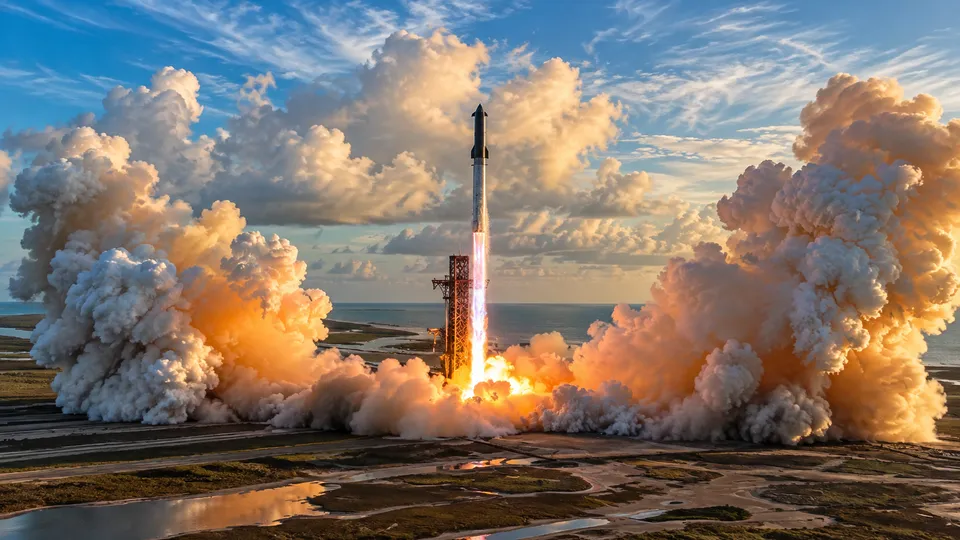
There are two ways to read a rocket flight that ends at hour three of a planned ten: something went wrong, or something almost went wrong and the people in charge declined to find out how wrong. SpaceX’s first orbital flight of its giant Starship — its 14th test flight overall, launched Monday from Starbase in Texas — appears to be the second kind.
The numbers, per Numerama’s coverage of the flight and follow-up reporting: the launch and ascent went smoothly. The Super Heavy booster separated and splashed down in the Gulf of Mexico about seven minutes after liftoff. The upper stage — the Ship, in SpaceX terminology — then lit its six Raptor engines to push toward a planned orbit about 275 kilometers up, an altitude that would have let it circle the Earth six times in close to 10 hours.
Here is the wobble. Shortly after separation, one of the Ship’s three Raptor Vacuum engines — the wide-nozzled versions built to thrust in the vacuum of space — shut down too early. The five remaining engines compensated by burning longer than planned, and that was enough to reach the intended trajectory. SpaceX has so far not said why the Vacuum engine cut out.
The hiccup was disclosed fairly early on SpaceX’s live broadcast on Monday, and it explains a stretch of on-air silence that numerama.com’s Julien Lausson flagged: for several minutes, flight controllers withheld the go-ahead to commit the Ship to orbital flight while they checked the data to make sure the vehicle was safe. The wait had a second purpose. Had the Ship never relit its engines, it would eventually have fallen back on its own — a suborbital flight like the previous test flights — along what engineers call a “passively safe” trajectory, no maneuvering required, ending in the Indian Ocean. Instead, controllers used the pause to verify that the three sea-level Raptors, the ones needed for later burns, were still healthy.
Why does one sputtering engine shorten a flight that had five engines to spare? Because coming home is the hard part. To leave orbit, the Starship must relight a Raptor and brake. Without that braking burn, a vehicle of this size would remain stuck in orbit for a while before falling back in a fully uncontrolled manner. Too risky for SpaceX’s taste. So caution won. The original plan called for a splashdown off Chile after 10 hours; instead, controllers commanded the deorbit 2 hours 12 minutes after liftoff, aiming for the northern Pacific — one of two return zones prepared before launch, both cleared of maritime and air traffic beforehand.
“Out of an abundance of caution, given the engine issue during ascent, the flight control team decided to limit the time spent in orbit and proceeded with the deorbit of Starship,” the company said in its post-flight summary, in Numerama’s translation.
Not everything was cut short. Before coming home, the Ship took time to release 26 Starlink satellites into orbit, a genuine operational payload rather than a ceremonial one. And the descent itself went by the book: the Ship relit a single Raptor for the first deorbit burn of the program, survived the trip through the atmosphere, then relit its three sea-level engines to flip upright — the belly-flop-to-tail-stand maneuver that has torched more than one previous Ship — and settled onto the water at the intended spot about an hour after the deorbit command, roughly 3 hours into the mission.
“Congratulations to the entire SpaceX team on Starship’s first orbital flight,” the company posted on X at around 6 p.m., and it later shared its own photos of the liftoff. Photographers on the ground, as is now tradition for the enormous launcher, had been competing for dramatic shots of their own within minutes of the ascent.
And in case three hours of orbiting, 26 deployed satellites, two successful splashdowns and one world-first deorbit burn threatened to make the whole affair sound too tidy: once bobbing in the Pacific, having done everything asked of it, the Ship exploded. Some traditions are sacred.