
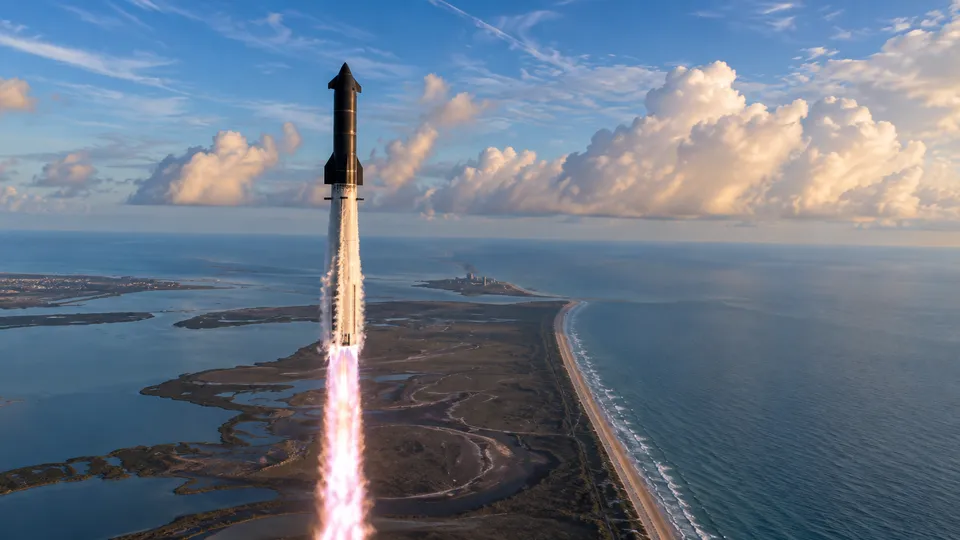
For three years and thirteen test flights, SpaceX’s Starship — at 407 feet the largest and most powerful rocket ever assembled — flew like a dog that had agreed in advance not to test the leash. Each flight topped out just shy of orbit, deliberately throttled back so Earth’s gravity could snag the 100-ton upper stage and drag it home before it completed a single lap. Often it fell into the Indian Ocean, sometimes in flames, always on schedule. On Monday morning over South Texas, SpaceX finally dropped the leash.
Flight 14 lifted off from Starbase, just north of the Mexican border, at 8:49 am EDT on Monday, according to Ars Technica (The Next Web’s clock read 7:48 am local time, for those keeping score). Thirty-three methane-fueled Raptor engines generated up to 18 million pounds of thrust. The Super Heavy booster separated, flipped around at altitude and made a controlled splashdown in the Gulf of Mexico, as planned. Then things got interesting.
One of the six Raptor engines on the upper stage shut down prematurely during ascent; the other five simply burned longer to make up the difference. Two of the booster’s 33 engines also failed — one during launch, another when it was supposed to relight for the return maneuvers, The New York Times reported. None of this was immediately fatal. But SpaceX now had a decision: restart a Raptor in space for the first-ever orbital insertion burn, or let the ship coast toward a familiar Indian Ocean reentry, as it had on every flight before.
For several minutes the answer appeared to be no. SpaceX commentator Dan Huot initially told webcast viewers the orbit attempt was aborted. Then, according to The Next Web, he reversed himself on air: “We are not giving up yet.” The dead engine, it turned out, was not one of the three center Raptors needed to circularize the orbit and, critically, to bring the vehicle back down afterward. Leaving a 100-ton spacecraft stranded in orbit with no way home — and no way to control where it eventually fell — was the one outcome the flight team had ruled out in advance.
“We were only going to go if we were very confident in the core systems that have to work to get you out of orbit once you’re up there. We took some extra time, added some extra drama, but we were able to clear the … three center engines and do our first ever orbital insertion burn. So that was a huge success.”
The chosen engine reignited for 19 seconds and added about 204 mph — roughly 1 percent of Starship’s total velocity — enough to settle into a stable orbit about 171 miles (276 kilometers) up, moving at 17,500 mph. “Starship is orbital,” Mission Control announced, to cheers. About 25 minutes had passed since liftoff.
Then Starship got to work. Packed in its cargo bay were 26 Starlink V3 satellites, the next generation of SpaceX’s broadband constellation — each about 2 metric tons at launch, too large to fit inside a Falcon 9, ejected one at a time by a system of pulleys and cables. SpaceX says each V3 adds 1 Tbps of network capacity, ten times what the older satellites provide, and that future flights could carry up to 60. The company made contact with all 26 after separation; according to The Next Web, three of them carry cameras to inspect Starship’s heat shield. Strict range-safety rules kept the deployment to a low-inclination orbit, reaching about 30 degrees north and south of the equator.
The satellites have been waiting a while. A first V3 batch flew on July’s suborbital Starship and burned up on the way back down, and Caleb Henry of Quilty Space said on a Spaceflight Now broadcast that finished satellites “just sat at a warehouse in Texas, as I understand it, because the satellites were finished well ahead of the launch vehicle.” SpaceX has deployed more than 12,000 Starlinks on the Falcon 9 since 2019 (the Associated Press counts about 11,000 older models still providing service), and has now phased Falcon 9 Starlink launches out of Cape Canaveral entirely, though polar missions will continue from Vandenberg for a while longer. SpaceX says these 26 will start serving customers within weeks; Henry cautions that “until there is a meaningful number of V3 satellites launched, they won’t be the spacecraft that defines the user experience just yet.”
The plan had been six full orbits at roughly 275 kilometers, nearly ten hours aloft and a splashdown west of Chile — a long-duration endurance test meant to prove readiness for NASA’s Artemis program. Instead, about three hours in, SpaceX brought the ship down in a pre-cleared stretch of the Pacific, reentering and splashing down north of Hawaii, where it tipped over and erupted in flames, the Los Angeles Times reported. SpaceX gave no official reason; the Times attributed the early return to the engine problems. The erstwhile record-holding July Starship, fished out of the Indian Ocean, is currently being tugged back to Starbase, and engineers had already used its scorched hide to modify this vehicle’s heat shield.
The caution is deliberate and, in Musk’s telling, commercially motivated. If the spacecraft breaks apart over land and rains debris on people, he said at a business summit this month, “our popularity would diminish very rapidly… That’s why we’re being extremely cautious here.” Pending review of Flight 14, the next Starship may attempt to fly home to Starbase and be caught mid-hover by the launch tower’s mechanical arms. Musk rates the odds of a successful catch as even or slightly better; if it works, SpaceX wants to refly the same spacecraft by the end of this year or early next. A second pad at Kennedy Space Center is nearing completion, with a third planned for Louisiana, from which higher-inclination orbits become possible.
NASA, which needs a working Starship rather badly, was gracious. “Gorgeous launch, getting Ship to orbit and managing every step in a safe, responsible, and especially inspirational way,” Administrator Jared Isaacman wrote on X. The agency’s Artemis III mission, possible as soon as next summer according to the Associated Press, is a three-launch orbital waltz: Jeff Bezos’s Blue Moon lander goes first, then Orion full of astronauts, then Starship, which docks with Orion once Blue Moon departs. Artemis IV, no sooner than 2028, would put astronauts on whichever billionaire’s lander is ready, with later flights alternating between them.
So the leash is off. Starship has now been trusted to stay up, to let go of 52 tons of paying cargo, and to come down where it was told. The remaining tricks are harder: catching the thing midair, flying it again within weeks, and eventually letting it carry people. SpaceX has spent three years rehearsing the fall. On Monday it finally demonstrated the other half of the trick — and coming down, as ever, turned out to be the part you schedule.