
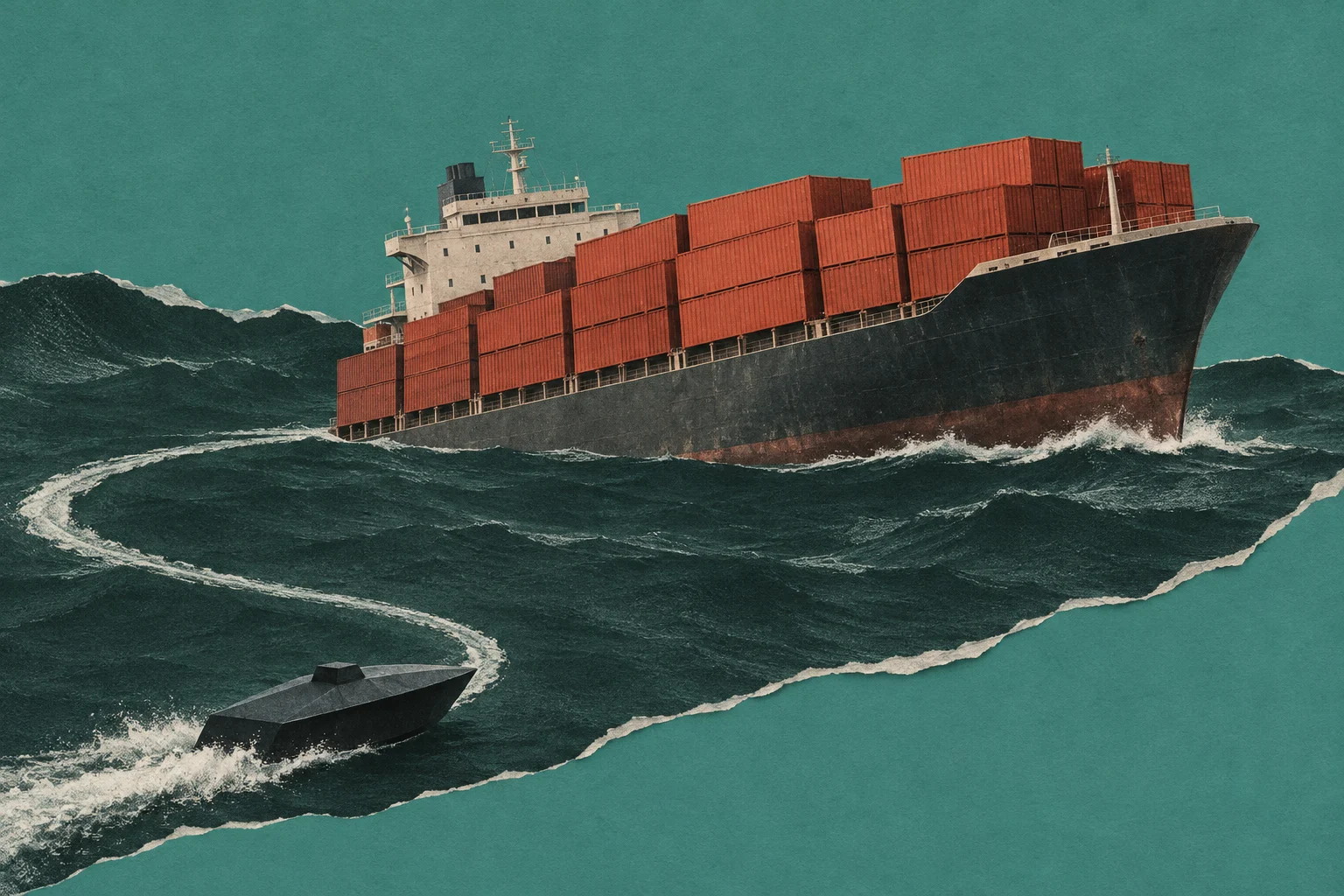
On Wednesday, 28 October, the Contship Jet, flying the Liberian flag, was moving slowly through the western Black Sea with more than 400 terracotta-coloured containers stacked on deck. It had sailed from the Israeli port of Haifa and was bound for Romania. Three black naval drones came at it across the water, aerial drones joined in, and the explosions left the ship listing until it went under. All 18 crew members were rescued, Bulgarian authorities said, as Mansur Mirovalev reported for Al Jazeera from Kyiv.
Bulgaria’s defence minister, Dimitar Stoyanov, said the drones struck about 21 nautical miles off the coast, near Cape Kaliakra. That put the ship inside Bulgaria’s exclusive economic zone but outside its territorial waters. The ship was carrying 421 containers to Constanța. The navy commander, Kiril Mihaylov, said a French patrol aircraft had warned of the drones, but the military could not stop the attack. According to the manager, Contships Management, the crew of 14 Filipinos and four Ukrainians was taken safely to Varna.
Footage verified by Reuters showed a sea drone running alongside the hull before turning into it. The maritime risk firm Ambrey described a matte black unmanned boat, five to six metres long, closing at high speed. Experts think it may be a modified Russian Murena-300S or something built from it. Kyiv blamed Russia. President Volodymyr Zelensky said Ukraine had no operations in that area and called the attack part of Moscow’s effort to make the western Black Sea “completely unfit for navigation.” The Bulgarian government has avoided naming anyone.
The ship sank while the defence ministers of Bulgaria, Romania and Turkey were meeting in Sofia to talk about security threats in the Black Sea. When they were done they agreed on more intelligence sharing, better early warning and closer coordination.
Counting the ships
Nobody agrees on the number of ships hit. i24NEWS called the Contship Jet the ninth civilian ship struck in the Black Sea that month. The Japan Times counted seven strikes on cargo ships near Romania and Bulgaria, after which NATO said it would send patrol planes, radars and drones. On the dead the figures are closer. Bulgarian and Romanian authorities and maritime trackers say at least 30 sailors have been killed or are missing in the recent wave.
A deal nobody signed
The sea war has more than one author. Ukraine has hit Russian freighters and tankers in the Black Sea and the Sea of Azov, as well as refineries and military sites, and it stepped up those strikes in July. Nikolay Mitrokhin, a researcher at Bremen University, said “a shadow deal… was breached by Ukraine in the summer.” He added that Vladimir Putin “definitely liked the idea of completely ruining Ukrainian exports” and had issued warnings before the strikes on Odesa’s ports. In December, Putin threatened to retaliate against ships from countries helping Ukraine if the attacks on tankers went on.

Moscow is paying too. Russia usually ships more than two-thirds of its harvest across the Black Sea, and it is now trying exports through Murmansk, in the far north, at much higher cost.
A reflection, not a finding: an unwritten truce suits rulers because nobody can be held to it, and the sailors on the decks of the ships it was supposed to protect never get a copy.
The arithmetic of bread
Before 2022, about a third of the world’s grain exports passed through this sea. Ukraine alone supplied 10 percent of global wheat exports and 15 percent of corn, much of it bought by countries in the Middle East and North Africa. Wheat has risen about 20 percent in a year. Chicago futures went from $5.03 a bushel in October 2025 to $6.03 in October 2026. The drones are not the only cause. The US-Israeli war on Iran, global warming and a drought in South Africa have all pushed prices up, and the other chokepoints have been under fire too.
Tomas Alexa of the UK-based Ambrey Analytics said the attacks make trade “much more costly, not just dangerous.” He warned that dearer wheat will hurt the Global South most and could drive more migration through North Africa, across the Mediterranean and towards the Canary Islands.

Brussels has used stronger language than anyone. In August the EU delegation in Kyiv said Russia was “systematically strangling Ukraine’s ability to feed the world” and accused Moscow of “weaponising hunger against millions in Africa, Asia, and the Middle East.” Paula Ritter-Moschutz, a spokeswoman for the European Commission, said Europe’s own food security is not at risk. She said the EU supports Ukraine’s access to markets and backs “the initiatives for a moratorium on Black Sea attacks.”
Wheat left standing
Russian drone and missile strikes have halted work at Odesa, Ukraine’s largest port. “Hardly more than 50 percent of grain can be exported via land routes,” said Viktor Honcharenko, president of the Association of Farmers and Private Land Owners of Ukraine. He said a lot of wheat is not being harvested at all. He expects farmers and businesses to grow poorer, jobs and tax revenue to disappear, and small farmers to suffer most, because the big agribusinesses get the trains and trucks first.
Aleksey Kushch, an analyst in Kyiv, puts this year’s harvest at up to 60 million tonnes. Because the railways are overloaded, he says, only half of it can leave the country. In his view Ukraine missed its chance to build large-scale processing into flour, starches and similar goods, and farmers may now have to move to the legumes and oil crops the EU wants, for less profit. That is the question Ukraine’s farmers have been asking since the sea closed. Kushch says Kyiv should have negotiated EU subsidies for chickpeas and soy. “The price of the matter is one billion euros,” he said.