
Israeli tanks and bulldozers moved west of the Yellow Line into central Gaza on November 18, the first documented armor crossing of that boundary since the ceasefire took effect on October 10, 2025. The army’s Coordination of Government Activities in the Territories unit (COGAT) named the target zone in Arabic-language instructions to residents: blocks 660, 661 and 666, wedged between the Nuseirat and Bureij refugee camps, as the Times of Israel reported. Two of those three blocks, 661 and 666, sit entirely on what the ceasefire map marks as Hamas’s side of the line. The army said it was destroying a tunnel that posed “an immediate and direct threat” to its troops; it did not explain why troops were operating in the area in the first place.
The Yellow Line is the line Israel drew for itself after the October 2025 truce: roughly 45km (28 miles) running the length of the Strip, marking where its forces would stop after pulling back from the September 2025 front, with everything further west declared a free-fire zone regardless of whether the boundary was ever marked on the ground, per [Wikipedia’s account](https://en.wikipedia.org/wiki/Yellow_Line_(Gaza)) of the demarcation. How much of Gaza that leaves under Israeli control depends on whom you ask and when: the pull-back itself left the military holding 53% of the Strip, by the Times of Israel’s account; JNS puts the current figure at roughly 54%; the Israeli military’s own spokesperson told reporters it was “more than 60%”, as France 24 noted; and the Times of Israel separately reports that Prime Minister Benjamin Netanyahu, as the disarmament talks stalled, ordered the army to push the line “several hundred metres toward the coast” until it covered 70%. A line that three different accounts place anywhere between 53% and 70% of the same territory is not a line so much as a negotiating position, and this week’s crossing shows Israel treating even its own marked boundary as provisional.
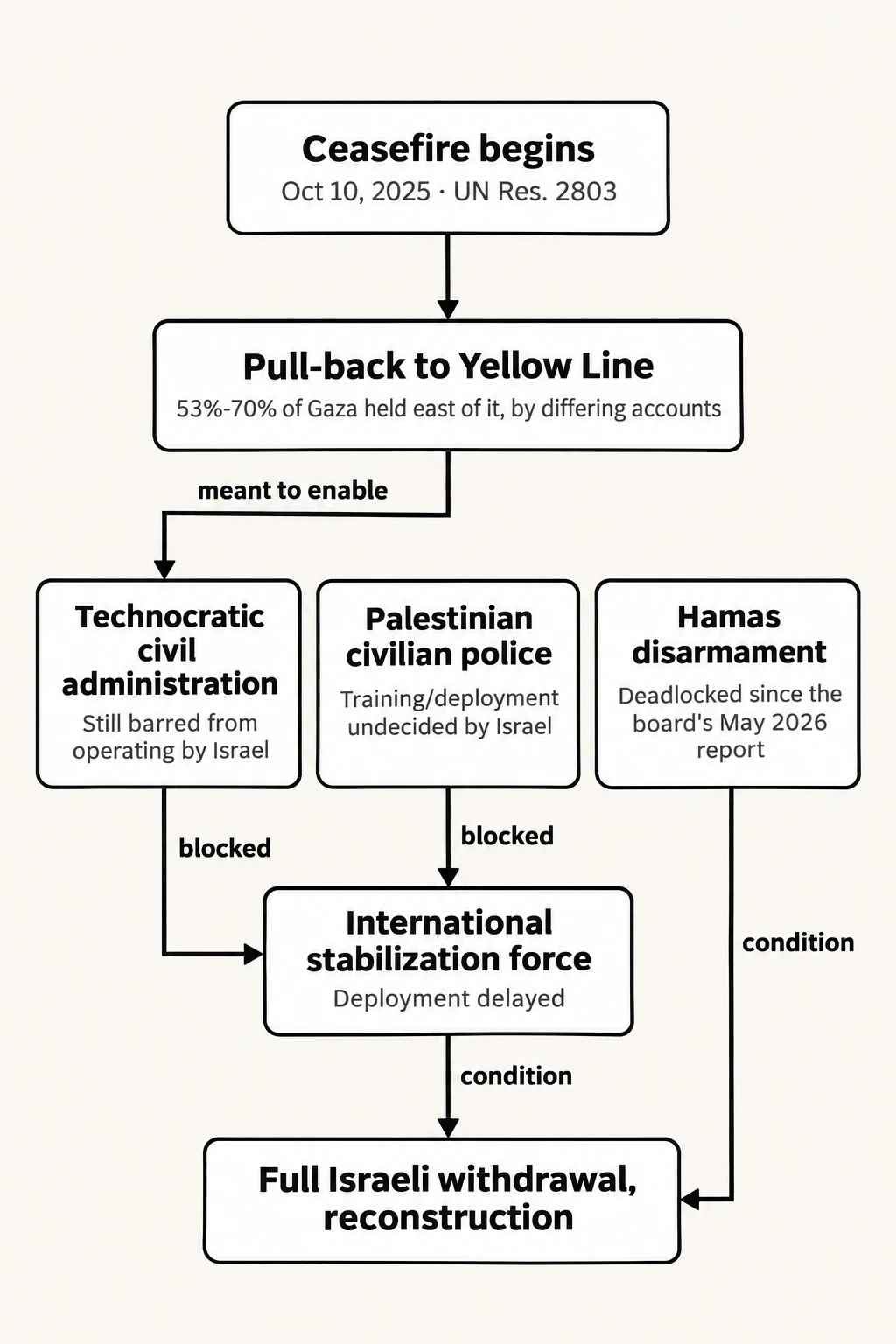
| From | To | How |
|---|---|---|
| Ceasefire begins (Oct 10, 2025 · UN Res. 2803) | Pull-back to Yellow Line (53%-70% of Gaza held east of it, by differing accounts) | |
| Pull-back to Yellow Line (53%-70% of Gaza held east of it, by differing accounts) | Technocratic civil administration (Still barred from operating by Israel) | meant to enable |
| Technocratic civil administration (Still barred from operating by Israel) | International stabilization force (Deployment delayed) | blocked |
| Palestinian civilian police (Training/deployment undecided by Israel) | International stabilization force (Deployment delayed) | blocked |
| Hamas disarmament (Deadlocked since the board's May 2026 report) | Full Israeli withdrawal, reconstruction | condition |
| International stabilization force (Deployment delayed) | Full Israeli withdrawal, reconstruction | condition |
COGAT ordered residents near Al-Bureij and Nuseirat to evacuate and told aid groups to stay out of the area; the army said it was “taking necessary measures to minimize the risk of harm to the civilian population.” Salah al-Din road, Gaza’s main north-south highway, was closed to traffic while tanks and bulldozers worked. One of the three blocks, 660, sits inside what the army calls the Orange Line, an inner boundary that had not previously been reported in public mapping of the ceasefire zones. A Gaza security source described intense artillery fire north of Nuseirat; Palestinian media reported gunfire and air strikes continuing into the afternoon. Um Ahmad al-Tartoori, who lives in Al-Bureij camp, told Al Jazeera residents “were terrified, especially since the area we live in is close to the points of incursion.” Mahmoud al-Saafin, 27, also of Al-Bureij, said residents fear a repeat of mass displacement they have “not yet recovered” from. Most of Gaza’s 2.1 million people have already been displaced at least once since the war began in October 2023.
Three Palestinians were killed in three separate drone strikes the same day, according to Gaza’s civil defence agency: one near Nuseirat camp, one in Gaza City, one outside the Deir el-Balah police station. The army said the first two hit “terrorists” and said it had no knowledge of the third; it is unclear whether any of the three were connected to the ground operation. Those deaths sit on top of a running total: more than 1,600 Palestinians killed since the ceasefire began, by an AFP tally drawn from Gaza’s Health Ministry, whose figures the United Nations treats as reliable even though the ministry answers to Hamas. On the other side of the ledger, Al Jazeera’s count puts Israeli losses over the same 13 months at seven soldiers and one civilian contractor, while the Times of Israel separately reports five soldiers killed since the ceasefire, one of them by friendly fire -- a gap of two that neither outlet explains, and a reminder that even the smaller, better-documented death toll in this conflict isn’t settled.
A warning filed the day before
The ground operation followed by one day the first annual report the Board of Peace has filed with the UN Security Council. The board, created at US President Donald Trump’s urging in September 2025 and formally stood up at the World Economic Forum in Davos in January 2026 under UN Security Council Resolution 2803, is run by High Representative Nickolay Mladenov, a former UN Middle East envoy, with Major General Jasper Jeffers commanding its operational forces. Its mandate under the resolution is to oversee Gaza’s reconstruction and coordinate aid and public services through an interim administration. Its November 17 report, obtained by the Associated Press and summarized by Al Jazeera, says neither side has met its obligations: “The distance between what has been agreed and what is happening on the ground nonetheless remains the principal risk to the process.” It is blunter about the stakes than the board’s first report, filed in May 2026, which had flagged the disarmament deadlock as the thing paralysing progress: “A ceasefire that delivers nothing visible cannot be sustained indefinitely,” the November report says, warning that if the truce collapses there would be “no road map to return to, no administration to deploy and no enabling environment to rebuild.”
The absence of decisions by the government of Israel on the necessary conditions and arrangements for the training, deployment and return of civilian police to Gaza continues to impede full implementation of the Comprehensive Plan.
The specific failures the board lists are asymmetric in kind, not just in degree. Against Israel: continued lethal air strikes, restrictions on aid entry that the board says are worsened by its own funding shortfall, and, above all, the fact that the technocratic civil administration the board itself created to run Gaza has still not been allowed by Israel to take up its job -- which in turn stalls the civilian-police handover and the international stabilization force the plan depends on. Against Hamas: continuing armed activity and, according to the board, taxing goods that enter Gaza. “Neither party may treat the other’s delay as license for its own inaction,” the report says, calling the two sets of obligations the only route to an Israeli withdrawal and reconstruction at scale, and insisting any outcome must preserve “the credible pathway to Palestinian self-determination and statehood.” Senior Hamas official Basem Naim dismissed the whole report as “pure disinformation.”

An election with no government, and a minister talking about permanent zones
The operation also landed in the middle of an Israeli political vacuum. The October 27 election left no governing majority; Netanyahu, who built his campaign on security credentials, now runs a caretaker government while opposition figure Gadi Eisenkot tries to assemble a coalition without him. Into that gap, Defence Minister Israel Katz said on November 18 that the army stood ready, if fighting resumes on any front, to seize further territory in Gaza, Lebanon and Syria, evacuate residents and convert what it holds into “permanent security zones” -- rolling back only once Hamas is dismantled and Gaza demilitarized, Hezbollah is disarmed throughout Lebanon, and all “jihadist threats” from Syria are eliminated. None of those four conditions has moved in thirteen months of the board’s reporting, which makes the statement less a timetable than a position: the zones stay until events nobody controls resolve themselves. The pattern of the Yellow Line itself moving only westward over the past year, as previously documented, and again a month later, suggests Katz’s language describes what has already been happening rather than a new threat.
The board’s next scheduled check-in with the Security Council isn’t fixed by the record available; its May and November reports were six months apart, which would put the next one around May 2027. Whether the civil administration gets any operating authority before then, and whether blocks 661 and 666 are handed back to the Hamas side of the line or simply redrawn into it, are the two numbers worth watching -- not the percentage figure either side quotes for how much of Gaza it currently holds.