
Mahmoud Harzeen is 35 and supports a family of 10. As Maram Humaid reported for Al Jazeera, he is putting up a tent about 200 metres from a row of yellow concrete blocks in Shujayea, in eastern Gaza City. It will be his sixth move. He doesn’t keep track of them by date. He keeps track by place: Zeitoun, Sahat al-Shawa, al-Muntazah. His last tent lasted a single night before the blocks moved again. “I pitched the tent and slept in it for one night,” he said.
Those blocks are the Yellow Line. It helps to be precise about what the line was supposed to be, because the distance between that and what it has turned into is most of the story. Under the October 2025 ceasefire, which grew out of US President Donald Trump’s 20-point plan, Israeli forces pulled back to a line that divided Gaza into an area they held and an area they didn’t. It was meant as a starting point. Under the deal, Israeli forces would withdraw further over time, which means the line would move east, toward Israel, and the Palestinian side would get bigger.
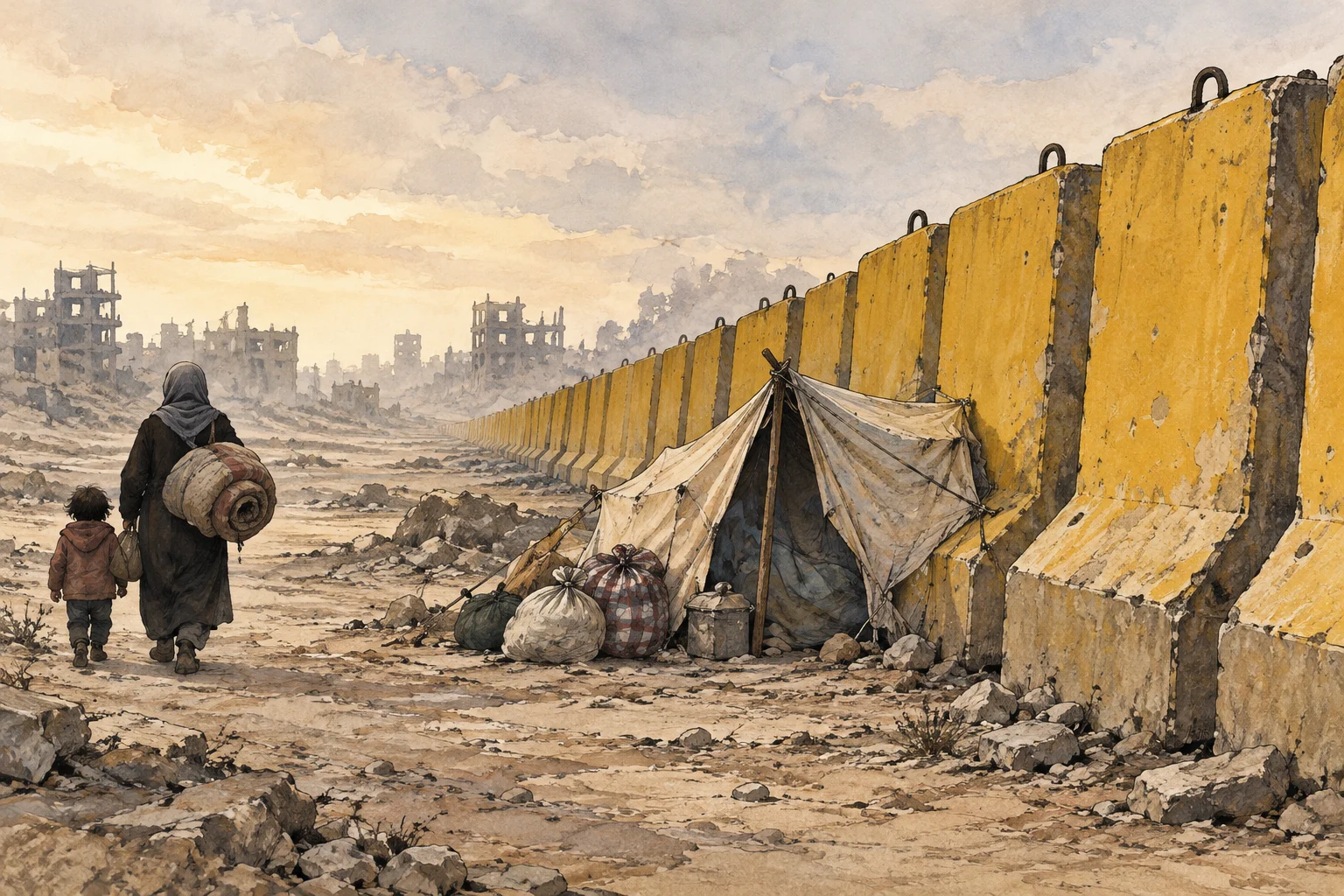
It has gone west instead. A year ago the agreed arrangement left Israel in control of 53% of the territory. According to the UN, it now controls about 65%. Al Jazeera’s mapping puts what remains at roughly 35% of the Strip, about 128 square kilometres, for 2.1 million people. Population density has nearly tripled since before the war, to about 16,000 people per square kilometre. Some simple arithmetic: if 35% comes to about 128 square kilometres, each percentage point is about 3.7 square kilometres. So the 12-point shift from 53% to 65% works out to something like 44 square kilometres, taken away from the part of Gaza where everyone is being told to live. The line that was supposed to move east has been heading the other way for a while now.
A border made of movable blocks
The line moves in a very literal way. It is marked by concrete blocks, and blocks can be picked up and put down somewhere else. On October 11, the ceasefire’s first anniversary, Israeli forces moved them dozens of metres west in Shujayea. That brought more of the neighbourhood under Israeli military control, and families who had settled near the old position had to leave again. Gaza’s civil defence service said hundreds of people had been displaced from the area since the previous Friday, according to Palestinian reports.
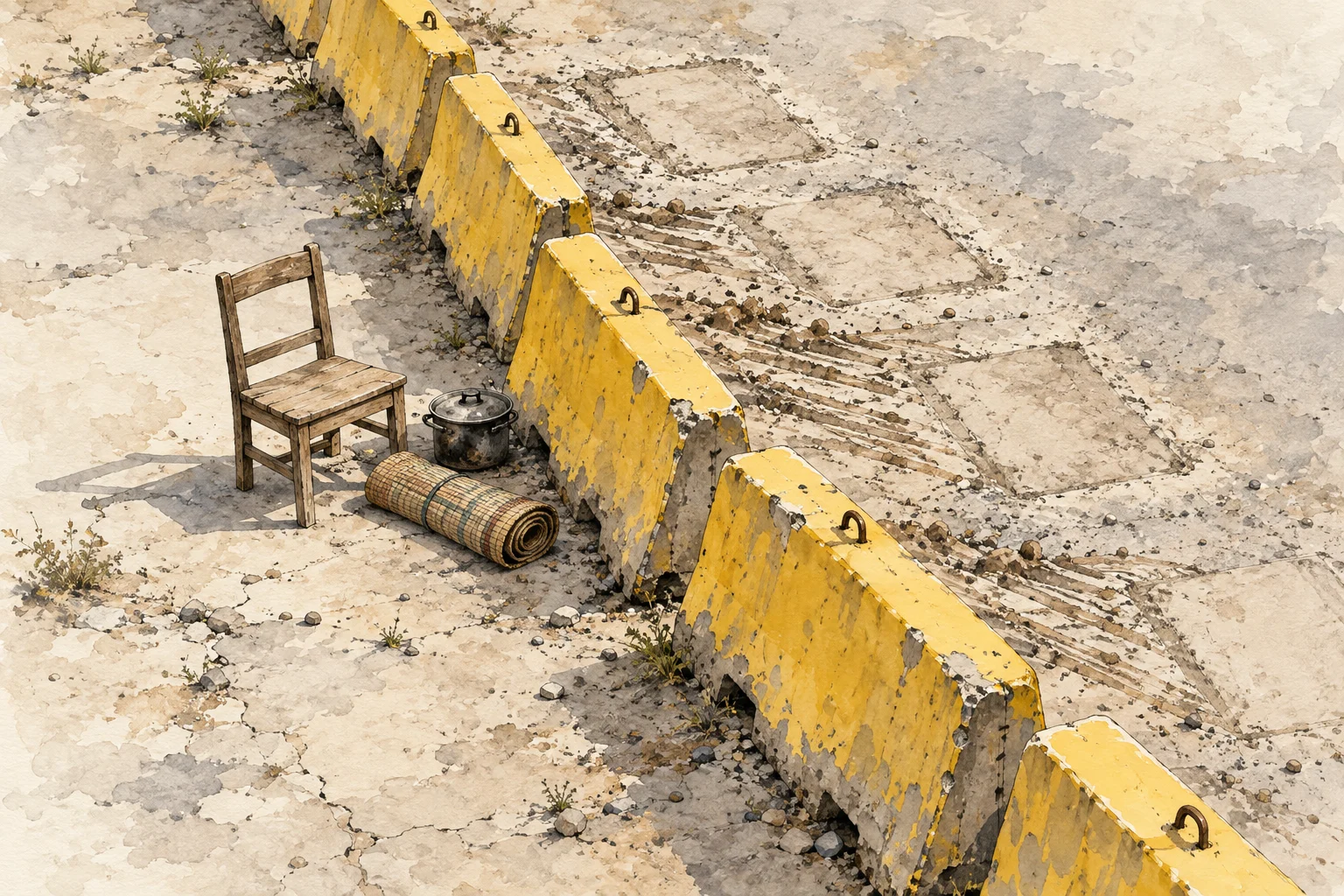
This has happened before. In mid-December, Haaretz reported that the markers were being moved west quietly and without warning. In January, BBC Verify used satellite images to show that Israeli troops had moved at least seven blocks in Tuffah, also in Gaza City, between 27 November and 25 December 2025, pushing them about 295 metres deeper into the Strip, [as summarised here](https://en.wikipedia.org/wiki/Yellow_Line_(Gaza)). Late in April 2026, Israel was reported to be planning an “Orange Line”, after military maps showed a larger restricted zone that would add 11% of Gaza’s territory beyond the Yellow Line. Israel’s stated reason for advancing the line, according to defence officials quoted by the Israeli news site Ynet, is that it lets troops act wherever they detect Hamas trying to regroup.
A few dozen metres sounds minor until you know what the line means on the ground. Israel treats the area beyond it as a free-fire zone, and Palestinians who have come close to it have been shot. So the line isn’t a mark on a map. It decides where it is survivable to sleep. Harzeen has turned this into a working rule: “Every time they move forward a little, we move back a little.” He describes drones, helicopters, artillery, stray bullets and shrapnel, and says that on the nights the line moves, “there are tanks, infantry coming down, and shells being fired.”
The obvious question is why he doesn’t move further away, and the answer is mostly money and space. Rents have soared beyond what he can afford, and the safer areas have little room left for tents. The ground closest to the danger is the ground that is still free. “They will probably move it forward again,” he said. “We keep moving.”
Seven or eight moves
Asma Ali, 32, is a mother of three from Shujayea. Her family has been displaced seven or eight times since the ceasefire began: central Gaza City, then the al-Mantar area of Shujayea, then a school, then a house near a bus stop, and finally relatives in central Gaza City. “Every night, we would flee, then come back in the morning,” she said. “The night the Yellow Line advances is terrifying. You live in fear.”
When their home was destroyed, the family lost gold, household goods and the children’s clothes. They also lost a brace belonging to her disabled son, which he had had for only two days. “It was gone in the blink of an eye,” she said. Going south isn’t simple either: transport is scarce and nobody can say whether it would be safe.
Israel has killed nearly 1,500 Palestinians during the year of the ceasefire and more than 74,000 since October 2023, according to Al Jazeera. Many of the missing are still under the rubble, some of it on the far side of the line.
Asked what she wants, Ali asked for something modest: “Somewhere I can put my children and where we can rest and settle.” The ceasefire was supposed to give her more of Gaza to do that in. A year later, the way to measure whether it is working is to watch which direction the concrete blocks move, and so far they have moved in only one.