
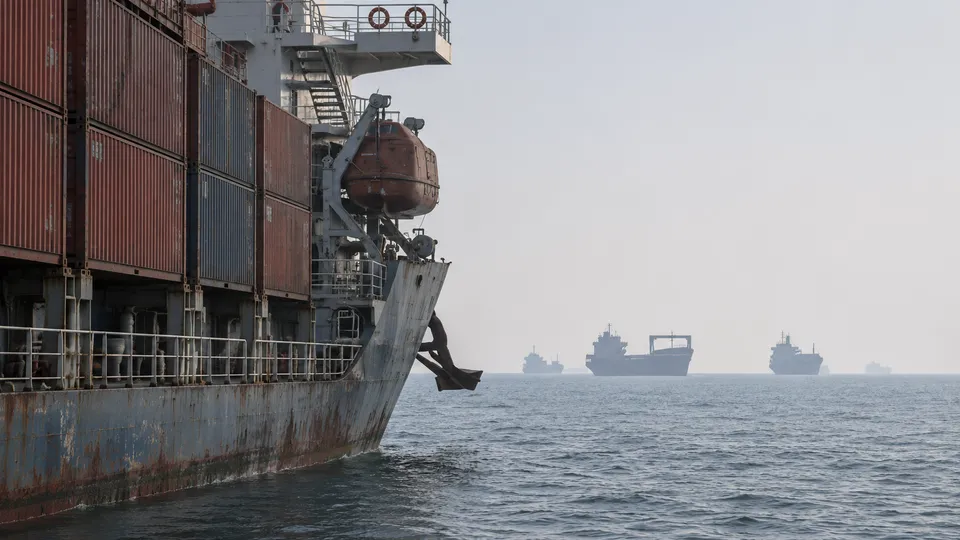
The war began on 28 February, when the United States and Israel launched strikes on Iranian targets. Nine months later to the day, the commander of Iran’s navy, Amir Shahram Irani, said his forces had struck the USS Abraham Lincoln on that first morning. He had a second story. The Americans, he said, had stolen two Iranian tankers, and Iranian commandos had boarded them and taken them back.
They stole two of our tankers, but the brave commandos of the Iranian Navy took action and took them back. When our forces entered the ship, the team assigned to protect it was asleep, and our commandos were able to capture them as well.
As CNBC reported, the words came through Tasnim, an Iranian state media outlet. Not every outlet traces them to the same agency: The Sun in Nigeria credits Fars. Irani had a third charge. Iran said Washington was charging ships “millions of dollars” to pass through the Strait of Hormuz, and The Sun put the figure Tehran named at $2.5 million.
A navy that does not exist
U.S. Central Command answered on X on Saturday, and it did not pick its words gently: “Iran no longer has a navy. The entire situation the Iranian military commander described is another fabricated lie.” Centcom also said Washington had seized no Iranian tankers, according to Pakistan’s Express Tribune, which leaves Irani’s commandos with nothing to have taken back.
Wartime communiqués have always been written for two readers, the enemy and the people back home. A navy chief tells his people of a daring raid and sleeping guards. The other side declares that his navy no longer exists. Both statements cannot be true, and neither is really aimed at the other side.
On the carrier, Centcom was just as flat. “The Abraham Lincoln Carrier Strike Group was well defended and never struck by Iran as a result,” it said. “In fact, the strike group completed a historically successful combat deployment to the Middle East and safely returned to the United States last month.” The ship was home after a long and punishing cruise, and Tehran was claiming a hit on it nine months after the fact.
The toll that is not a toll
Centcom’s answer on the strait is worth reading slowly. “While U.S. forces and regional partners do control the Strait of Hormuz, there is no toll for passing ships,” it said. “CENTCOM’s efforts have restored freedom of navigation through the international waterway.” The first clause admits what the second is there to soften. Washington says nobody pays to use the strait. It says just as plainly that it controls the strait, and that ships move through it on terms set by the people who control it.
How the strait came to be controlled is the history of this year. Once the war began, energy shipments through the waterway fell sharply and world oil prices shot up. Since then the United States has blockaded Iranian ports, and last week the USS Theodore Roosevelt arrived in the region as the third American carrier there. Freedom of navigation, as Centcom uses the phrase, has never been under so many guns.
The markets do not read communiqués. They watch the tankers. On Friday Brent crude ended a three-week losing streak with its first weekly gain of November, about 3 percent, as attacks on tankers in the strait and on Saudi energy infrastructure revived fears for Middle East supply. West Texas Intermediate fell 0.9 percent over the same week. The cost of the war still turns up in the oil price, whatever either side says about tolls.
Off Balhaf
Far to the south-west, on Saturday morning, the other front produced a story with no communiqué behind it. The United Kingdom Maritime Trade Operations agency said the master of a cargo ship had reported being boarded by “armed unauthorised persons” about 64 nautical miles south-west of Balhaf, on Yemen’s coast. Anadolu Agency gave the rest of the alert: position 12°55N 048°04E, time 0630 UTC, and one short line: “The unauthorised persons are in command of the vessel.”
Nobody claimed it. These are the waters where the Tehran-backed Houthis have opened a second front, attacking ships again and again to the south and west of the Arabian Peninsula and firing at targets in Saudi Arabia. On the same Saturday, Saudi civil defence issued several alerts, and the Saudi-led Coalition to Support Legitimacy in Yemen said on X that its air defences had “intercepted and destroyed two ballistic missiles” launched by the Houthis towards southern Saudi Arabia.
The men left to pay for these words and missiles are the crews. On a ship off Balhaf, a master radioed that armed strangers had come aboard, and then his ship stopped being his. Seafarers have already died in this war. Not one of them was a party to the argument over who controls the water.
On 24 November, a Xinhua photographer in the southern Iranian port of Bandar Abbas photographed merchant ships out on the strait. They are still there, moving through water that Washington says it controls, that Tehran says it still contests, and that both sides insist costs the ships nothing.