
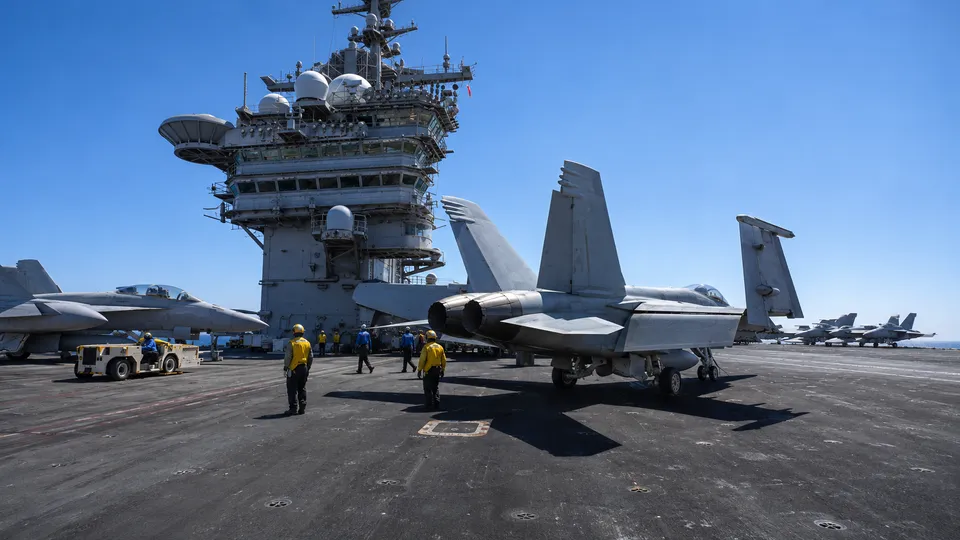
Three. That is how many US Navy carrier strike groups are now sitting in US Central Command’s area of responsibility, after the USS Theodore Roosevelt entered the region on November 15, according to a US official cited by Axios and confirmed to Al Jazeera by a separate official. Neither the Pentagon nor CENTCOM has put that fact on the record. As Al Jazeera reported, the Roosevelt joins the USS George H.W. Bush and the USS George Washington, nine months into a war that began on February 28 with joint US-Israeli strikes on Iran’s nuclear programme.
A carrier strike group is not one ship; it is a package. The carrier supplies the flight deck and roughly 60 to 80 aircraft in its air wing. Around it sail escorts that provide air defence, anti-submarine cover and land-attack missiles the carrier itself doesn’t carry. The Roosevelt’s package, per reporting in The National, runs Carrier Air Wing 11, the Ticonderoga-class cruiser USS Chosin, the destroyers USS Decatur and USS Paul Hamilton, a Tomahawk-equipped nuclear attack submarine, and the USS Seahawk, a 145-tonne, 137-foot uncrewed drone ship on its first deployment. Across all three carriers currently in theatre, that adds up to as many as 144 front-line strike fighters, F/A-18s and F-35s combined.
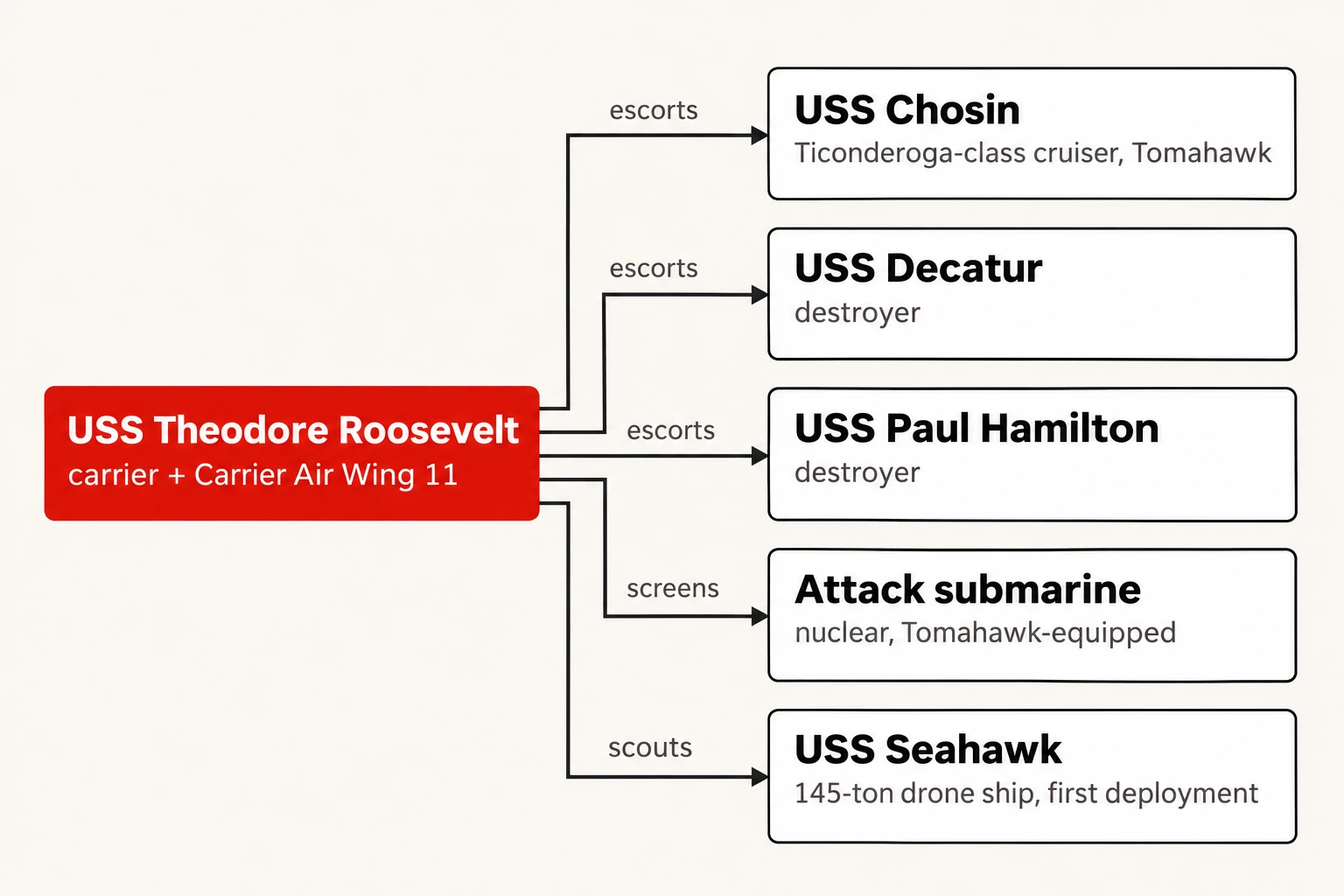
| From | To | How |
|---|---|---|
| USS Theodore Roosevelt (carrier + Carrier Air Wing 11) | USS Chosin (Ticonderoga-class cruiser, Tomahawk) | escorts |
| USS Theodore Roosevelt (carrier + Carrier Air Wing 11) | USS Decatur (destroyer) | escorts |
| USS Theodore Roosevelt (carrier + Carrier Air Wing 11) | USS Paul Hamilton (destroyer) | escorts |
| USS Theodore Roosevelt (carrier + Carrier Air Wing 11) | Attack submarine (nuclear, Tomahawk-equipped) | screens |
| USS Theodore Roosevelt (carrier + Carrier Air Wing 11) | USS Seahawk (145-ton drone ship, first deployment) | scouts |
Based on The National
None of this is cheap to keep at sea. In a 2013 paper for the Center for a New American Security, the naval analyst Henry Hendrix put the running cost of a single carrier strike group at $6.5 million a day, a figure that counts the air wing, five escort warships, an attack submarine and roughly 6,700 crew. Brown University’s Costs of War project, in an October 2025 accounting of Middle East operations, adjusted that figure for inflation to $9.05 million a day. Multiply either number by three, and simply keeping the current carrier presence afloat costs the US Navy somewhere between $19.5 million and $27.2 million a day, before a single missile leaves a tube.
Three carriers, again
This is the second time in 2026 the US has massed three carriers in the region simultaneously. The first was in April, when the USS Abraham Lincoln, USS Gerald R. Ford and USS George H.W. Bush operated together — the first time three American carriers had been in the Middle East at once since the 2003 invasion of Iraq, when the Navy sent five, according to Steven Wills of the Navy League’s Center for Maritime Strategy, cited in Military Times’ coverage of the April buildup. The ships are different this time: Lincoln and Ford have rotated out, replaced by Washington and Roosevelt, while Bush has stayed in theatre since the spring. Since the war opened on February 28, the Navy has cycled at least five of its eleven deployable carriers — Lincoln, Ford, Bush, Washington and Roosevelt — through CENTCOM, close to half the fleet, for a conflict Washington has not formally declared over.
The blockade and the Strait
The buildup sits on top of a US naval blockade of Iranian ports that Tehran has made the central demand in ending the war. President Trump said on Truth Social last week that “we don’t need a deal with Iran” and that “we’ve got their Strait,” a claim examined in earlier rews reporting on his decision to pull Vice President Vance off the negotiating file. Iran’s Revolutionary Guard says otherwise. It claims six vessels have caught fire and sunk in the Strait of Hormuz since Sunday, and that two tankers struck sea mines and exploded before that, according to The National’s reporting; the UK Maritime Trade Operations centre separately logged a vessel hit by an unidentified projectile while leaving the Strait on Monday morning, with a fire but no casualties. None of the IRGC’s sinking claims have been independently verified. The IRGC Navy has told shipowners to avoid what it calls the “American-backed southern route,” branding it a “minefield of fire” in retaliation for what it terms an “illegal American blockade.”
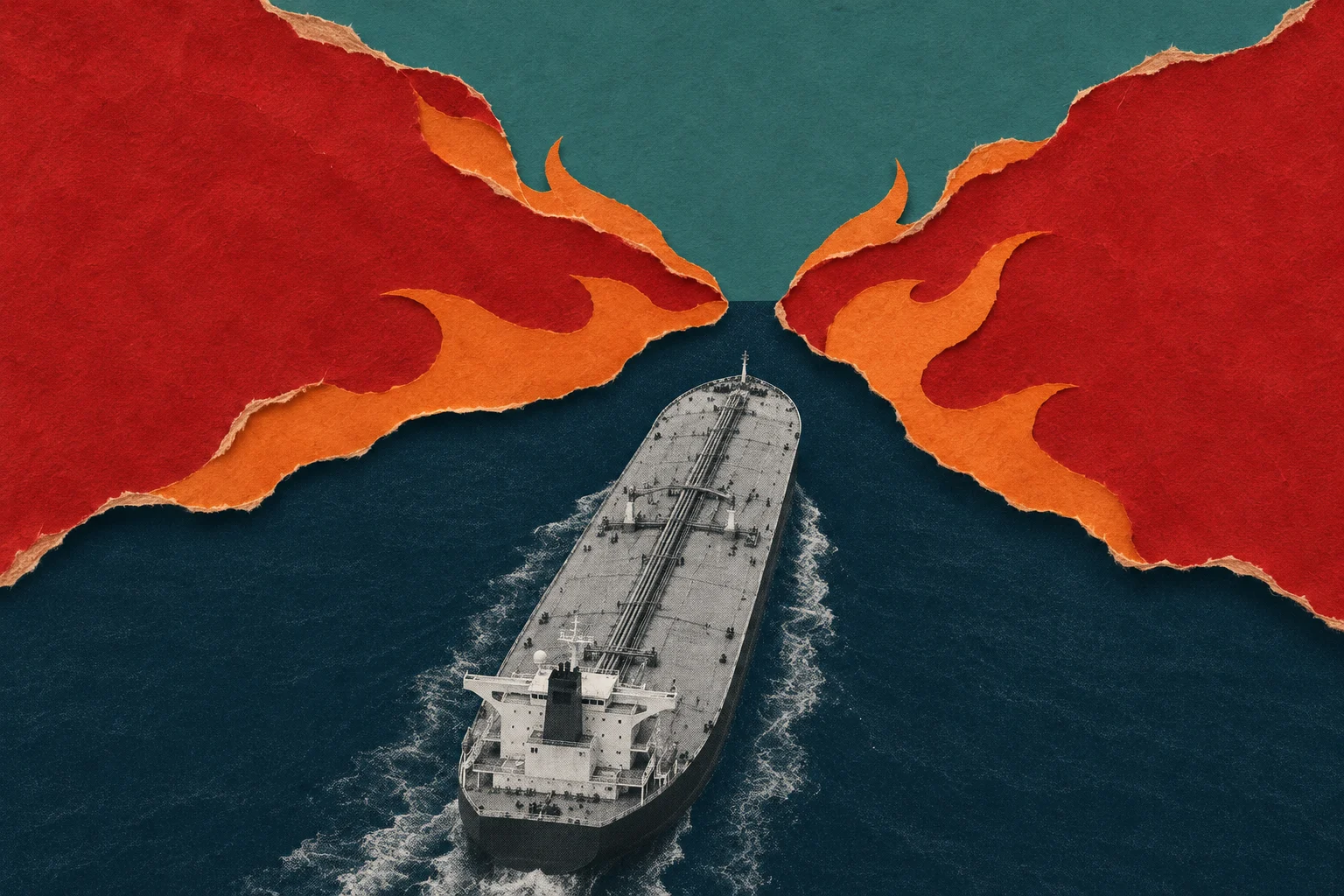
Shipowners cooperating with American forces will become “prey to the flames.”
That warning accompanied a drone attack on a US radar site at Riffa air base in Bahrain, where the IRGC’s Aerospace Force says it fired six drones and scored a “precise and successful impact”; Bahrain’s military says it intercepted all of them before they reached their targets. Iran’s embassy in South Africa separately published photographs of two named US Navy officers from the destroyer USS Spruance — commanding officer Cmdr Leigh R. Tate and executive officer Lt Cmdr Jeffrey E. York — with the caption “we will find you,” alleging they ordered Tomahawk strikes that killed children at a school in Minab. That allegation has not been independently established. The Spruance had just finished a 357-day deployment that included what The National described as combat operations against Iranian forces. CENTCOM has also stood up a separate task force aimed at Iran’s overland and Caspian trade routes, on top of the naval blockade.
What the carrier count actually tells you
Analysts disagree on what three carriers in one theatre signals, which is itself informative: the fact pattern is genuinely ambiguous. Megan Sutcliffe of the risk consultancy Sibylline told The National that concentrating three carriers in one region has historically preceded major combat operations. Tom Sharpe, a former Royal Navy commander, said the timing fits a pattern of post-midterm escalation that gives Trump “a lot of strike options,” noting that Republican losses in this month’s midterms leave the president roughly two months to act before a Democrat-controlled Congress is seated in January. Dr Lynette Nusbacher, a military analyst, offered the more cautious reading: the Roosevelt could simply be relieving another carrier, though she called the timing “awfully convenient,” and still put the odds of a renewed US strike, with or without Israel, as “more than likely.” Trump himself said last week, after meeting Qatar’s prime minister, that further strikes were “quite unlikely” and that the war was “effectively over” militarily — while adding that US forces remain “locked and loaded.” Secretary of State Marco Rubio has argued economic pressure on Iran “is going to get even worse,” reducing the need for military action; an earlier rews account of the October troop surge found the same split between officials talking up sanctions and officials moving hardware.

Iran’s missiles say otherwise
The clearest check on Washington’s claim that Iran’s military has been largely dismantled is a missile count. US intelligence agencies estimate Iran retains between 1,500 and 2,500 missiles despite months of strikes on its weapons infrastructure, the Wall Street Journal reported, citing officials who describe the estimate as low-confidence because of the difficulty of counting missiles in storage versus ready to launch. Even the low end of that range means Iran has rebuilt more than half its prewar stockpile, according to former Pentagon official Simone Ledeen, cited in the same report. Western intelligence officials told the Journal Iran is now producing roughly 50 new ballistic missiles a month, with Russian help, albeit slower than its prewar production pace. That sits awkwardly next to Defense Secretary Pete Hegseth’s statement last Tuesday that Iran’s defence industrial base is “gone” and more than 80 percent of its nuclear industrial base destroyed — a figure Iran’s Defence Ministry rejected the next day, saying its real stockpile “far exceeds” Hegseth’s numbers.
Iran’s own list of conditions for ending the war, laid out by parliament speaker Mohammad Bagher Ghalibaf, runs to five items: lift the naval blockade, lift sanctions, release frozen funds, end hostilities on every front, and issue a formal declaration that the war is over. The carrier count has moved from two to three twice this year without any of those five being met. The number worth watching next is not the carrier total but the missile one: at roughly 50 a month, Iran’s production rate, if the Journal’s estimate holds, will have added another 350 missiles to its arsenal by the time any ceasefire that started this year reaches its first anniversary.