
The decision came on a Wednesday, 18 November, in a court in Beersheba, a city at the edge of the Negev. Hussam Abu Safia, director of Kamal Adwan Hospital in northern Gaza, will stay in detention for another six months. He has not been charged. He has not been tried. As Al Jazeera reported, the news reached the outside world through his lawyer, by way of a post on Abu Safia’s own account on X. A man who cannot speak for himself had his words passed out through a social media feed.
The court refused his request to be released. According to his lawyer, as quoted in Palestinian coverage of the ruling including the Palestine Chronicle, the judges found that the 53-year-old physician “poses a threat to the State of Israel.” No public charge sheet says what the threat is.
The hospital
His story belongs to a building. Kamal Adwan was one of the last hospitals still working in the north of the Gaza Strip, and Abu Safia had stayed in it when Israeli displacement orders told people to leave, choosing to remain with his patients. In October 2024 his son was killed during an Israeli raid on the hospital. The doctor kept working. On 27 December 2024 Israeli forces stormed Kamal Adwan again, and this time they took him, along with other medical staff and patients. Since then it has been the cell rather than the ward.
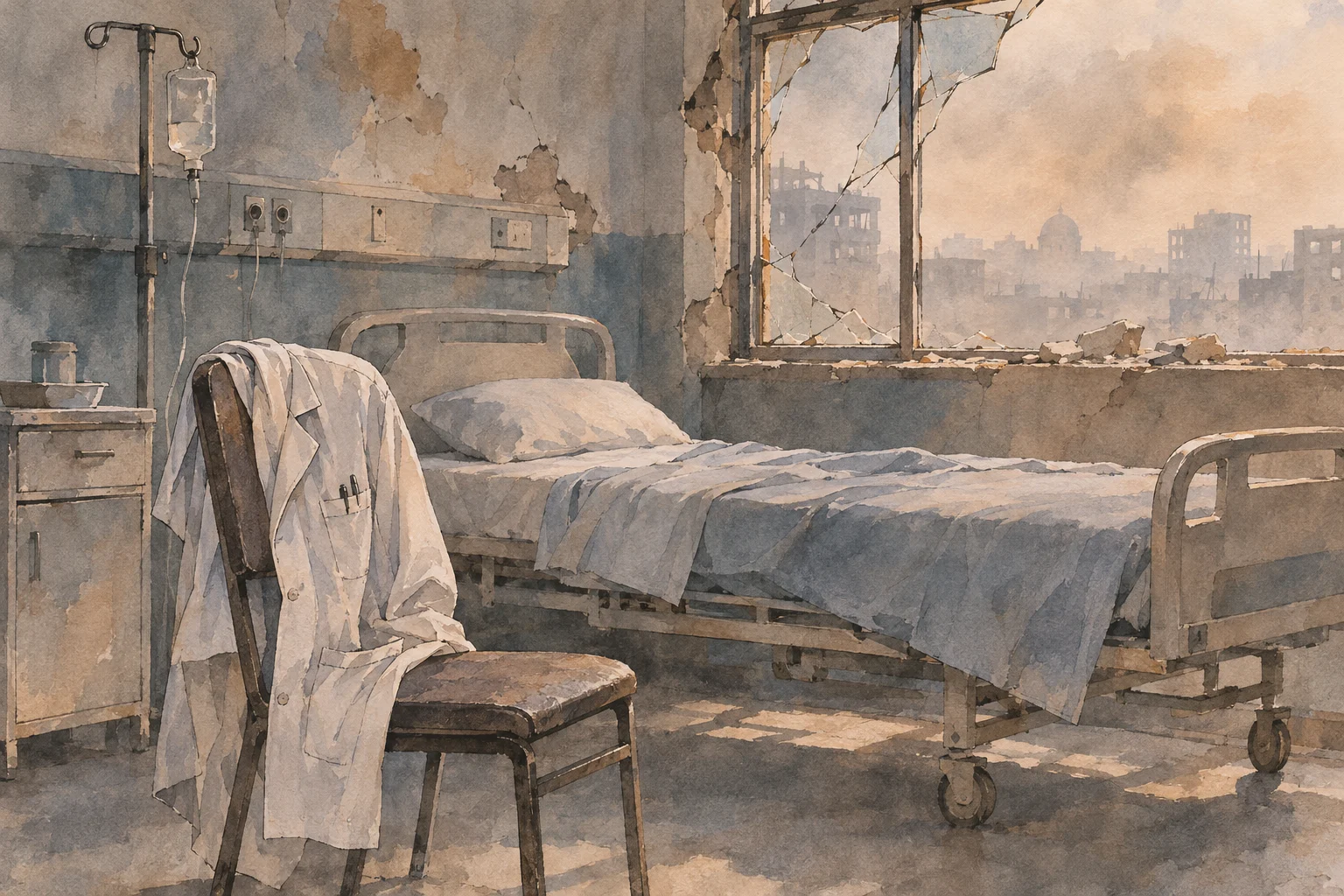
Those who treat the wounded in Gaza have often had to carry their own dead to work. Abu Safia carried his, and then he was carried off himself.
The law
He is held under Israel’s 2002 Unlawful Combatants Law, a statute that lets the state keep a person locked up without filing criminal charges or bringing him before a trial. In March 2025 a court in Beersheba upheld his detention under that law and ordered six months more, The New Arab reported, on the strength of evidence the defence does not get to see. Each period ends, and a new one begins. On paper there is a procedure. In practice the procedure has no end.
A reflection, not a finding: there is a particular genius in detention that is never final. A sentence can be served, counted down, appealed. A renewal has no last day. The prisoner never learns his crime, and so he can never be cleared of it.
The body
What has happened to him inside comes from those allowed to reach him. Physicians for Human Rights–Israel reported that his lawyer, Nasser Odeh, visited him at the underground Rakefet interrogation facility in Nitzan Prison and described a sharp decline in his health “to the point of tangible danger to his life,” as Middle East Eye carried the group’s warning. His lawyers and rights groups say he has been beaten, deprived of sleep and held in solitary confinement. The Palestine Chronicle has reported that he suffered fractured ribs after assaults in prison.
When he appeared before Israel’s Supreme Court by video link, he was handcuffed and shackled, and the court declined to have the shackles removed. By then he had been held for more than 500 days without charge.
In March 2026, UN experts demanded his immediate release and access to medical examination and treatment, saying they had received new reports that he had been subjected to “severe torture.” In July the UN Commission of Inquiry called for him to be freed, citing credible reports of “continued and severe abuse,” and a separate UN rights body called his detention “arbitrary,” Al Jazeera reported. Israeli authorities rejected the claims of mistreatment. The UN human rights office has said that despite several appeals to Israeli courts against the legality of his detention, the courts have so far failed to protect his rights under international law.
So the appeals go up, the statements go out from Geneva, and the orders come back from Beersheba, stamped and renewed.
The question
Through his lawyer, Abu Safia answered the ruling with a question: why had the order been renewed yet again? He said he was being punished for doing his humanitarian work and his professional duty as a doctor at Kamal Adwan. He said he missed his family deeply.
It is a short message. A director of a hospital asks a court why. A father says he misses his children. Neither has received an answer the public can read.
His case does not stand alone. Earlier this month a Jaffa journalist was held for five days in Petah Tikva and then released without charge. Abu Safia’s count is measured in years. He was taken on 27 December 2024. Six months from this Wednesday takes him to the middle of May 2027, when the same court may sit again to decide whether the threat it says he poses has passed.