
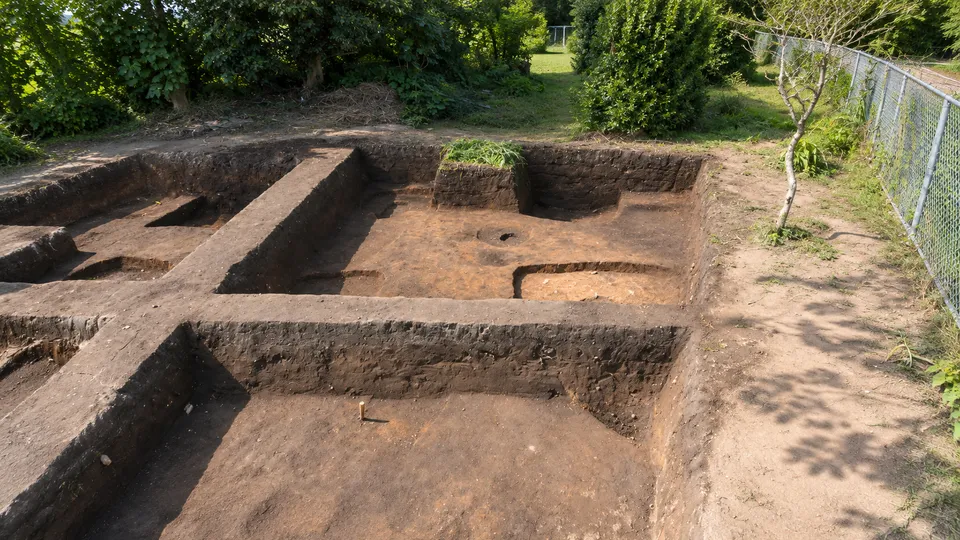
Two buildings now stand, in archaeological outline, inside a walled compound at the Saikū ruins in Meiwa, Mie Prefecture: postholes roughly 1.7 metres square, spaced about 3 metres apart, found immediately north of an already-identified structure during digging that ran from October into early November 2026. Mie Prefecture’s November 5 statement reads the new building’s near-central position in the compound as marking it the seiden — the main hall — of a palace built for the Saiō, the imperial priestesses who represented the emperor at the Ise Grand Shrine, as Arkeonews reported. The whole claim rests on posthole geometry and a comparison to other Nara-period palaces. No seal, inscription or dated wooden tablet has turned up to say whose hall it was.
What a posthole tells you
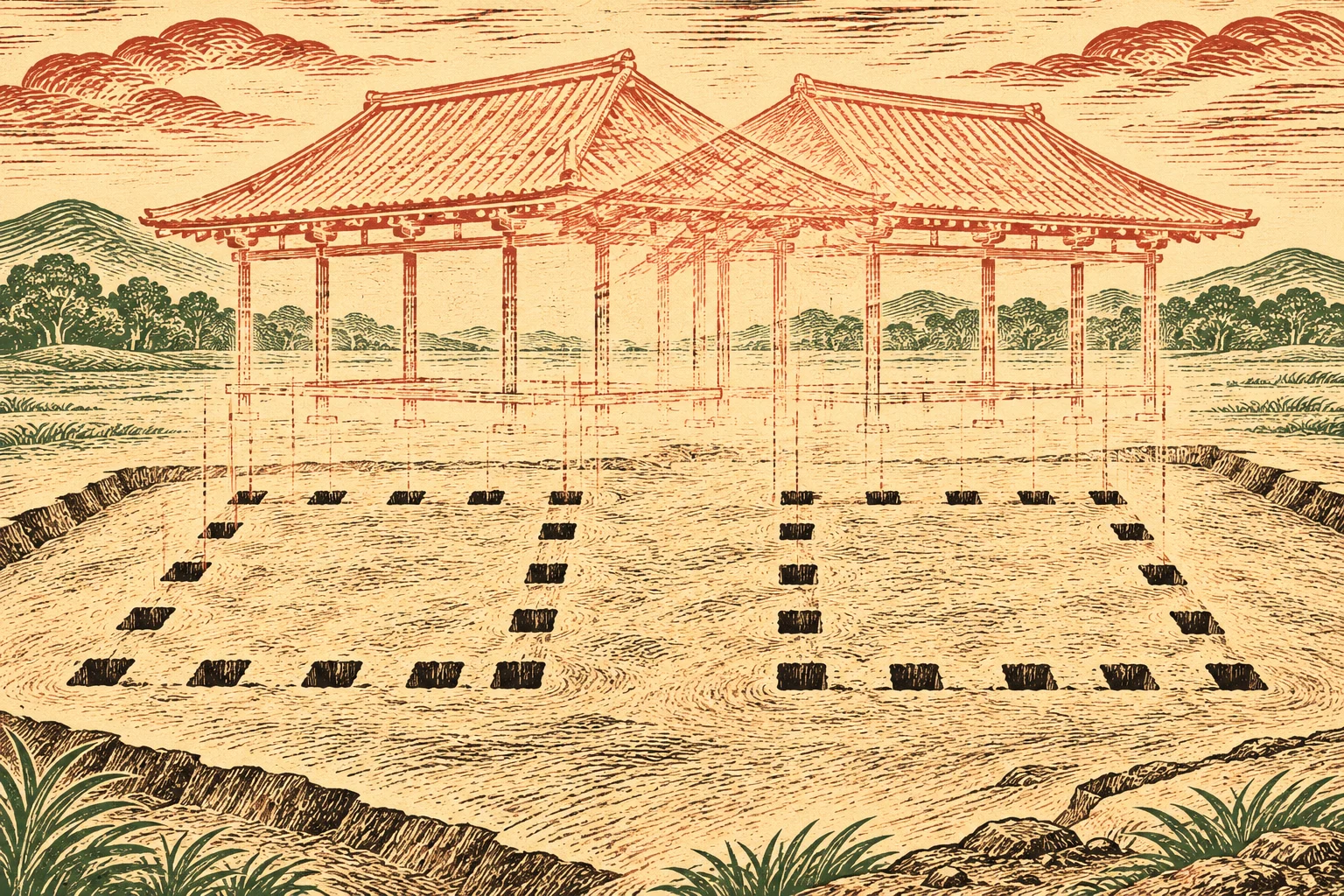
A posthole is what’s left when a wooden pillar rots away or is pulled out: a stain of disturbed soil in the shape of the hole dug to set it. The hole’s width gives a rough pillar diameter; the spacing between holes gives the building’s bay size; the layout of holes gives a floor plan, with no wall, roof or upper structure attached to any of it. At Saikū, the newly found hall’s postholes measure about 1.7 metres per side, set at roughly 3-metre (10-shaku) intervals. A separate hall found to its south between June and September, announced on August 14 and walked through at an on-site briefing on August 22, had postholes 1.7 to 2 metres per side at 3.2-metre (11-shaku) intervals, with an estimated pillar diameter of about 50 centimetres — the largest postholes yet recorded at the site, per the Ise Shimbun. The regional paper Yukan Mie, via Yahoo News, reports the museum now reads the two buildings as a pair: the southern one a zendono, a forehall where the Saiō met with officials, and the newly found northern one the seiden proper. Both buildings’ pillar spacing comes out to a round number of shaku, the pre-metric Japanese measure of about 30 centimetres — the detail the museum’s researchers cite when comparing the layout to palace halls at Heijō Palace, the eighth-century imperial capital in Nara.
The dig that found the new hall is Saikū’s 213th formal excavation since archaeologists began working the site in 1970 — roughly 3.8 campaigns a year, or one every three months, for 56 years running. The site covers about 137 hectares, Arkeonews reported; this one walled compound is a small piece of it, and researchers say they still don’t know the new hall’s full footprint, only the postholes nearest its presumed centre.
| Excavation | Announced | Building size | Post spacing | Interpretation |
|---|---|---|---|---|
| 205th dig | Oct 2023 | 17.0m × 15.0m footprint (255 m²), twin-hall design | not stated | Called first Nara-period main hall found at Saikū; tentatively Inoe's |
| 213th dig, south building | Aug 2026 | Postholes 1.7–2m square, pillars ~50cm thick | ~3.2m (11 shaku) | Largest postholes yet found at site; later read as forehall (zendono) |
| 213th dig, north building | Oct–Nov 2026 | Footprint not yet determined | ~3m (10 shaku) | Central position in compound; read as main hall (seiden) |
Source: Mie Prefectural Government; Ise Shimbun. Floor-area figures are only available for the 2023 find; the 2026 buildings' full dimensions are unreported
Which princess, again
The Saiō office ran for about 660 years, from the second half of the 7th century to the 14th, according to the Saikū History Museum: an unmarried woman of the imperial family, chosen by divination whenever a new emperor took the throne, went through a long purification, then moved to Saikū to stand in for the emperor before the Ise Grand Shrine. More than 60 are recorded by name in historical sources. Three times a year she took part in the shrine’s major rites; the rest of her time she spent at Saikū with attendants and administrative staff around her, which is why the museum treats the site as part religious residence, part outpost of court government.
The new hall’s date comes from its position inside a compound already assigned, on other grounds, to the first half of the 8th century — the reign of Emperor Shōmu, 724 to 749. On that timing, Mie’s 2023 statement on a different Saikū building named Shōmu’s own daughter, Princess Inoe, as the likely resident, selected as Saiō by divination during her father’s reign. Inoe’s later life is better documented than her time at Saikū: she went on to marry Emperor Kōnin, serve as empress from 770, and was deposed and arrested in 772 on accusations of using curses against the throne, dying in custody — presumably poisoned — in 775, before being posthumously restored to the title of empress in 800. That same name is the one now attached to the newly found hall too, again on chronology alone, not on any object that names her.
This is also not the first time Mie Prefecture has announced finding the Saiō’s main hall at Saikū. In October 2023, officials said a 255-square-metre building found in a separate excavation plot, the site’s 205th dig — 17 by 15 metres, a twin-hall (narabidō) design the government’s own release said had no known parallel among Japanese main halls — was the first Nara-period seiden ever found at Saikū, and also, tentatively, Inoe’s. The newly announced hall sits in a different compound and has no stated floor area yet. Mie’s November statement doesn’t address how two ‘first main hall’ claims about the same dead princess, three years apart, fit together; the honest reading is that both are provisional, and the museum has revised its best guess at least once already.
What the capital comparison would have to prove
Mie Governor Ichimi Katsuyuki told reporters at a press conference on November 4 that a building layout matching the imperial capital’s palaces could help clarify Saikū’s standing within the imperial administration, as Arkeonews reported — the idea being that if Saikū’s halls were built to the same spacing and scale as Heijō’s, the Saiō’s household was treated by Nara’s building bureaus as an extension of the court rather than a remote shrine posting. That’s a reasonable inference from round-shaku spacing and a north-south hall pair. Showing it would take excavating the rest of the walled compound and getting matching dates across every building in it, to establish the whole complex was laid out to one plan rather than assembled piecemeal over decades — which a site with 213 separate digs behind it plainly was.
Postholes have carried a similar evidentiary load elsewhere this year: a Bronze Age square hall beside a chieftain’s grave mound in northern Germany, and a Neolithic hall inferred from 120 postholes at Liangzhu in China, were both read the same way: floor plan first, function and occupant argued afterward. It’s the only method available for timber buildings that left no walls standing. It also can’t, by itself, tell a forehall from a main hall, or a princess from her staff.
The Saikū History Museum will walk visitors through the new postholes at a free, no-registration briefing on November 14, from 10 a.m. to 11:30 a.m., at the dig site in Takegawa, Meiwa Town. What would settle the attribution question is not another comparison to Heijō Palace but the thing no posthole can supply: an object from the fill with a name or a date on it.