
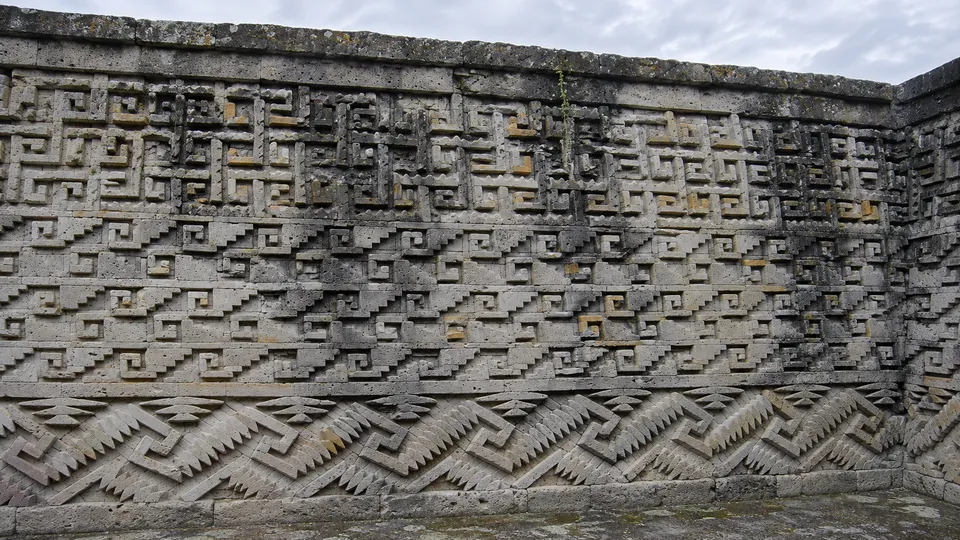
The Zapotecs had a name for Mitla before the Spanish one stuck: Lyobáa, “the place where the souls rest.” It was a city of ceremony and of tombs, and its stone halls still stand in Oaxaca. For more than a century, the people who came to measure those halls reached the same conclusion. The dimensions wandered. The pillars refused to match. The builders, it seemed, had worked without a fixed measure.
A new study argues the opposite. The builders measured, and closely. They used their own system, and they may have built the calendar and the afterlife into it. As Leman Altuntaş reported for Arkeonews, the work is by Genevieve Lucet of the National Autonomous University of Mexico (UNAM). Her paper, “Measurement as Cultural Practice: Cosmogonic Order in the Architecture of Mitla, Oaxaca”, was published online in the Cambridge journal Ancient Mesoamerica on 3 November 2026, according to the journal’s article page, which lists her at UNAM’s Instituto de Investigaciones Estéticas.
The width of four fingers
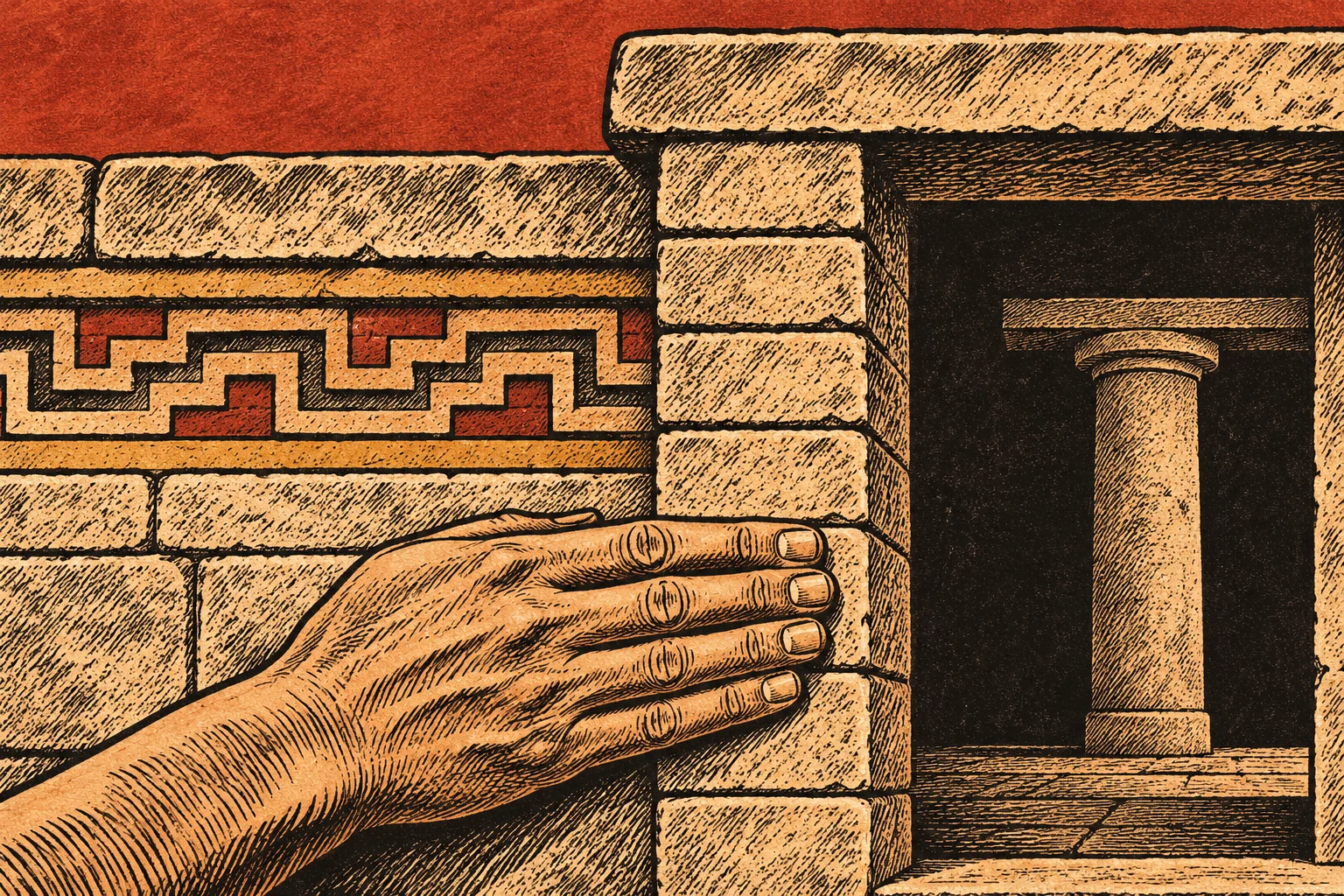
The whole system starts from something small: about eight centimetres, the width of four fingers laid side by side. Lucet calls it the palm. The paper compares it with the Nahuatl macpalli, which is estimated at 7 to 9 centimetres. The larger units are multiples of this hand. Twenty-three palms make 1.84 metres and twenty-four make 1.92 metres, each within a tolerance of about two centimetres. Those two lengths keep turning up in Mitla’s doorways, columns and floor plans.
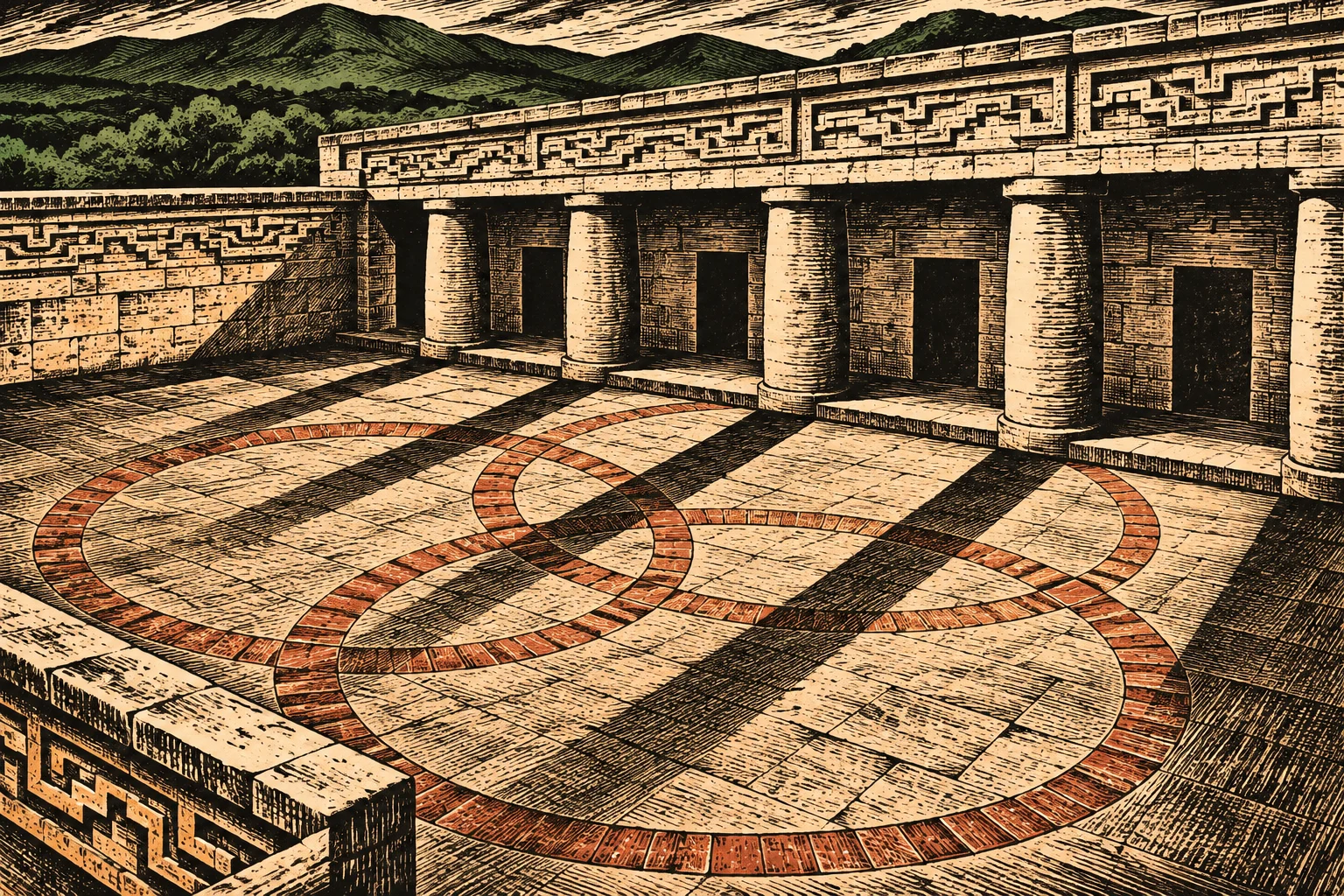
Lucet worked through three architectural groups, known as the Church, the Arroyo and the Columns. She measured door openings, columns, courtyards and other elements across nine complexes. According to the paper, the 1.84-metre unit is the main one and mostly sets quadrangles, doorways and room widths in the Church and Arroyo groups. The 1.92-metre unit mostly sets patios, plazas, pillars and tombs, and a 25-palm unit sets heights. Each kind of space had its own rule.
That answers the old verdict. The paper traces it to Corner, who in 1899 read the irregularities of the Hall of the Columns as proof that no precise measurement was used there. For Lucet, the variations were deliberate. Each space was sized for its function and its importance.
What looked like carelessness was a grammar nobody had learned to read.
Three times fifty-two
The Mesoamerican calendar ran on two wheels. One was a 365-day solar year and the other a 260-day ritual count. They came back to the same starting position only after 18,980 days, which is 52 years. The end of that cycle was tied to the renewal of time and the survival of the cosmic order.
On the façade of Hall 21 in the Columns Group, Lucet found that the doorway openings and the columns together measure 156 palms. That is exactly three times 52. The paper says this explains why the hall’s pillars, at 2.61 metres, fit no standard unit. Hall 21 also uses a 30-palm unit, the largest at the site. The surface area of one courtyard, Quadrangle B, also comes to 156. Similar numbers turn up in other courtyards and elements. Lucet suggests the architects may have built their ideas of time into the stone on purpose.
Arkeonews is careful to add that this does not prove what the architects intended. One matching number could be chance. The argument rests on the same patterns returning in space after space.
Nine to the north, thirteen to the south
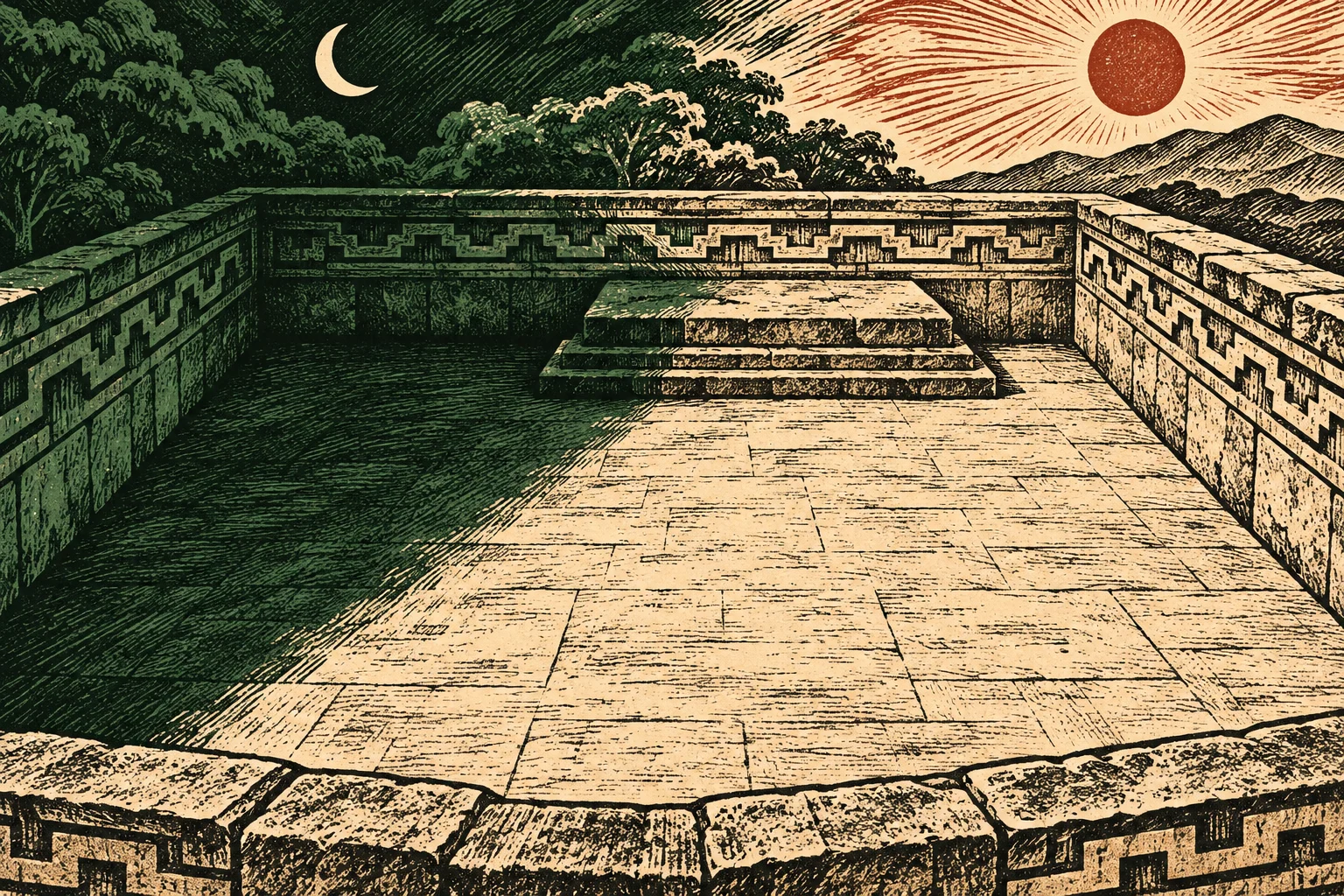
The Columns Group uses larger units, and units found nowhere else at the site. Lucet reads this as a mark of its ceremonial weight. In Complex E, the altar does not sit in the centre of its courtyard. By her measurements, its north face is 9 units of 1.92 metres from the edge of the plaza and its south face is 13 such units away. That works out to roughly 17 and 25 metres.
In some Mesoamerican traditions, nine and thirteen are the lords of the night and the lords of the day. The same numbers appear in accounts of the layers of the universe. The paper also offers another reading that links them to the New Fire ceremony. Either way, Lucet argues that the builders of a funerary city were thinking about more than symmetry. Ritual, the turning of time and the afterlife may all have shaped where the stones went.
It is a familiar habit of the powerful to carve their own names into monuments. Here something quieter seems to have been carved: a count of years and of the dead, set into the distance between an altar and a wall.
Beyond the valley’s ceremonial centre
Traces of the same units appear at other Oaxaca sites. At Atzompa, according to the paper, the western and northern plazas measure in multiples of the 1.92-metre unit. The main ballcourt measures 24 of the 1.84-metre units by 12 of the 1.92-metre ones. At Suchilquitongo, a Late Classic cruciform tomb in the Etla Valley, measured with a total station in 2005, was laid out in the 1.92-metre unit as well. This suggests a shared tradition in funerary building across settlements and periods.
Even so, no other Zapotec settlement has yet shown a system as detailed and consistent as Mitla’s. The meaning of every number cannot be settled. Lucet has done this kind of work before, in studies of dimensioning at Cacaxtla in Tlaxcala and of how its painters shared a measure with its builders. Her Mitla paper is one of several recent studies that treat Mesoamerican builders as calculators: a temple in the mountains of Puebla aligned to the sun, and a Maya mathematician whose name can now be read.
The palm is not listed as a named unit in Juan de Córdoba’s Zapotec dictionary. If the measure had a name, the paper records none. What survives of it is a count in the doorways, kept for the place where the souls rest.