
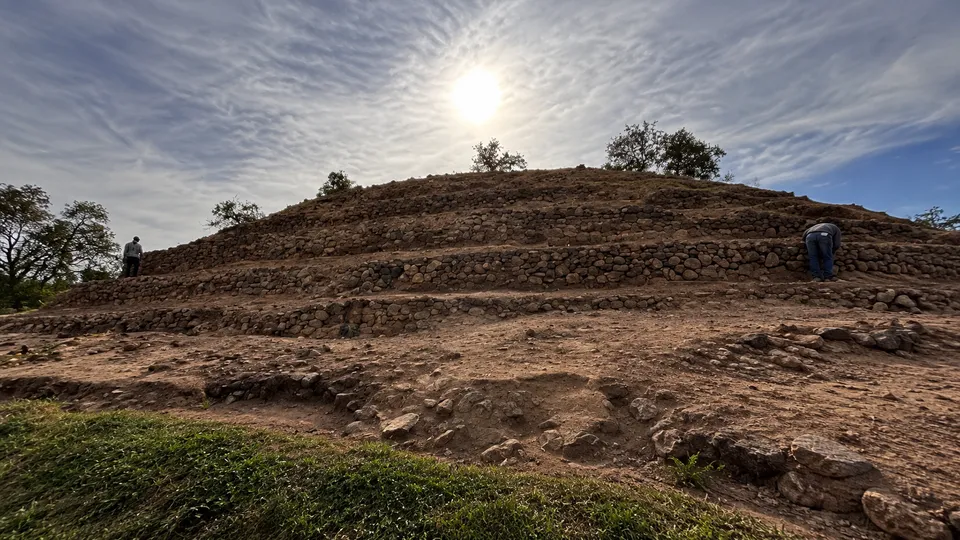
Long before there were borders, before there was a Mexico or a Puebla, there were people in these mountains who needed to know when to plant and when to harvest, and who answered that need the way their age answered all great needs: with stone. Archaeologists have now confirmed that a monumental complex in the Sierra Norte de Puebla, built more than 2,500 years ago, was a solar observatory — the first of its kind documented outside the Maya region, according to Mexico’s National Institute of Anthropology and History, as Arkeonews reported.
A courtyard that watched the horizon
The place is called Tetelihtic, within the site of Teteles de Ávila Castillo, an ancient ceremonial settlement in the mountains of central Mexico. Researchers established its astronomical function by studying the original layout, the orientation of its pyramidal structures and their relationship to the rising sun. The complex is arranged around a quadrangular courtyard set between two monumental buildings. The eastern platform runs roughly 90 meters north to south and 40 meters east to west; a smaller western structure, 46 by 27 meters, served as the observation point. From it, a priest or a surveyor could follow the sunrise as it walked back and forth along the horizon through the year.
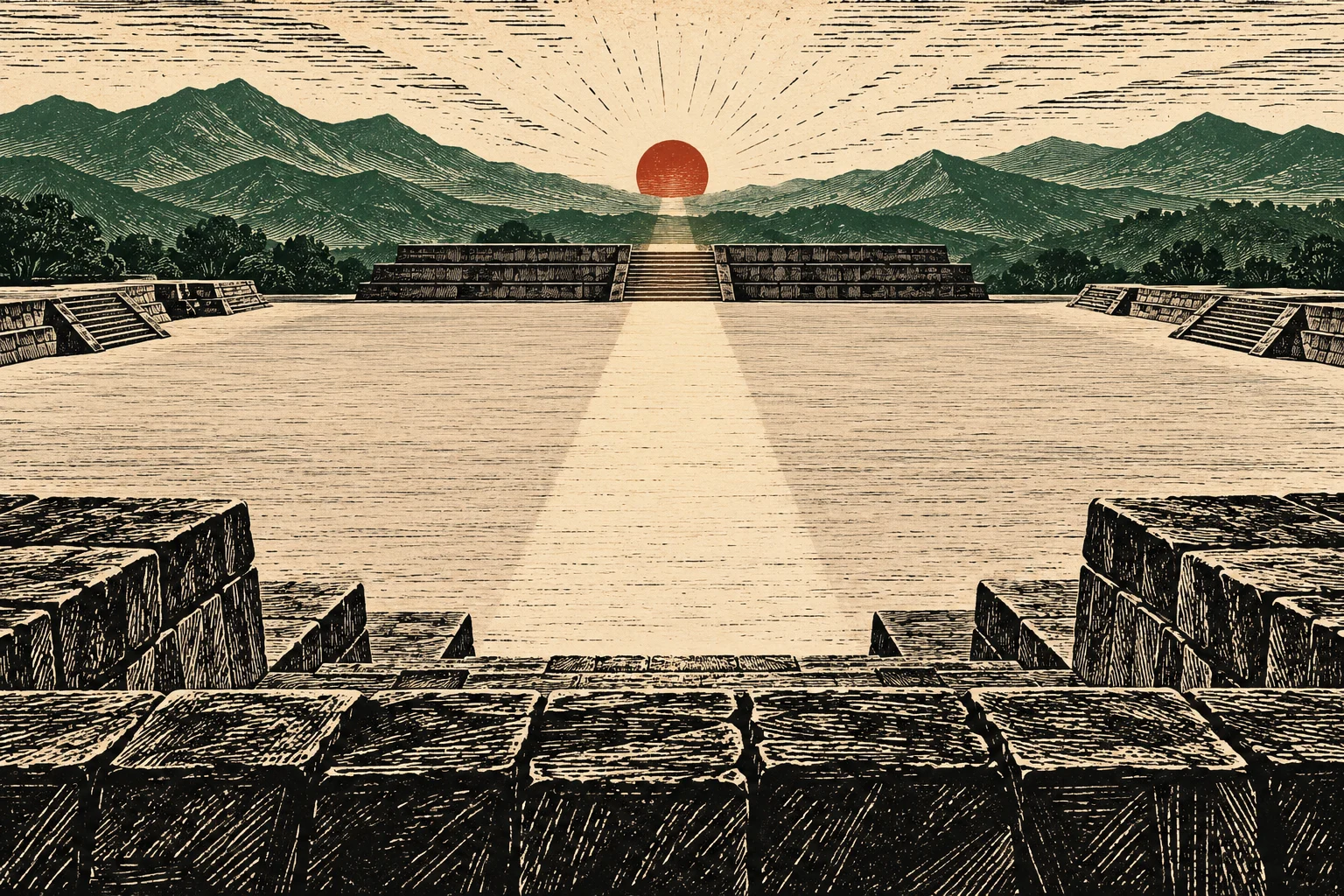
INAH dates the complex to the Middle Preclassic period, roughly 1000 to 600 BCE, and its plan will be familiar to anyone who knows the archaeology of the Maya: it closely resembles the E-Group tradition, the arrangement of a western pyramid facing a line of structures along an eastern platform that archaeologists first parsed at Uaxactún in northern Guatemala in the early twentieth century. Related complexes stand at Ceibal, where an E-Group was raised around 1000 BCE, and at Tikal, Caracol and Xunantunich, scattered across present-day Guatemala, Belize and southeastern Mexico.
Beyond the Maya heartland, twice the size
What makes the Puebla observatory remarkable is its address. The known E-Group observatories are concentrated in the Maya world; INAH describes Teteles de Ávila Castillo as the first solar observatory of its kind recorded outside it — comparable to Uaxactún, yet approximately twice its size. The find does not settle the old argument about how far astronomical knowledge travelled: E-Group-like forms have been noted before, in regions tied to La Venta and Chiapas, but resemblance alone proves nothing, since such buildings could serve ritual and political ends as readily as astronomical ones. In Puebla, the orientations themselves have now been measured, and the stone speaks.
And what it says is practical as much as sacred. The elongated platform does not merely mark the equinoxes along a central axis, in the classic Uaxactún manner. According to the archaeological team, its alignments signalled the beginning of the Mesoamerican calendar in February and the harvest season in October, while observations from the eastern structure picked out the equinoxes and solstices as well. Here, then, was a calendar a farmer could read from a pyramid — a machine for marrying the sky to the maize, for making the ceremonial year and the agricultural year one.

Who built it, and who remembered it
The harder question is the human one. Project director Alberto Diez Barroso Repizo suggests that Maya-related cultural influences may have reached this region as early as the first millennium BCE, and that the site’s affinities could bear on the history of the Huastec peoples, whose language sits within the Mayan family. He also raises the possibility that Tetelihtic’s builders were ancestral to the populations who later raised Yohualichan in Puebla and the great pyramids of El Tajín in Veracruz — the people we call Totonac.
The settlement itself lived from about 900 BCE until around AD 100, then faded as Cantona, Cholula and Teotihuacan rose. But memory, in Mesoamerica, outlives masonry. Offerings left between AD 100 and 600 show the place retained its ceremonial gravity long after abandonment, and a later Totonac offering, dated AD 600–900, marks yet another pilgrimage back to the empty plaza. Researchers have even suggested — preliminarily, they insist — that the alignment of a major structure with Canopus, among the brightest stars of the night sky, may connect to the Nahua goddess Nantehuitz.
An observatory, in the end, is an argument that the heavens are regular and that men can learn their schedule. In the Sierra Norte de Puebla that argument was built in stone more than two and a half millennia ago, and it has outlasted every empire raised on this soil since.