
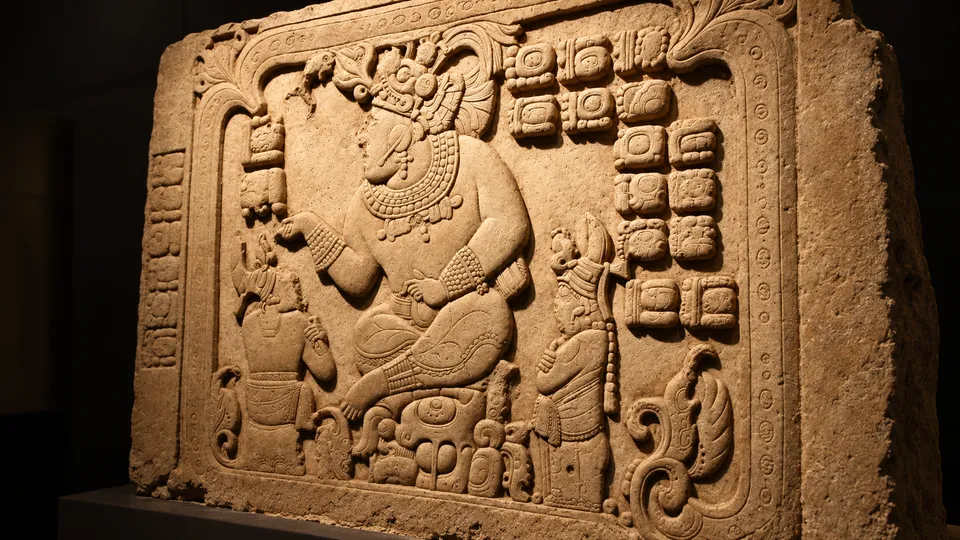
2,920 days is five Venus cycles of about 584 days, and also eight solar years of 365 days. Classic Maya astronomers knew this, and at the city of Xultun, in the Petén region of northern Guatemala, one of them wrote the equivalence on a wall, extended it with Mars and three calendar systems, and signed the result. The signature reads Sak Tahn Waax — “White-chested Fox” — and a study in Antiquity by Franco Rossi, David Stuart and Heather Hurst identifies him as the first Classic Maya mathematician known by name, as Arkeonews reported.
What the 11 glyphs compute
The inscription, designated Text 19, occupies a small section of one interior wall and contains only 11 hieroglyphic blocks, but the calculation spans the full 2,920 days. What makes it unusual is the decomposition. Instead of repeating the standard Venus table, the author assembled the period from four different units: the 20-day month, the 260-day ritual calendar, the 360-day tun, and Mars’s synodic cycle of roughly 780 days. The individual units are common in Maya texts; this arrangement is not. The authors take that as evidence the writer was probing how different timekeeping systems fit together, not just logging sky events.
There is also a pattern in the counts. The formula uses one 20-day month, one 260-day cycle, two Mars cycles, three 360-day periods and five Venus cycles — 1, 1, 2, 3, 5, the opening of the Fibonacci sequence, where each term is the sum of the previous two. The researchers are explicit about the limits: this does not show Sak Tahn Waax discovered the sequence or understood it as a modern mathematician would, and they cannot say whether the pattern was deliberate or how widely Maya scholars recognised it. What it does show is a scholar constructing a joint framework out of planetary cycles and calendars, rather than counting days one at a time.
A date: 11 November AD 781
By reconstructing damaged calendar signs and measuring the intervals between recorded dates, the team recovered a possible starting point for the calculation: 11 November AD 781 in the Gregorian calendar. That is a candidate epoch for the arithmetic, not necessarily the day the wall was painted, but it anchors the work in the eighth century, when Maya scholars were already tracking Venus and Mars to set dates for ceremonies, royal events and building dedications.
“So says” a mathematician
The final two glyphs are the finding. After the dates and numbers, the text carries a phrase translated as “so says,” followed by the name. Maya artists and sculptors are known to have signed works; no Classic Maya mathematician had ever been found with a name attached to a mathematical or astronomical result. The caveat the authors keep: Text 19 does not prove Sak Tahn Waax painted or even computed the formula himself. A scribe may have copied it and credited the originator, perhaps a senior astronomer whose tables circulated. One proposed reason this text got a signature while the room’s other astronomical notes did not is that Text 19 is a complete, reusable calculation — a template for any 2,920-day period, not a one-off record.
The room that kept it
Archaeologists found the chamber, Structure 10K-2, in 2010. It holds roughly 52 texts covering lunar cycles, planetary observations and numerical calculations, plus painted figures of seated and kneeling court members. Papermaking tools suggest books were produced there; a mix of skilled and less accomplished handwriting suggests teaching. The Maya later filled the room and built over it, which preserved the paintings while moisture and roots degraded them; modern imaging recovered the faded strokes, including the name. Sixteen years after excavation, the walls are still yielding. The open problem is the one any signed work raises: whether Sak Tahn Waax was one unusually credited individual or a surviving trace of a wider practice of attribution that the record mostly lost.