
AST SpaceMobile wants to launch a rocket it has not built, using an engine that has not finished qualification testing, to lift satellites that may be too heavy for the lift capacity it has announced. The company’s chief executive, Abel Avellan, calls the plan “simple.” The rocket, named Blacklift, is supposed to fly for the first time in 2028, launch twice a month from a Virginia pad that used to serve the retired Antares rocket, and carry five of AST’s Bluebird satellites per flight on a reusable first stage. AST is paying for the confidence: $1.3 billion, under a deal announced November 6 and detailed at a public event in New York on November 12, as Eric Berger reported for Ars Technica.
The money breaks into two pieces. Under an SEC filing describing the agreement, AST pays Firefly Aerospace roughly $800 million for a perpetual license to Firefly’s engine designs, split between $400 million in cash and 10 to 14 million shares of AST Class A stock. A separate supply contract adds $250 million for the 27 Miranda and 9 Vira engines needed for Blacklift’s first three rockets, plus another $250 million in engineering-support fees paid over three years, according to AST SpaceMobile’s own press release. That’s nine Miranda engines and three Vira engines per rocket.
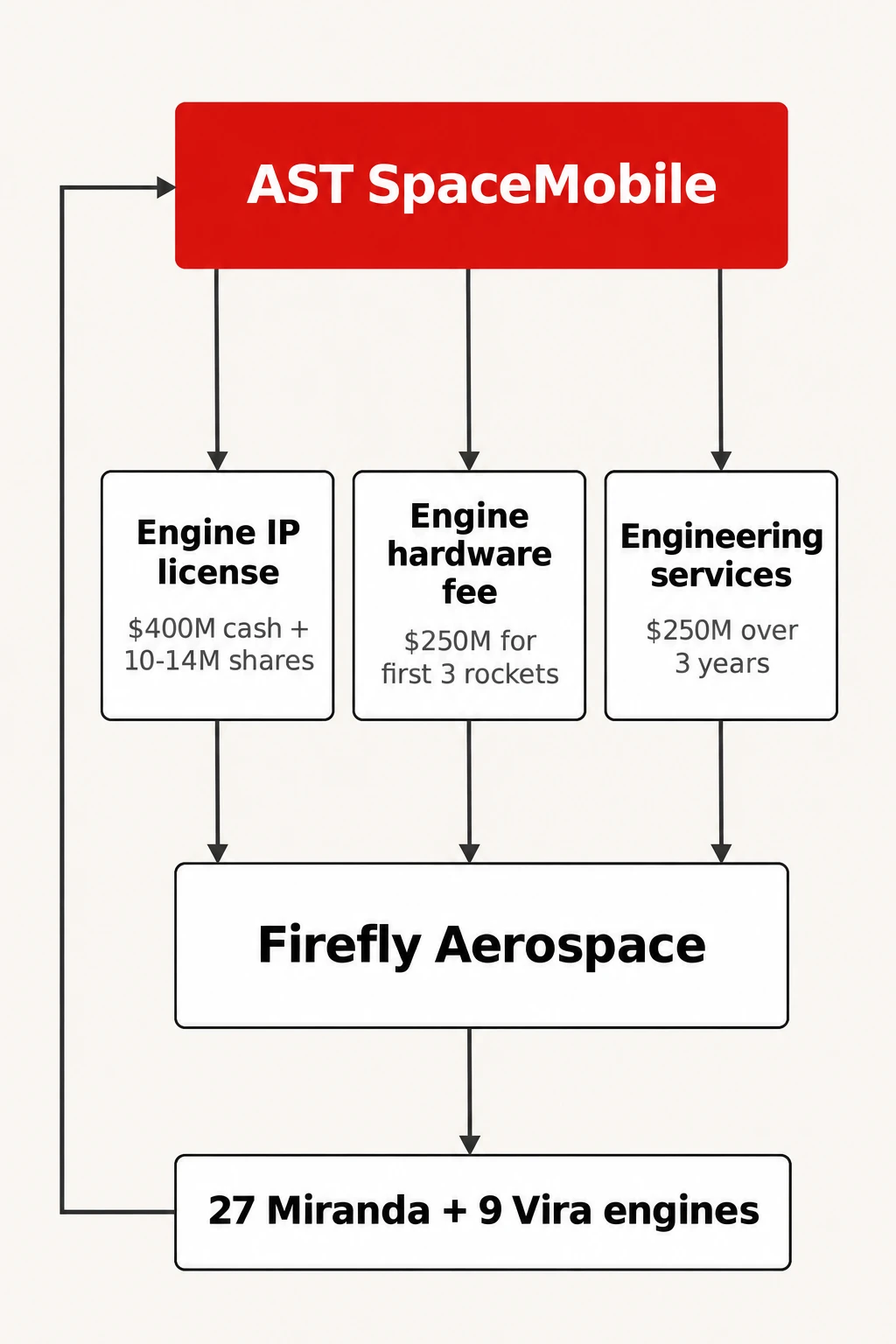
| From | To | How |
|---|---|---|
| AST SpaceMobile | Engine IP license ($400M cash + 10-14M shares) | |
| AST SpaceMobile | Engine hardware fee ($250M for first 3 rockets) | |
| AST SpaceMobile | Engineering services ($250M over 3 years) | |
| Engine IP license ($400M cash + 10-14M shares) | Firefly Aerospace | |
| Engine hardware fee ($250M for first 3 rockets) | Firefly Aerospace | |
| Engineering services ($250M over 3 years) | Firefly Aerospace | |
| Firefly Aerospace | 27 Miranda + 9 Vira engines | |
| 27 Miranda + 9 Vira engines | AST SpaceMobile |
Based on AST SpaceMobile SEC filing
Blacklift’s advertised specs: three stages, all-composite propellant tanks, a reusable first stage, 20 metric tons of lift capacity, and up to five Bluebird satellites per launch. The arithmetic on that last pair of numbers is worth doing, because AST publishes both figures itself.
AST’s current production satellite is the Bluebird Block 2, the design the company is actually building and launching now. According to the satellite-tracking database Gunter’s Space Page, the first Block 2 unit, launched in December 2025, massed 6,100 kilograms; later units in the same block mass 5,830 kilograms. Five of the lighter units weigh 29.15 metric tons. Five of the heavier ones weigh 30.5 metric tons. Either way, that’s 46 to 53 percent over Blacklift’s stated 20-metric-ton capacity. Five of the older, lighter Block 1 satellites (about 1,500 kilograms each, by the same source) would total 7.5 tons, comfortably under the limit — but Block 1 isn’t what AST is shipping to orbit anymore.
One engine, three rockets
Avellan’s confidence rests on the Miranda engine, which he calls “ready to fly.” It isn’t flying yet, on anything. Firefly’s own chief executive, Jason Kim, told investors on the company’s November 10 earnings call that Miranda’s qualification campaign is still underway, with 175 hot-fire tests completed across 20 engines, totaling more than 4,200 cumulative seconds of burn time — about the equivalent of 20 full first-stage flights, per Firefly’s third-quarter results. One test ran a flight-like firing at 110 percent of the engine’s rated 230,000 pounds-force thrust. Kim called it “a very mature engine,” but mature and qualified are different words for a reason: nobody has flown it.
Two of those three rockets also share a launch pad. Eclipse, Firefly’s medium-lift vehicle built with Northrop Grumman to replace the retired Antares, is slated to fly from the Mid-Atlantic Regional Spaceport’s Launch Pad 0A at Wallops Island — the same facility AST says will host Blacklift. Kim, asked on the same earnings call whether Eclipse’s first launch still stood for 2027, discussed development milestones but did not confirm a date. One unqualified engine is now the long pole for at least three separate launch-vehicle programs, two of which want the same patch of Virginia coastline.

Composites are hard too
Avellan’s other claim is that 80 percent of a rocket’s development cycle is driven by engine work — propulsion first, everything else follows. That’s an overstatement. Rocket Lab, which has flown more than 80 orbital missions on its Electron vehicle, has slipped its Neutron rocket’s debut twice in 2026 alone over composite-tank problems, not engines. A first-stage tank ruptured during a hydrostatic pressure test in January, and in October the company found microscopic voids between carbon-fiber layers in the tank’s forward dome, pushing Neutron’s first flight from the fourth quarter of 2026 into 2027, according to reporting on the delay. Rocket Lab’s stock fell 13 percent the day the delay was announced. Composite structures, avionics, stage separation, fairings and the jump from one-off prototypes to production at rate have each cost real schedule time on real rockets; engines are hard, but they are not the only hard part, and AST has not built any of the others yet either.

The deal looks less one-sided once Firefly’s own balance sheet is in view. Firefly’s stock closed at $15.18 the day before the AST announcement, its lowest level in a year after a 47.7 percent slide over the prior six months. The $1.3 billion contract sent the stock up 36.8 percent in a single session, and Jefferies reiterated a buy rating with a $35 target, framing the deal as validation of Firefly’s engine technology and a non-dilutive source of cash, in a note covered by the Motley Fool. Firefly needed the money as much as AST needed the engines; neither company had much reason, in November, to describe Miranda’s readiness conservatively.
AST’s rocket ambitions sit inside a wider scramble among satellite operators to lock down launch capacity before Falcon 9 ages out, a race that has also pulled in the Pentagon as a lender to rocket makers and sent Relativity Space onto a test stand with its own untested stage. AST’s own earlier framing of the Blacklift deal is detailed here. What happens next is a qualification campaign that has to finish, a mass budget that has to close, and a launch pad that two Firefly-engined rockets currently plan to share. None of those three problems is solved by writing a check for the engines.