
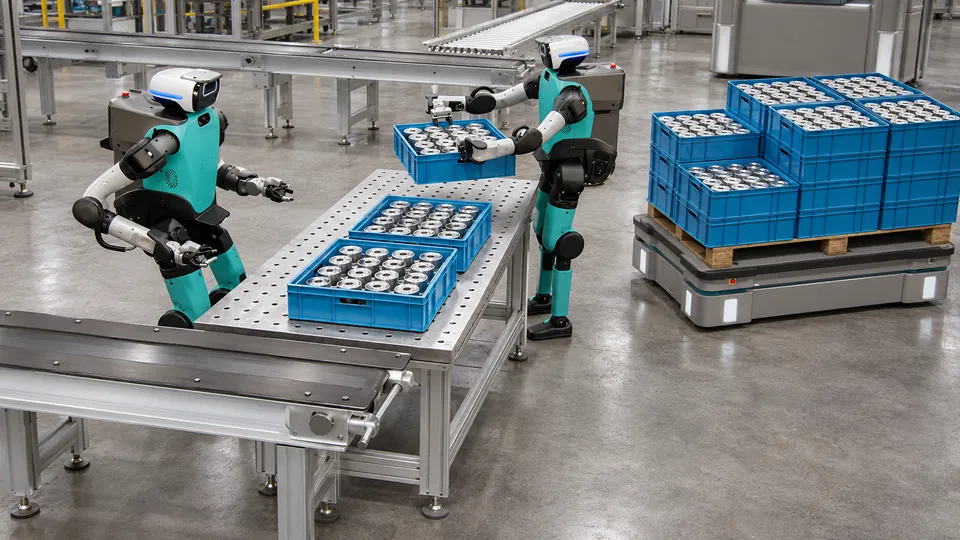
Agility Robotics booked $1.8 million in revenue in fiscal 2025 against a net loss of $138.1 million, according to the merger filings Business Insider reported. More than half that revenue came from five robots bought by one of the company’s own investors. A SPAC merger — a shell company that already raised cash in its own IPO merges with a private operating company, letting the target skip the usual roadshow and list directly — is how those numbers reached a public filing at all. Agility’s vehicle was Churchill Capital Corp XI, run by former Citigroup banker Michael Klein. The merger closed November 4, and Agility began trading on Nasdaq under the ticker AGLT the next morning, the first dedicated humanoid-robot company on a US exchange.
The stock opened at $11.26, above the $10 reference price used to value the SPAC deal, then slipped to $10.30 intraday. The merger set Agility’s pre-money equity at about $2.5 billion and is expected to deliver roughly $465 million in gross capital before expenses: $164 million released from Churchill’s trust account after shareholder redemptions, a $201 million PIPE led by Foxconn — Apple’s main iPhone assembler — and $100 million from an earlier funding round. Churchill’s shareholders approved the deal on November 2 with more than 84% of votes cast in favor. Existing Agility shareholders and the SPAC’s sponsor are locked up for 180 days, with early release tied to the stock hitting certain price targets.
The $138.1 million headline loss overstates the cash problem and understates it at the same time. About $38 million of it is non-cash, tied to employee stock awards. The cash that actually left the building was $99.8 million, what Agility calls its 2025 operating burn. Strip out R&D and overhead and look only at the robots it sold: Agility still lost $2.7 million on them. Negative gross margin on hardware this early isn’t unusual, but it means every unit shipped before the pricing and manufacturing cost converge is subsidized, not sold.
Agility’s Digit robot is running in nine customer facilities, including Amazon, Toyota and the logistics firm GXO, per its S-4 filing, reported in detail by Ars Technica. Agility’s investor list — Amazon, Foxconn, Nvidia, SoftBank, and DCVC — overlaps with its customer list, a pattern worth flagging given that one of those investors accounted for the five robots behind half of last year’s revenue. Amazon alone runs about a million robots across its warehouses, almost none of them humanoid; Digit is a rounding error in Amazon’s own fleet even as it’s central to Agility’s.
The filing lists more than $300 million in orders for 1,000 Digit 5 units from a single customer, structured as a three-year usage fee rather than a one-time sale — robots-as-a-service, not equipment purchase. The order is conditional on Agility hitting its own deadlines: deliveries are targeted for the first half of 2027, with general availability by the end of that year. Digit 5’s structural change from earlier versions is dropping the safety cage requirement, letting it share floor space with people without a fence around it.

The valuation gap
Agility’s $2.5 billion pre-money equity sits well below its privately held, pre-revenue-at-scale rivals. Austin-based Apptronik raised $520 million at a valuation Bloomberg put at more than $5.5 billion in February 2026. Germany’s Neura Robotics closed a Series C worth up to $1.4 billion that valued it at $7 billion in June 2026. Figure AI’s last priced round, in September 2025, set it at $39 billion and nothing has repriced it since, despite reported Nvidia talks in October. None of those three has Agility’s count of working deployments; Agility has the lowest paper valuation and the most robots actually moving pallets.
“This is a trend we’re seeing, where companies with deployments who are actually shipping hardware today are valued by the market a lot lower than companies that are betting on this future,” George Chowdhury, a principal analyst at ABI Research, told Business Insider. Michelle Sun, who writes the robotics newsletter Core Matter, told the outlet Agility’s listing gives public markets their first reference point for pricing a humanoid-robot maker, adding: “There’s a lot of challenges when it comes to solving unit economics.”
Who’s actually shipping
Research firm Omdia counted about 13,000 humanoid robots shipped worldwide in 2025; IDC, using different scope, put the figure as high as 18,000. By Omdia’s count, Chinese makers took roughly 90% of that total, led by Shanghai’s AgiBot with 5,168 units (39% global share), Unitree with 4,200, and UBTECH with 1,000. Figure AI, Agility and Tesla each shipped around 150. Tesla’s Optimus fell short of its own 5,000-unit target for 2025; outside estimates, per Rest of World’s reporting, put actual production at a few hundred units total.
The gap is why Washington has started treating humanoids as a supply-chain problem rather than a gadget category. On July 28, 2026, the Federal Communications Commission added “advanced robotic devices” — humanoids, quadrupeds, and some robot vacuums — to its Covered List, barring new foreign-made units from the equipment authorizations needed to import, market or sell them in the US. Models already authorized are exempt until January 1, 2029; federal purchases aren’t covered either, and the Pentagon can grant its own waivers. The FCC describes the rule as country-neutral, but given that Omdia’s shipment data shows Chinese firms making nearly everything currently on the market, the practical effect falls almost entirely on Unitree, UBTECH and AgiBot. Agility manufactures Digit at its own factory in Oregon.
Agility’s own risk disclosures name Boston Dynamics, Tesla, Apptronik, Figure AI, 1X Technologies, Sanctuary AI, Hexagon and NEURA Robotics as competitors with “significantly greater brand recognition, customer relationships, and financial, technical, manufacturing, and other resources,” per the filing Ars Technica reviewed. That list has grown mostly on the strength of capital raised rather than robots deployed: robotics startups raised more in the first six months of 2026 than in all of 2025, and Silicon Valley has committed $33.4 billion to humanoid and robotics bets whose hardware, in most cases, still can’t reliably use its hands.
Agility co-founder Damion Hurst frames the opportunity as “millions of unfilled roles” doing manual work that currently requires relatively low-skilled, higher-cost human labor. He expects Agility customers within a year to be sharing video of Digit “just very boringly doing their work,” past the point where “all of the excitement and hype and novelty of humanoids has worn off,” telling Ars Technica the market will look “a bit like the dawn of the automotive market,” with different makers building their own Ford F-150 or Mazda Miata equivalent. He’s also explicit about the limits: “Digit 5 is not going to walk into your living room and do dishes and stuff like that. Nobody is.”
At its 2025 burn rate of $99.8 million a year, Agility’s roughly $465 million raise buys a little under five years of runway if spending stayed flat — it won’t, given the Pittsburgh facility and RoboFab expansion the company announced October 21. The number to watch is whether the 1,000-unit, $300-million order survives contact with its own delivery deadline: Digit 5 units in the first half of 2027, general availability by year’s end. A SPAC merger let Agility’s financials reach the public market years ahead of when a traditional IPO underwriter would have allowed it. Whether that was a favor to investors or to the company is the question its first annual report will start to answer.