
Here is a rough model of the consumer electronics business. A big company spends a fortune on engineering, sells you a finished object at a price that covers that fortune plus a margin, and in exchange you get a thing that works when you take it out of the box. The margin is, in a sense, a fee for not having to know anything. You don’t learn what an inertial measurement unit is, and nobody in China gets to sell you a fake one.
Virtual reality is a slightly awkward place to run that model right now, because the big companies seem to have lost interest in collecting the fee. Writing in Ars Technica, Tim Stevens traces the arc: a 1990s false start, a real comeback with the Oculus Rift in 2016, Mark Zuckerberg going all in, Apple joining with the Vision Pro, and then a long fade, with many companies, Apple included, cutting back or shelving their headset plans. (Apple’s next headset is, at last report, four concepts, one of them a puck.) New hardware still trickles out, such as the Steam Frame and the Pimax Dream Air, but Stevens argues that much of the most interesting work is now being done by hobbyists.
So he became one. What follows is his account of what happens when you pay yourself, rather than a company, to do the engineering.

The stranded customer
His motive was a familiar one: a platform owner walked away. Stevens uses VR mainly for sim racing, and his headset was an HP Reverb G2, built for Microsoft’s Windows Mixed Reality standard. Microsoft deprecated WMR in December 2023, and Windows 11 version 24H2 removed it outright, which left WMR headsets with nothing to run on. As it turned out, he needn’t have worried: volunteers kept those headsets alive with third-party drivers like OASIS, which Windows Central reported was written by a Microsoft engineer on his own initiative. That is about as neat a summary of the industry as you could ask for. The company dropped the product, and one of its own employees picked it back up in his spare time.
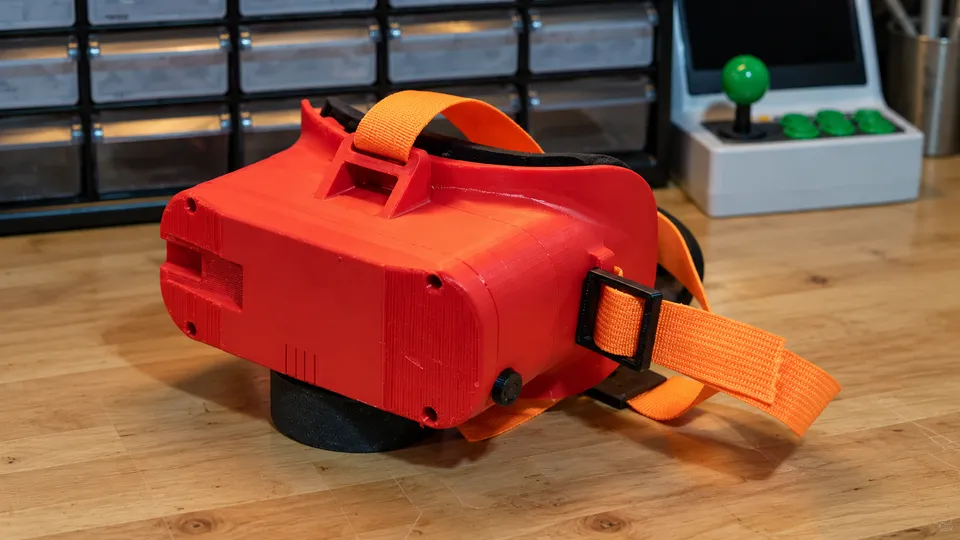
Before he knew that, though, Stevens found a video by the YouTuber CNCDan on building a headset for $150, and he already had the soldering skills from years of taking apart and fixing pinball machines. The software side was mostly ready-made. The usual starting point is Relativty, an open-source project begun in the late 2010s by Jonas Ceccon, Gabriel Combe and Maxime Coutté. Its repository bills it as a SteamVR-compatible headset “for $200” and describes itself as fully open source, from the hardware through the firmware. Other options exist, including OpenVR Arduino HMD, Project North Star and SlimeVR for full-body tracking. Stevens went with Relativty’s software and CNCDan’s 3D-printed shell.
The bill
The parts list goes like this. Two 2.9-inch LCDs with a controller cost about $125. Each panel is 1440×1440, with 150 nits of brightness and a 600:1 contrast ratio. Those are mediocre numbers, but this is a screen that sits a few inches from your eyes, so its poor viewing angles never come into play. Next comes a GY-91 sensor board with an accelerometer, gyroscope, magnetometer and barometer, for about $5, and then an Arduino Pro Micro to tie it together, for $5 or less. On top of that you need two 34 mm lenses, assorted hardware, a nylon strap and a face pad from an HTC Vive, since nobody wants raw 3D-printed plastic edges against their face. You also need a 3D printer, or a mail-order service such as Formlabs.
His total came to just under $180. The three named components account for about $135, so the lenses, strap, pad and screws make up the remaining $40-odd. That is $30 over the video’s headline price and still $20 under Relativty’s. Sure, but none of those figures counts the hours, and the hours are where the price really sits.
The fake part
Flashing the firmware is supposed to be the easy part. You install the Arduino IDE, download the FastIMU project, plug in and compile. Stevens’s build failed over and over with the error “e:-1.” Eventually he worked out that the GY-91 he’d paid for, sold with a 9250 IMU and reporting itself as one, actually carried a cheaper 6500, a chip that has no magnetometer. He calls this “disconcertingly commonplace.” The two chips are compatible and mostly behave the same, but without the magnetometer, he writes, tracking gets substantially worse.
This is the part I like most, because it shows what the fee in a finished product really buys. When you buy a $5 board from an anonymous seller, a big share of your purchase is the risk that the board isn’t what it says it is. A headset maker has a supply chain and a returns department to absorb that risk. A hobbyist has a forum thread. Once Stevens changed his code to target the chip he actually had, everything flashed on the first try.
The expensive mistake
Assembly was worse. CNCDan’s design allows you to adjust interpupillary distance, which means many printed parts, threaded inserts melted into place, rods and screws, and two eye boxes that each hold a lens and a display. The instructions say to clip the displays in. Stevens did that, and the light pressure broke both of them, with no visible damage until he switched them on. Those displays were most of the budget. His advice is to print the boxes without the clips, or snap the clips off, and hold the panels in place with thin strips of painter’s tape. His did.
Then he screwed everything together, put on the pad and strap, and spent around five minutes trying to make it comfortable. In his words, “I never quite succeeded.”
Anyway, his conclusion is that this is “decidedly niche,” which seems fair. The big companies decided there wasn’t enough money in selling VR headsets. The hobbyists have shown you can make one for $180, provided you treat your weekends, your patience and the occasional pair of shattered LCDs as free.