
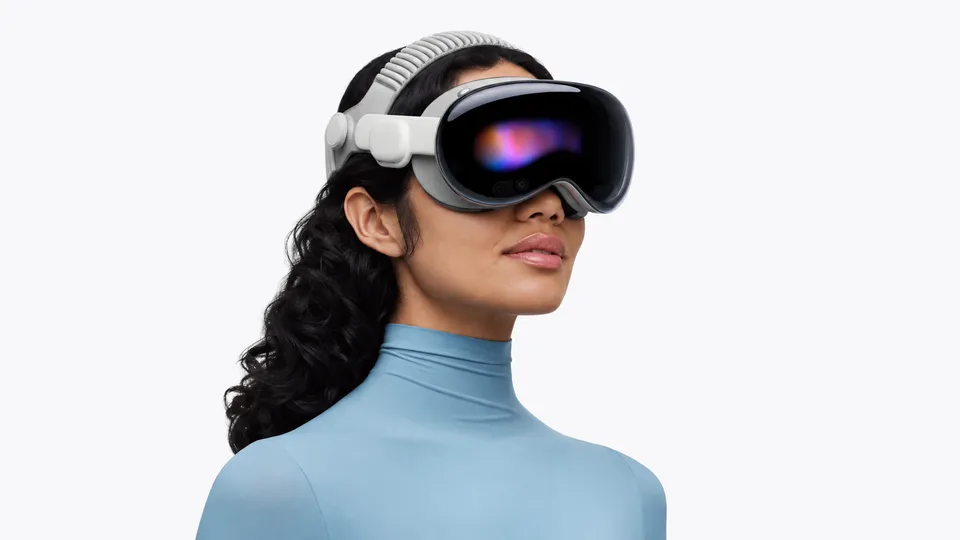
Twelve cameras, five sensors, six microphones. That is the load the current Vision Pro carries on its wearer’s face, its R1 chip processing the flood from all of them in real time — before anyone counts the M5, with its 10-core CPU, 10-core GPU, 16 gigabytes of unified memory and 153 gigabytes per second of memory bandwidth, or the high-resolution micro-OLED displays the whole apparatus exists to feed. The result, worn on a head, has drawn one consistent criticism since launch: weight, and the battery constraints that come with it.
It is that weight Apple’s next headset project is reportedly organized around solving. The project, codenamed N224, exists inside the company as an exploration rather than a program — Apple has said nothing publicly about it — and according to Bloomberg’s reporting, relayed by 9to5Mac, engineers are evaluating roughly four design concepts rather than pursuing one settled direction. Bloomberg characterizes the effort as potentially “on life support”: it could change direction or disappear entirely.
Four concepts, one face
One path keeps the familiar egg-shaped visor and tries to trim mass through materials — plastic, titanium, other metals. The other major concept splits the machine in two, offloading both the computing hardware and the battery into an external puck tethered to the headset, an arrangement that resembles what Meta recently unveiled with its own VR glasses. The appeal is plain: less mass, and less heat, pressing against a face. But some Apple executives reportedly favor staying closer to an all-in-one design, and that internal disagreement means no concept has yet cleared the company’s bar.
Why the grams are stubborn
The engineering is unforgiving in both directions. A puck reduces facial mass but introduces cables or wireless links, and hands the customer yet another accessory to carry. An all-in-one preserves simplicity, but lightening it demands real advances in chip efficiency, thermal management, or materials science before the scale moves noticeably. These are the implications of the reported designs, not confirmed N224 specifications; nothing about the project’s internals has been made public.
N224 is also not Apple’s first attempt at this problem. The company reportedly shelved an earlier project called N100 — commonly described as a possible “Vision Air” — which targeted a lighter, less expensive device in the Vision Pro mold. N224 is not clearly framed as a budget replacement, and no price or pricing strategy has been confirmed. The Vision hardware roadmap is better read as fluid than as a schedule.
If N224 ever reaches store shelves, Bloomberg’s reporting suggests the earliest window is late 2028 to early 2029 — not a release date, but the soonest point current development could allow. Until then the confirmed M5 model, twelve cameras and five sensors and six microphones and all, remains the only Vision Pro money can buy, and its successor remains a set of sketches, one of which moves the machine off the face and into a puck the size of nothing yet decided.