
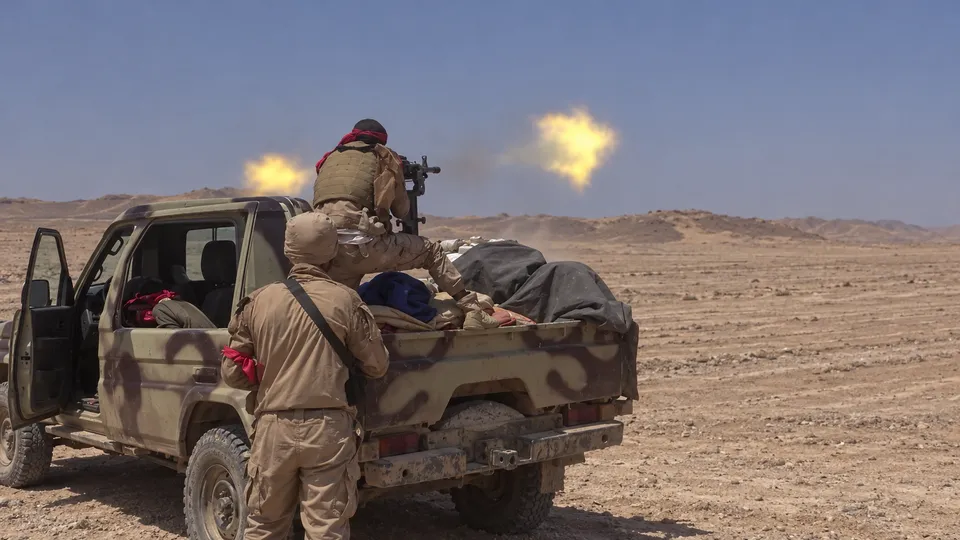
Al-Hazm, the capital of Yemen’s al-Jawf governorate, has been under Houthi control since 1 March 2020, when the group stormed the city from several directions and routed the forces defending it. By late April of that year the Houthis held 11 of the province’s 12 districts and roughly 95% of its territory, according to the research group the Sana’a Center for Strategic Studies, whose executive director Majed al-Madhaji called the capture a turning point that let the Houthis threaten to encircle the government’s last northern stronghold, Marib. On Saturday, Yemen’s internationally recognised government said its forces had taken back some ground east of that city — not al-Hazm itself, which has now been outside government hands for five years and eight months.
The army’s media centre posted on X that the 1st Emergency Brigade had seized weapons and ammunition depots east of al-Hazm after killing, wounding and capturing Houthi fighters and destroying armoured vehicles, as Al Jazeera reported. The post gave no casualty count. The Houthis, for their part, said they had thwarted the government’s advances in both al-Jawf and neighbouring Marib — a direct contradiction that neither side’s account lets an outsider resolve, since there is no independent monitor verifying positions on either front.
A national tally, bundled
The same reporting period produced a second, more granular claim from the Yemeni military’s own channels: 1,119 strikes against Houthi targets since Friday, with 427 fighters “neutralised” and 142 vehicles or other assets destroyed or disabled, as Eurasia Review reported, citing the spokesman for the “Dawn of Yemen” campaign. “Neutralised” is doing the same work that “killed, wounded and captured” did in the al-Jawf-specific post: it is one number standing in for three different outcomes, none broken out.
That tally is worth lining up against the government’s own numbers from three weeks earlier. On 10 October the government said it had carried out more than 2,750 strikes in the preceding 24 hours and neutralised more than 1,400 fighters, a scale reported at the time. Saturday’s figures cover roughly two days, Friday to Saturday, so the daily rate works out to about 560 strikes and 214 neutralised fighters — a fall of roughly four-fifths in the self-reported strike rate and six-sevenths in the neutralised-fighter rate since the campaign’s second week. These are the government’s own unverified figures on both dates, not an outside count, and they should be read as a measure of what the government wants reported, not of what happened. But a claimant’s own numbers declining by that much, three weeks apart, in a campaign it is still publicly committed to, is itself informative.

What the UN’s numbers show
The World Health Organization’s own situation reports show a similar deceleration, for what is presumably a more neutral count. Its seventh report, covering 6 August to 11 October, found 1,282 people killed and 5,891 injured, and broke out the period of 3–11 October separately: 2,007 additional casualties, a daily average of about 223 people killed or wounded, nearly double the 114 a day recorded in the period before it, as Türkiye Today reported. By its most recent report, issued 28 October, the daily rate had fallen to 93 over 20–25 October, against 168 a day in the report before that — roughly half, as Middle East Monitor reported. Total casualties since 6 August had reached 9,072, of which 1,677 were deaths, as of 25 October.
The surge in early October lines up with the start of the Dawn of Yemen offensive, launched on 4–5 October when Rashad al-Alimi, chair of the Presidential Leadership Council, announced a campaign to “restore state institutions, liberate the capital, Sana’a, and end the coup” the Houthis began when they took the city in 2014. The trigger was the Houthis’ seizure of Al Turbah, south of Taiz, cutting the only road linking Taiz to government-held Aden. The offensive drew in outside firepower: the Saudi-led coalition said 100 fighter jets had taken part, its first acknowledged resumption of air strikes since a 2022 truce; a US official told Al Jazeera that roughly 200 US advisers were stationed in Saudi Arabia in support; Pakistan and Turkey agreed to send troops to the kingdom; and the UAE said it would rejoin the war by funding some government units. Against that scale of backing, Al Jazeera’s news-analysis desk assessed early in the campaign that “it is a lofty ambition, and the achievements so far have been modest — most notably a limited advance into areas near Bab al-Mandeb.” Four weeks on, a brigade seizing depots east of a city the government has not held since 2020 is consistent with that assessment of modest, not sweeping, progress.
A rival account from the same day
A pro-Houthi Yemeni outlet, Al-Khabar Al-Yemeni, published its own account of fighting in the same general area on the same day: it said Saudi-backed Emergency Forces had launched a broad attack on positions held by Sana’a-aligned forces on the Huwaishian front east of al-Jawf, and that the attack had been repelled with “dozens of dead and wounded” and dozens of damaged or burned vehicles on the government side. The report named the 1st Emergency Division’s chief of staff, Ahmed al-Naw’ah, as wounded by mortar shrapnel, and the Emergency Forces’ Fifth Brigade commander as critically wounded, alongside several named tribal fighters killed or wounded. It mentioned no Sana’a-forces casualties at all. Read next to the government’s own claim of seized depots and captured fighters, the two accounts describe the same stretch of desert, on the same day, in opposite terms — a pattern that has held through most of this war and makes neither claim verifiable without a source that isn’t a combatant.
The siege that isn’t slowing
The clearest number in this war is the one measuring who is fleeing it. Nearly 260,000 people had been displaced since the start of August, the UN said in late October; by 28 October the figure had risen to more than 281,000, with more than half sheltering in Taiz governorate alone, according to the UN’s daily briefing. Three-quarters of those displaced are in places short of shelter, water and sanitation; more than 35,000 families still lack shelter assistance and more than 230,000 people need emergency water and sanitation support, the same briefing said. The World Food Programme has said more than 800,000 people in Taiz city are cut off from aid by the Houthi siege that began in early October, three-quarters of them dependent on humanitarian assistance, at least 200,000 of them women and children; UN screenings found more than 52,000 children in Taiz with acute malnutrition, including roughly 11,500 with the severe form, as Al Jazeera reported. The European Commission has pledged an additional €22.5 million ($25.2m) on top of the €87.5 million ($97.9m) it had already committed to Yemen for 2026 — about €110 million in total, against a WHO appeal for just $31 million to keep essential health services running nationwide, of which donors had so far provided $2.1 million.
| Deaths (people) | Total casualties (people) | |
|---|---|---|
| Marib | 45 | 143 |
| Taiz | 34 | 237 |
| Lahj | 21 | 158 |
The governorate breakdown in WHO’s latest window shows why Marib, the province directly south of al-Jawf, deserves as much attention as Taiz. Marib recorded 143 casualties in the six days to 25 October but 45 deaths among them — a 31% death share. Taiz recorded more casualties, 237, but a lower death share, 14%. Lahj, 158 casualties, 13% deaths. Only six of Marib’s 31 hospitals were still operating, WHO said. Al-Jawf’s fighting does not happen in isolation from Marib’s: both provinces sit on the same Houthi defensive line that has held, with only cosmetic movement at its edges, since 2020.
Four weeks into Dawn of Yemen, the two numbers that move independently of either side’s press office — the WHO’s casualty rate and the UN’s displacement count — are telling different stories. The casualty rate is falling. The displacement count keeps climbing. Whether that means the fighting is settling into the kind of grinding stalemate al-Jawf has seen since 2020, or just a lull before the next push on al-Hazm itself, is the number to watch over the next situation report.