
Palestinian refugees in Lebanon’s camps have lost school days, clinic hours and classrooms this year as UNRWA, the UN agency for Palestinian refugees, cuts services to cope with a budget gap it hasn’t been able to close.
Fadi al-Tayyar, a spokesman for UNRWA, said in October that the agency needed about $70 million to $80 million more for 2026 and had cut service hours by 20 percent since February, Justin Salhani reported for Al Jazeera on Friday. Many UNRWA schools in Lebanon, which teach more than 35,000 pupils in 58 buildings, went to a four-day week for the 2026-27 school year. Only 15 of the agency’s 26 primary health centers and clinics were operating, according to its June emergency report.
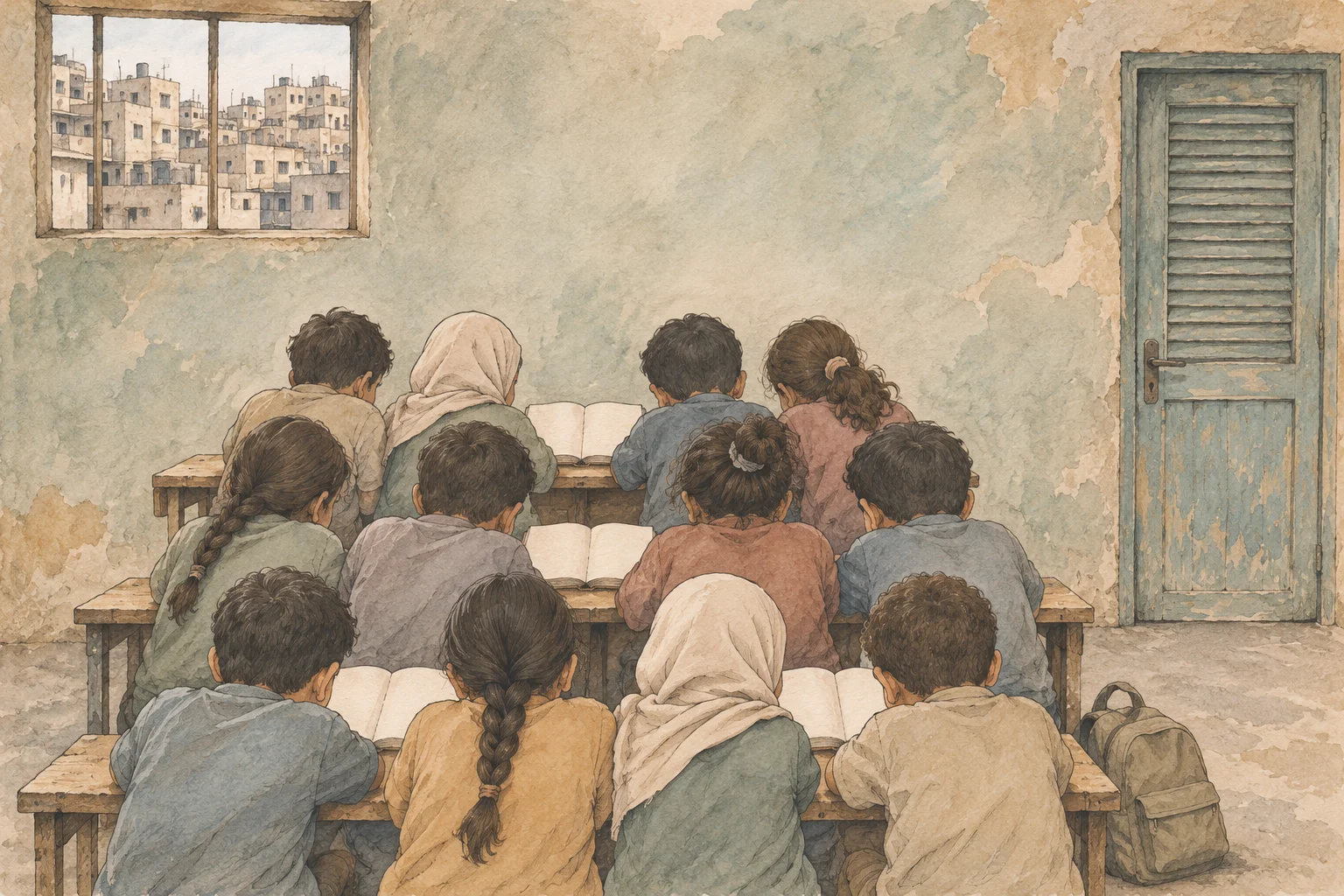
Doumoua al-Baitan, a divorced mother of four, was born and raised in Bourj el-Barajneh, a refugee camp in Beirut. Residents there said most of the camp’s schools have closed, and classes often hold 40 students or more. “My kids cannot retain what they are taught in class,” Ms. al-Baitan said, blaming the crowding. She now pays $200 a month, as much as her rent, for after-school lessons for two of her children.
The money problem goes back to the Trump administration’s decision in February 2025 to keep a freeze on U.S. funding that had been imposed the year before. The agency received $829 million in 2025, barely a quarter of what it assessed it needed, and faces a $100 million cash-flow deficit for 2026, Truthout reported in September.
UNRWA has worked in Lebanon since 1950. The country has 12 Palestinian camps and about 230,000 Palestinians, descendants of the 750,000 people displaced in the 1948 Nakba. Most are effectively stateless and are barred from professions including medicine, law, engineering and pharmacy.
Some have even less. Between 3,000 and 5,000 Palestinian refugees in Lebanon are undocumented, and about 19,000 are Palestinians who came from Syria. A Lebanese policy adopted in May 2024 stopped residency renewals for many in that group, leaving them open to detention and making it harder to work or register.
The Jafra Foundation, which tracks conditions in the camps, said in its monthly report that the shortfall “threatens the education, healthcare, water, and sanitation services provided by UNRWA.” Its October report said a recent UNRWA flour handout “has sparked widespread dissatisfaction.” Refugees said one 5-kilogram bag per family came nowhere near what a household needs.

Fadi Abu Halawa, a security officer, described “a very tired economic situation and there is no work.” He said crime and drug dealing were rising. “Of course, all of this is 100 percent due to the economy,” he said.
Ali Huwaidi, a researcher, told Truthout that poverty among Palestinian refugees in Lebanon had reached an estimated 80 percent and real unemployment 45 percent. He said both got worse after Israeli attacks on Lebanon in 2025 and 2026, and funding didn’t rise to match.
Five of the camps are in southern Lebanon, where the war has also hit farmland. In February, Israeli attacks killed 12 people across the country, two of them in Ein el-Hilweh in Sidon, the largest camp. Three months before that, Israeli attacks there killed at least 13 people, including 11 children playing football, Al Jazeera reported. Jafra said families feared the escalation could bring “a new wave of displacement of refugee families.”
Refugees have answered the cuts, the lack of work and the poor services with sit-ins. The anger isn’t limited to Lebanon, where the UN has also halved food aid in the West Bank. On Nov. 7, Arab News reported protests against service cuts in West Bank camps, where a Palestinian official said diplomats would press donors to cover a gap of about $70 million in UNRWA’s budget.
Residents of Shatila camp in Beirut planned their own sit-in for Friday.