
For three years now, Israel has been waging war on Lebanon. It has occupied large parts of the south and destroyed homes and infrastructure there — a campaign some experts describe as a deliberate effort to make the land uninhabitable. As Justin Salhani reported for Al Jazeera, the war has also gone after something older and quieter than any militia: the country’s wheat crop, and the farmers whose lives are bound to it.
The numbers in the fields
Al Jazeera’s report cites a study of the destruction, and its figures are the kind that erase rather than describe. In the border town of Bint Jbeil, 100 percent of the cropland was destroyed. In the Baalbeck district to the east, the figure was approximately 32 percent. A field is not a front line; it cannot surrender, cannot retreat, cannot be evacuated. It can only burn, or be bulldozed, and wait.
The ruin came in two waves. First the economic crisis, then three years of war — and the farmland of the south, largely unindustrialised, worked by hands rather than machines, had little defence against either. One of the experts quoted in the report, Ghadban, pointed to the rising cost of living and salaries that have failed to keep pace: “The expenditure on basic needs went up.” Experts warn that the destruction may prevent many farmers from rebuilding their livelihoods even after the fighting ends — that the war will outlast the war.
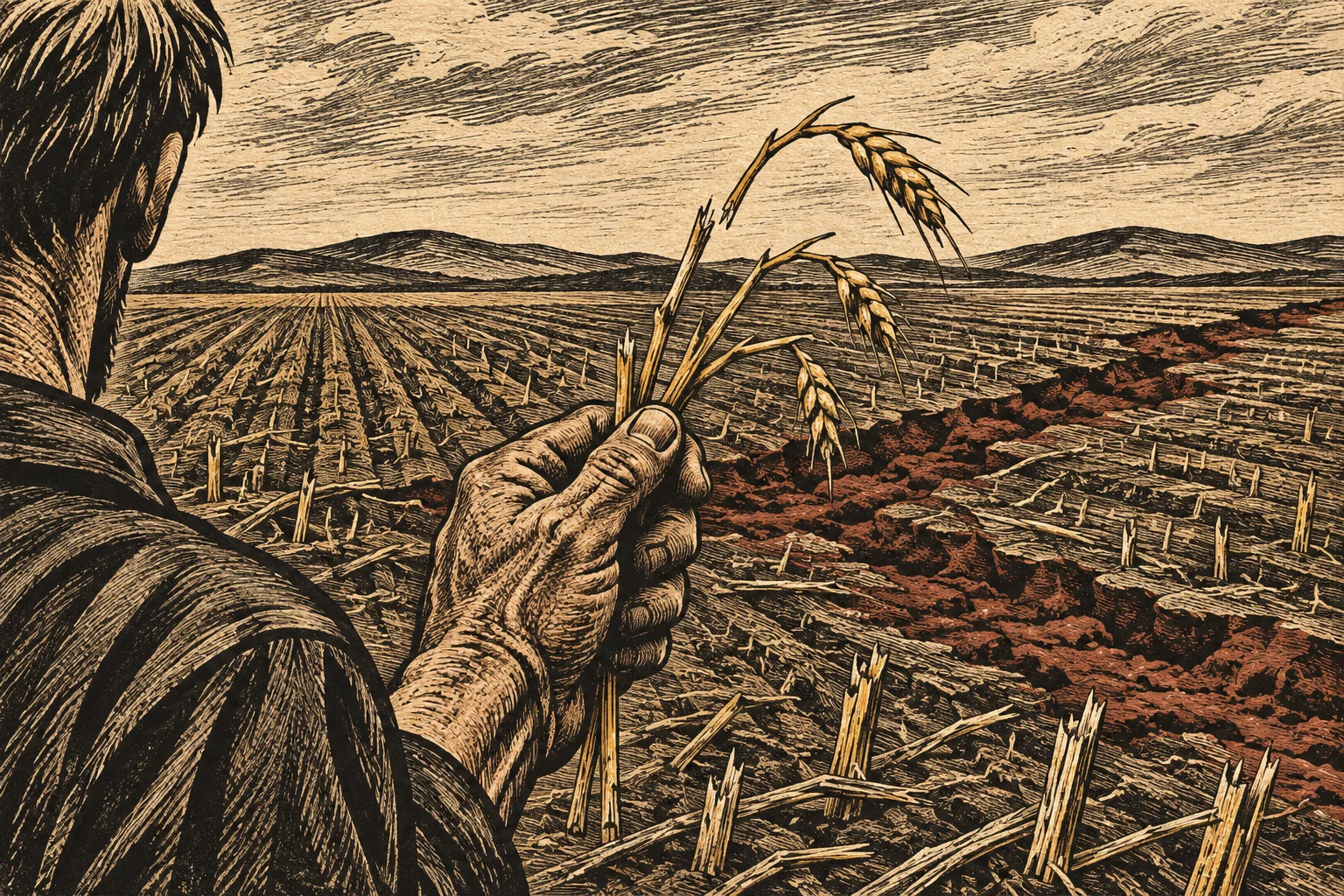
Lebanon’s agriculture ministry has put its own figure on the damage. In an interview with the Anadolu Agency, the minister, identified as Hani, said 22.5 percent of the country’s agricultural land had been damaged by the war. Earlier assessments by the UN World Food Programme and the Food and Agriculture Organization, made with the ministry, warned that between April and July 2026 around 1.2 million people in Lebanon could struggle to secure adequate food and would require support. “Despite the war and losses,” Hani said, “the agricultural season continued.”
It is the oldest arithmetic of siege and conquest: armies pass through, but what they trample is bread. Empires have always known that a people can be conquered in its stomach long after it has survived in its streets. The wheat of the south does not care whose flag flies over the hill; it asks only for a season. A season is precisely what war denies.