
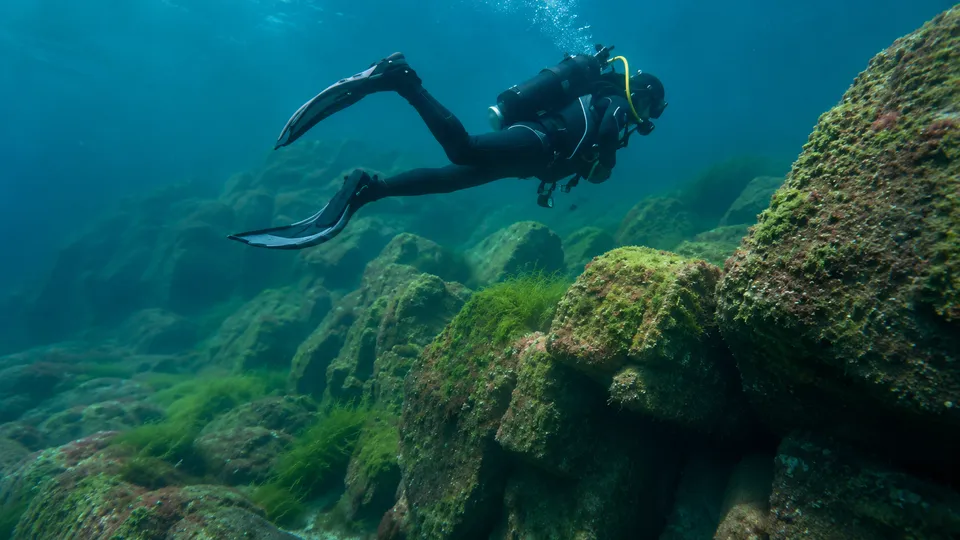
In early November a group of divers from the Bolivian Navy’s Sport Diving Club went down into Lake Titicaca off the Island of the Sun, Isla del Sol, and came across stones that made them pause. Some sat in rows like steps. Others stood together like the remains of an old wall. As Oguz Buyukyildirim reported for Arkeonews, the divers placed the dive in the first week of the month, though some Bolivian accounts, among them Infobae’s, put it a week later. The news first ran in the Bolivian press on November 12, in La Razón and Opinión.
A navy in a country with no coastline, diving in a lake that sits high in the Andes. There is something fitting about it. Here, in Bolivia, the water has always been asked to stand in for other things.
What the commander would not say
Captain Max Álvaro Villarroel Muñoz commands the navy’s High Altitude Diving Training Center, known by its Spanish initials CIBA. Speaking to ABI, the Bolivian state news agency, he was careful. Lake Titicaca is full of rock formations, he said, and only scientific study can show whether any of them are archaeological remains. Yes, what the divers saw looked like a staircase or an old wall. But he would not say whether people had built it or whether nature had simply lined the rocks up. That call, in his view, belongs to archaeologists.
He added that formations like these have turned up in other parts of the lake, and that experts have already looked at some of them. Nobody has dated the new find. Nobody has yet carried out a detailed archaeological survey of the spot.
So what exists so far is a shape and a resemblance, with a cautious officer standing between them and a headline. It is the same unanswered question that hangs over the drowned stones off Murujuga on the far side of the Pacific.
Gold for the lake
The resemblance draws attention because Titicaca has already given up so much. Bolivian and foreign teams began a systematic survey in 2012 and have made more than 1,350 dives since. UNESCO figures put the result at about 20 underwater archaeological sites and more than 20,000 objects, from the Tiwanaku era through to the Inca Empire.
The richest of these sites is the Khoa Reef, also near the Island of the Sun. People of the Tiwanaku state dropped offerings there during religious ceremonies: gold ornaments, ceramic incense burners, objects made of seashell, and the bones of young llamas killed in sacrifice. In a 2019 paper in PNAS, Christophe Delaere, José M. Capriles and Charles Stanish described the first systematic excavation below the reef floor. The incense burners were shaped like felines. The authors argued that these rituals, repeated in cycles at fixed points in the lake between the eighth and tenth centuries, helped the Tiwanaku state consolidate its political and religious authority. That state flourished around the lake between AD 500 and 1100.
The ceremonies seem to have been carried out from the water. When the study was published, Capriles noted according to Phys.org:
The presence of anchors near the offerings suggests that officiating authorities may have deposited the offerings during rituals held from boats.
One may reflect, without claiming to know more than the excavators, that rulers worked out early how useful it is to give generously to something nobody else can reach. The people standing on shore saw the gold go into the water. They never saw it again. In this reading, the authority came from watching it disappear.
A box with its lid on
The Inca continued the practice. In 2014, at the K’akaya Reef, archaeologists found a small stone box about six meters down, its lid still in place. Inside were a miniature llama or alpaca carved from seashell and a thin sheet of gold, rolled up. Delaere and Capriles analysed the box and where it lay in a 2020 study in Antiquity, concluding that the lake stayed sacred under the Inca and that the custom of giving to the water outlived Tiwanaku. Similar boxes and figurines have been found at other Inca ceremonial sites across the Andes.
Empires rose and fell, and the habit of feeding the lake carried on through all of it. None of this, however, connects the new stones to those ceremonies. No archaeological link has been established.
Older than the empires
People were on the island long before either state existed. In a study published in Latin American Antiquity in March 2026, Stanish and Brian Damiata pushed human activity there back to at least 3500 BC, more than 700 years earlier than the previous evidence. They did it by re-examining charcoal collected in the 1990s at Ch’uxuqullu, a hillside site above Challa Bay. Its layers held stone tools and obsidian fragments and recorded activity from about 3500 to 160 BC.
The lake stood much lower thousands of years ago. Even so, the researchers concluded that for most, if not all, of the last 5,000 years the Island of the Sun could only be reached by boat. That means people in the region were building craft able to make the crossing far earlier than archaeologists had assumed. The obsidian supports this. The volcanic glass does not occur on the island, and some of it came from as far away as the Chivay region, which suggests Titicaca was part of a wider exchange network thousands of years before the Inca.
For five thousand years people have rowed out to this island, carrying stone from distant volcanoes, gold for the gods and young llamas for sacrifice. Now there are steps, or what look like steps, a few meters under the surface nearby. Until someone goes down with a measuring tape and a trowel, the lake will not say whether hands laid them or the water did.