
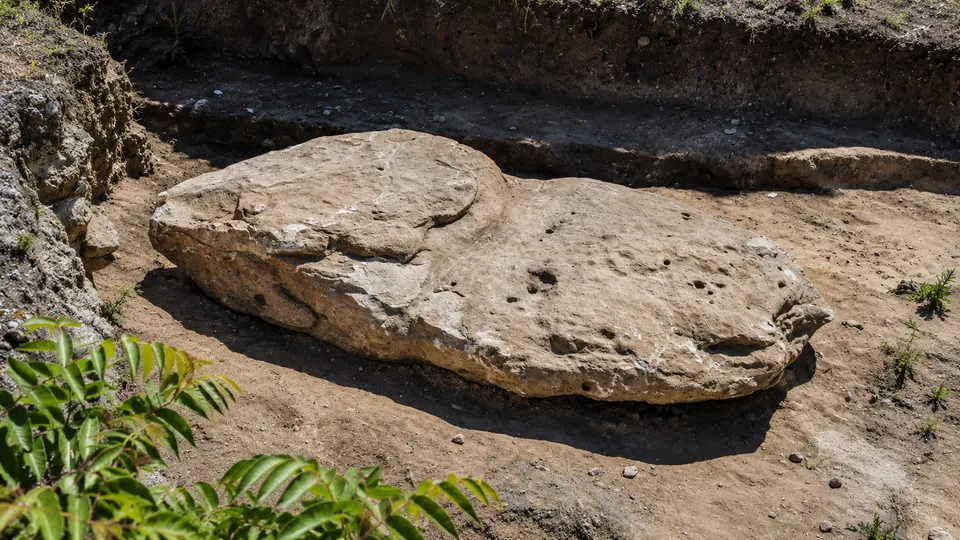
The usual way a Neolithic cemetery gets found in France goes like this. Somebody wants to put up a building. Before they can, the state’s regional archaeology service tells them that archaeologists have to look at the ground first. So archaeologists from Inrap, France’s National Institute for Preventive Archaeological Research, show up and dig. Most of the time they find something modest. Sometimes they find a 9.7-tonne stone carved to look like a person.
That second case is what happened at Champigny-sur-Marne, just outside Paris. Inrap announced the find on 2 November and Arkeonews wrote it up. The site was a planned property development, and under it was a funerary complex dated to between 4750 and 4300 BCE. It has 11 graves and 30 megalithic stone blocks, plus wooden structures, a mound with nobody buried in it, and evidence that the builders were mixing their own cement. In Île-de-France, burials from this period usually turn up one at a time, so a whole organised cemetery is unusual.
On the age: Arkeonews rounds it to 6,500 years, and the Italian outlet Stile Arte went with 6,700. Both are fair readings of Inrap’s range. Counting back from 2026, 4750 to 4300 BCE works out to roughly 6,325 to 6,775 years ago. It’s a 450-year window, and nothing reported so far says the cemetery was in use for all of it.
The stone
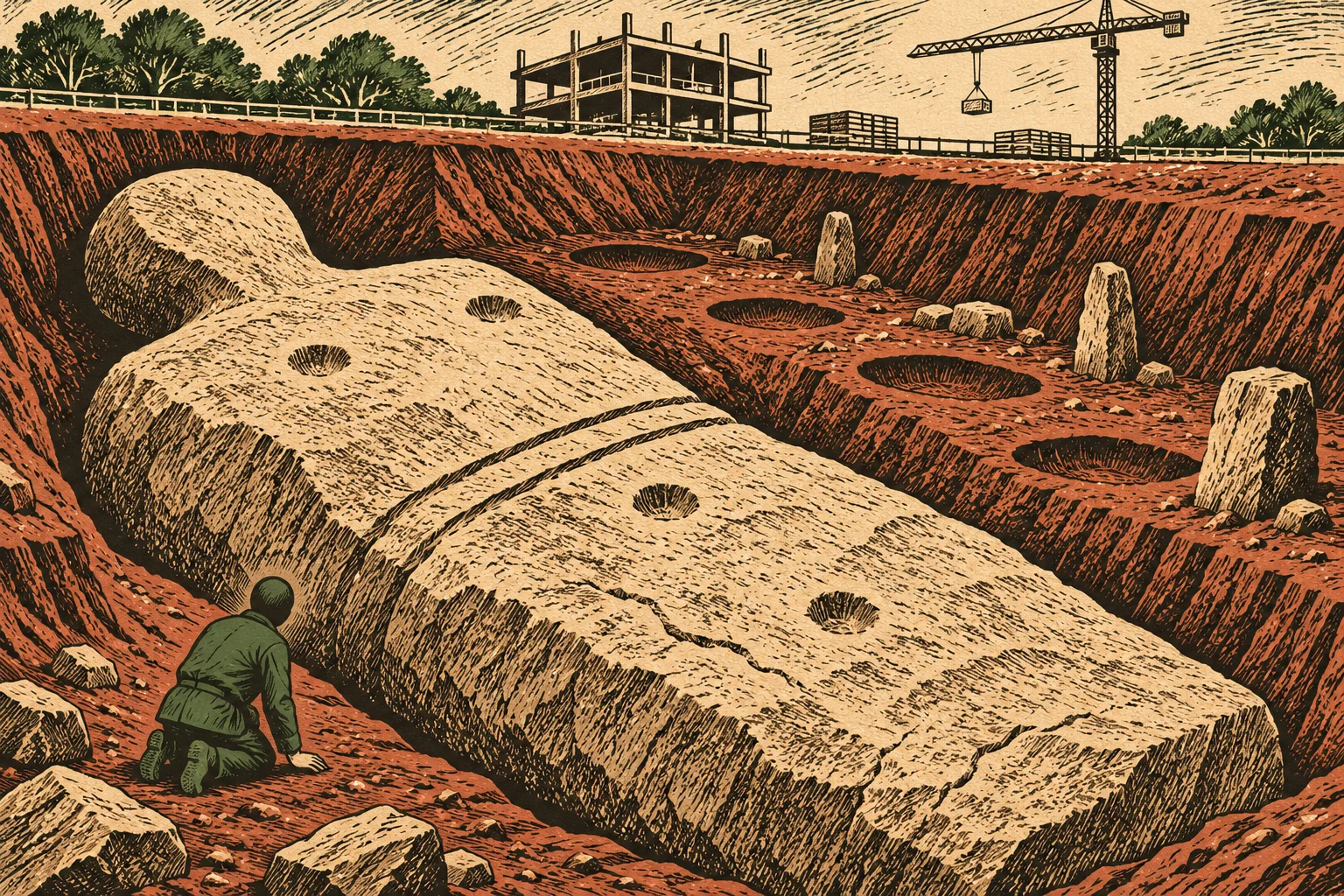
The headline object is a statue-menhir, meaning a standing stone shaped or carved to suggest a human figure. This one is 3.04 metres long, 1.68 metres wide and 0.74 metres thick, and Inrap estimates its weight at 9.7 tonnes. Multiply the dimensions and you get about 3.8 cubic metres. Divide 9.7 tonnes by that and you get roughly 2.6 tonnes per cubic metre, which is about what solid rock weighs. So the estimate holds up. The carving includes a belt and a set of cupules, small round hollows cut deliberately into the surface. There may also be traces of black and white pigment, so the figure may once have been painted.
It was lying flat in its setting pit, the hole dug to stand it upright. Inrap reads that as a snapshot of the stone being abandoned after it fell. Nobody knows why it fell. Close by were two smaller sandstone blocks. One looks like a small stele, and the other may have marked out the burial area.
Statue-menhirs are rare in the Paris region. When Inrap found one at Chamigny in Seine-et-Marne, a different town with an annoyingly similar name, it called the find an exceptional megalithic discovery. That one was dated to the late fourth or early third millennium BCE. The Champigny stone is older by something like a thousand years or more.
The graves
The cemetery sits on top of a terrace of sediment laid down by the Marne. Eight graves are packed into about 60 square metres south of the mound, which works out to about 7.5 square metres each. The other three lie further north, around the statue-menhir and two more megalithic blocks. Modern construction has disturbed part of that northern area, so the original layout there is harder to read.
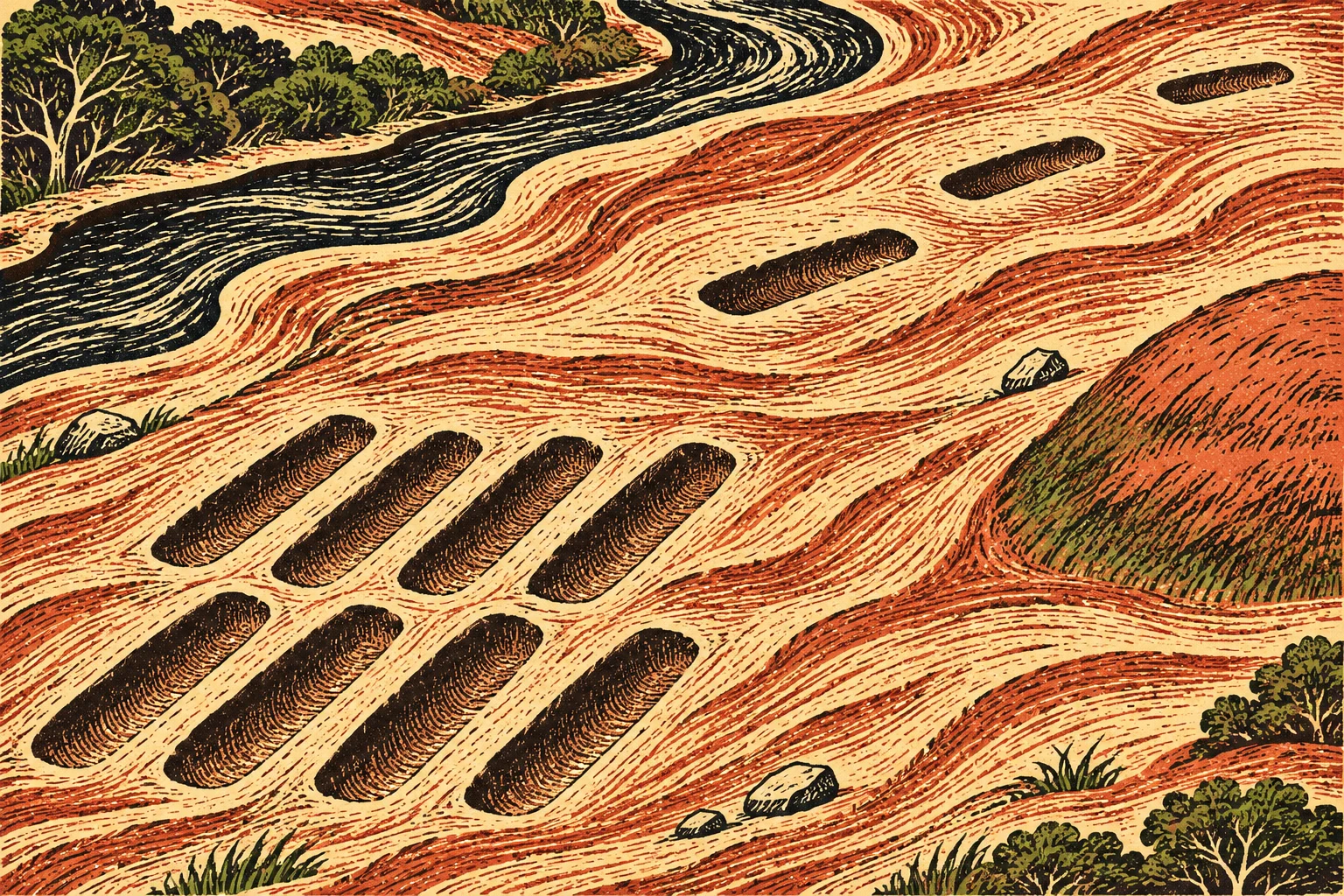
The first two graves came up in the preliminary investigation. Both were eroded, and both held women laid on their backs, aligned east to west. Full excavation found nine more burials, and seven of those nine were extended burials. Most of the dead had large pits. Postholes near the skulls suggest wooden markers once stood over the graves. Buried with them were stone blades, projectile points, other stone tools and a sandstone axe made from local stone. Two graves also had worked bone objects.
One burial doesn’t fit. In a narrow round pit that looks like a well, an adult was buried sitting up, with the lower legs and feet fully encased in calcite. Inrap has not worked out why this person was treated differently from everyone else.
The mound with nobody in it
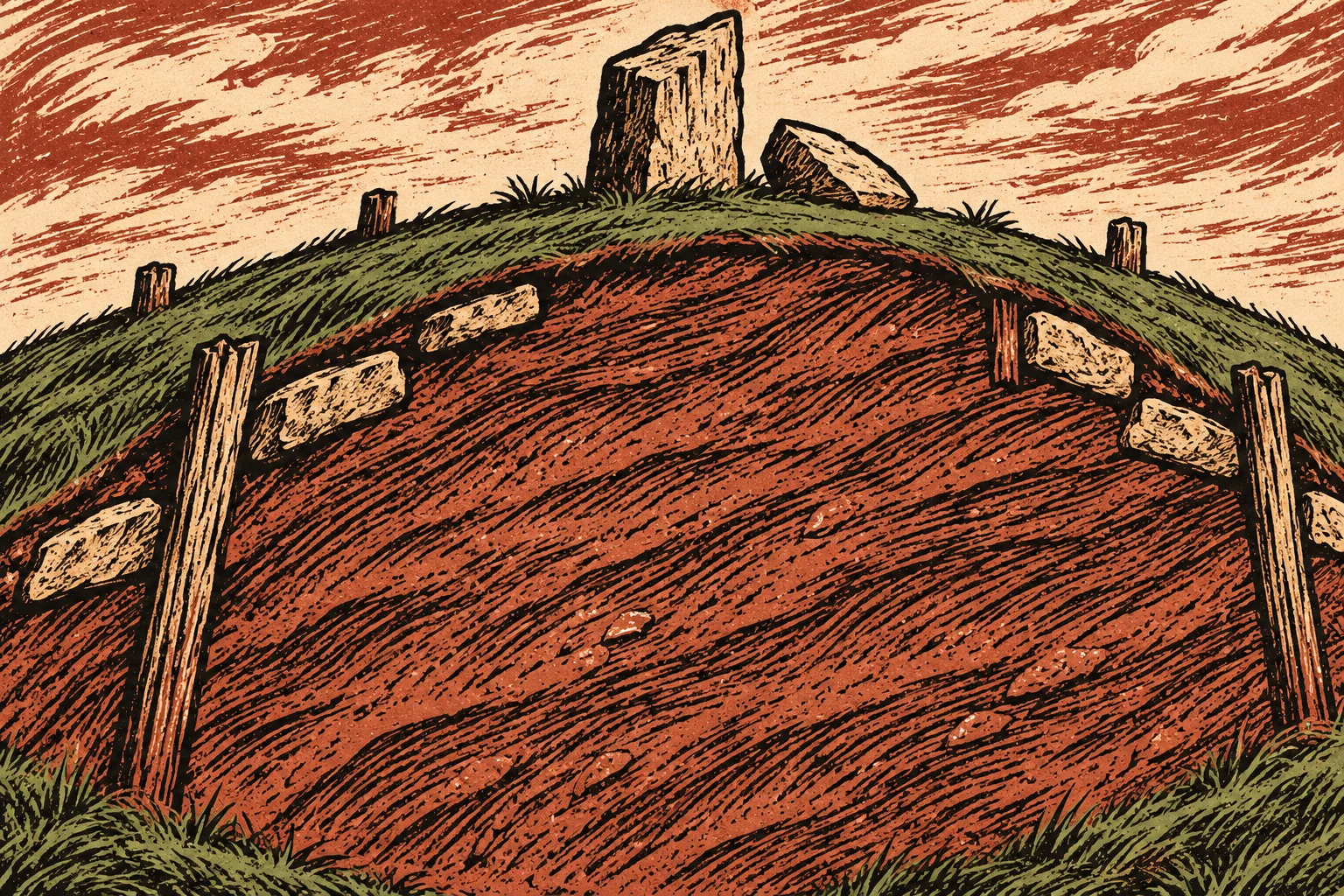
In the southeast corner of the dig is a dome of brown silt covering about 30 square metres. A small stele, now broken in two, stood above an elaborate arrangement of pits, palisaded ditches, stone blocks and wooden posts. It looks like a burial mound. A burial mound, though, has a grave under it, and this one doesn’t. One suggestion is that it was a landmark, something you could see from a distance. It sits close to the graves, so it was presumably part of the same complex. Beyond that, its purpose is unknown.
I like this a lot. Someone organised what had to be real labour (ditches, a palisade, posts, stone, a silt dome) to build something that looks like a tomb and isn’t one. Maybe it was a sign. Maybe it was a memorial. Maybe it was meant for someone who never ended up in it. The archaeologists aren’t saying, and I’m not going to guess on their behalf.
The cement
The most practical finding is about building materials. The builders took local sandy and silty sediments rich in carbonate, mixed them with gravel and water, and let the mixture dry into a hard material that worked as a primitive cement. It turns up along the edges of graves, in the pits holding the standing stones and other big blocks, and inside the silt dome. They also used less-processed materials (beige sand, brown silt, wood), and the way the prepared and natural materials are combined suggests someone decided which went where.
Carbonate-rich building materials have been found before at Neolithic and later prehistoric sites in Western Europe. Those finds were mostly in Mediterranean settlements and houses. Champigny shows the same technique being used for funerary monuments in the Paris region, which fits a broader idea that prehistoric graves were built as deliberately as anything else.
Next come ancient DNA and isotope analyses. They may establish the ages, sexes, health and diets of the people buried here, and where they came from and moved during their lives. That could tell us who they were. Middle Neolithic funerary sites are fairly rare in the region, so that matters.
After that, presumably, the building goes up. The site had stood for more than six thousand years before anyone in modern times knew it was there. A few months of digging is all it got before the property development.