
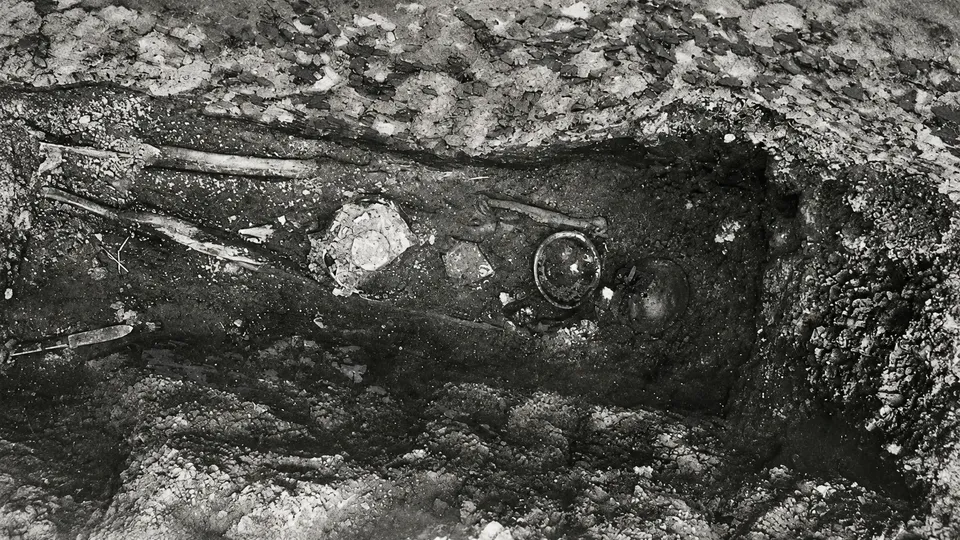
Some of the richest graves of Bronze Age Greece were composed like works of art, not simply stocked with treasure, a study published this year argues.
Writing in the Cambridge Archaeological Journal, the archaeologist Rachel Emma Phillips proposes what she calls an “artistic approach” to Early Mycenaean burial: reading the whole grave, the body, the objects, their colors and shine, and the viewpoint of the mourners standing above, as a single visual composition. Her case study is three intact burials from a tholos tomb at Dendra, in the southern Peloponnese, dated to about 1400 B.C.
The archaeologist Axel Persson uncovered the burials in 1926, after finding that the tomb’s main chamber had already been robbed. One body wore gold rosettes around the neck and gold spiral pendants around the torso. Another pit held two extended skeletons and hundreds of objects made from precious metals, glass and semi-precious stones. Before burial, the dead appear to have been washed, dressed and adorned. The pits were then closed beneath stone slabs.
That sequence matters, Ms. Phillips argues, because the objects had a direct physical relationship with the body. They covered it, followed its contours or occupied fixed positions around it. Once the tomb closed, flesh decayed while gold, bronze, glass and stone kept much of their form. The burial outlasted the body itself, becoming what she calls a “hybrid artwork” of corpse and durable materials.
The materials show a repeated interest in contrast, color and surface. A wooden box received bronze fittings that covered its plainer surfaces. Swords combined bronze blades with ivory or agate pommels, gold decoration and glass inlays. Two cups paired silver exteriors with gold interiors, and several rings layered iron, copper, lead and silver even though only the silver was visible on the finished piece. Value alone did not decide what went into the grave. Appearance did.
The clearest example is a set of glass ornaments found around the head of a burial presumed to be male. They appear to imitate a boar’s-tusk helmet, an object tied to Early Mycenaean warrior identity, but there were too few pieces to rebuild a whole helmet. The ornaments may have covered only the part visible from above, perhaps fixed to leather or textile. What mattered was not a working helmet but its recognizable image for the person looking down.
The same burial shows the body used almost as a canvas. Four swords lay with their hilts directly on the shoulders, their blades running alongside the arms, setting up a correspondence between shoulder and hilt, arm and bronze blade. As the body decomposed, the swords kept their shape and went on echoing limbs that no longer did.
Who was meant to see all this? The narrow pits meant that anyone standing at the edge viewed the arrangement mainly from above, and the study suggests the full image belonged to the few who entered the tomb and arranged it. They may have been close relatives or members of a small elite group, though the evidence cannot identify them with certainty.
Once the stone slabs went on, the composition disappeared from sight. That did not necessarily make it less important. The image could persist, the study argues, in the memories of the people who had created and seen it, long after they could no longer return to it.
Ms. Phillips does not claim the Mycenaeans understood these graves as art in the modern sense. Art, in her use, is a tool for examining composition, materials and viewing position. And three burials at one site cannot prove that every Early Mycenaean grave worked this way.