
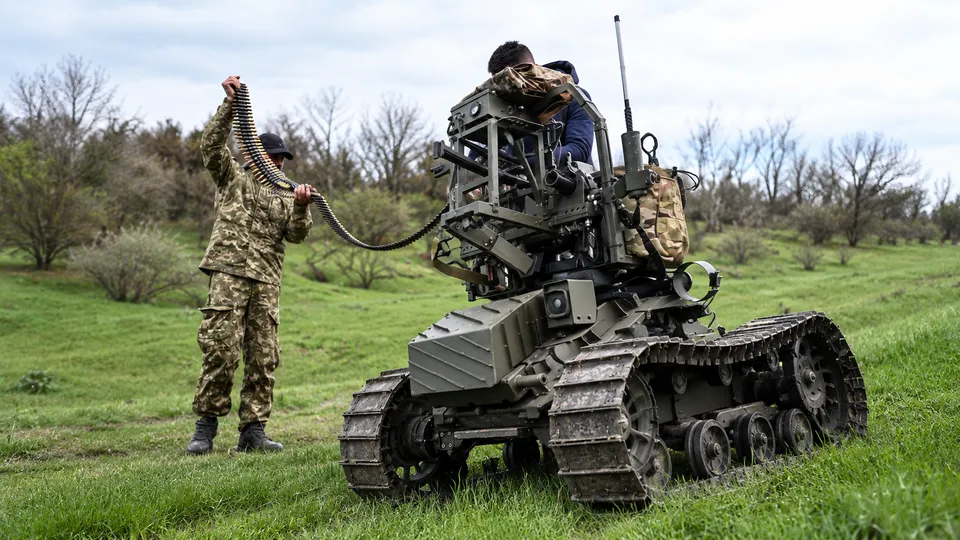
Here is one way to fight a war when you have fewer people than the other side: don’t send people. Ukraine’s Third Army Corps, in an operation it calls Vivaldi, has been flying unmanned ground vehicles behind Russian lines around Lyman in the northern Donetsk Oblast and having them attack Russian troops from behind, while its operators sit somewhere that is not being shot at. It appears to have worked startlingly well. Security experts told CNBC the offensive seems to have undone more than a year of Russian territorial gains in the area, a region Moscow’s forces have spent the past 12 months trying to encircle — the so-called fortress belt cities that make up the remaining Ukrainian-held territory in the Donbas.
The numbers as stated by Brigadier-General Andrii Biletskyi on Sept. 28: the operation’s third phase liberated another 51 square kilometers, bringing total territory retaken to 176 square kilometers, with more than 2,000 Russian losses inflicted and over 250 Russian soldiers taken prisoner in the latest phase. Those are Ukrainian figures about a Ukrainian operation, so apply the usual seasoning, but even the general shape is remarkable. Taking prisoners, in particular, implies Russians walking out of positions to surrender to machines, or to the people standing safely behind the machines.
Patrick Bolder, a defence expert at the Hague Center for Strategic Studies, called the offensive a “big bloody nose” for Vladimir Putin’s minimal war aim of seizing the Donbas, and described to CNBC how the pieces fit together: an ability to keep the planning secret, disinformation campaigns run against Russia, a months-long air operation disrupting logistical supplies to the frontline, and finally control of the air over Lyman sufficient to deny Russia the use of its own drones — freeing Ukraine to drop its ground robots behind enemy lines without risking personnel. “They put this together masterly,” Bolder said. For the Kremlin, he added, “gaining the Donbas is very far away at the moment because the Ukrainians have come into better defendable positions now.” Russia’s embassy in London was not available to comment.
The interesting question, I think, is what a robot is for, economically. A soldier is expensive in every currency a state has: training, pay, morale, and the enormous political cost of the coffin coming home. An unmanned ground vehicle is expensive only in money. Ukraine, outnumbered in manpower for four and a half years of full-scale war, has every incentive to make that substitution as aggressively as physics allows, and we’ve noted the mines-by-night, assaults-by-day division of labour its units have been building. Serhii Kuzan, chairman of the Ukrainian Security and Cooperation Center in Kyiv, told CNBC by email that where “dozens or hundreds of soldiers were required, remotely controlled platforms are increasingly being deployed,” reducing risk to personnel and changing “the very logic of combat.”
The experience of Operation ‘Vivaldi’ has demonstrated that the systematic replacement of human personnel with robots is changing the paradigm of modern warfare, enabling tasks to be carried out with minimal personnel losses. — Serhii Kuzan
Volodymyr Zelenskyy, who visited soldiers carrying out the counteroffensive, called ground robotic systems “one particularly promising area” in a Sept. 30 social media post and said the capability would be scaled up “so that, more and more often, a drone rather than a warrior carries out the most dangerous tasks at the front.” That is a heads of state announcing, as policy, that the marginal soldier should be a robot.
Not a breakthrough, but a message
Everyone quoted by CNBC is careful to say this is not a decisive breakthrough. It is, in David Kirichenko of the Henry Jackson Society’s phrasing, “a powerful message to Moscow and to Kyiv’s partners that the highly innovative Ukrainian military remains capable of defeating Russia on the battlefield.” Kuzan said the Lyman counteroffensive was aimed at seizing the initiative and ultimately forcing the Russian army to abandon the objectives set by its political leadership — which, per Ukrainian officials, had wanted the whole Donetsk region by the end of this year and is now said to be asking for an extension to March. The reason, according to Ukrainian intelligence cited by Kuzan: on the main thrust directions of Kostiantynivka, Sloviansk and Kramatorsk, the Russian army is suffering its heaviest losses, 70 to 80 per cent of all casualties.
Meanwhile the rest of the war goes on in its grim arithmetic. Russia has stepped up attacks on Kyiv and other major cities in recent days, hitting data centers, communications and energy infrastructure to cut information flows and power ahead of winter; Ukrainian officials say they urgently need faster responses to missile and drone threats, a problem compounded as Russia’s jet-powered drones outrun the interceptors. Ukraine, for its part, keeps raising the cost of the war by hitting Russian oil refineries and logistics hubs.
So the robots have not won anything decided, and 176 square kilometers is a patch of the Donbas, not the Donbas. But there is something clarifying about a battle in which one side’s attackers were dropped in by drone, controlled from a safe distance, and captured 250-odd human beings. The沉默 cost asymmetry of this war — Russia spending men, Ukraine spending machines — just got a very concrete demonstration. Russia can rebuild its machines too, of course. The uncomfortable part is that it has so far preferred not to need to.