
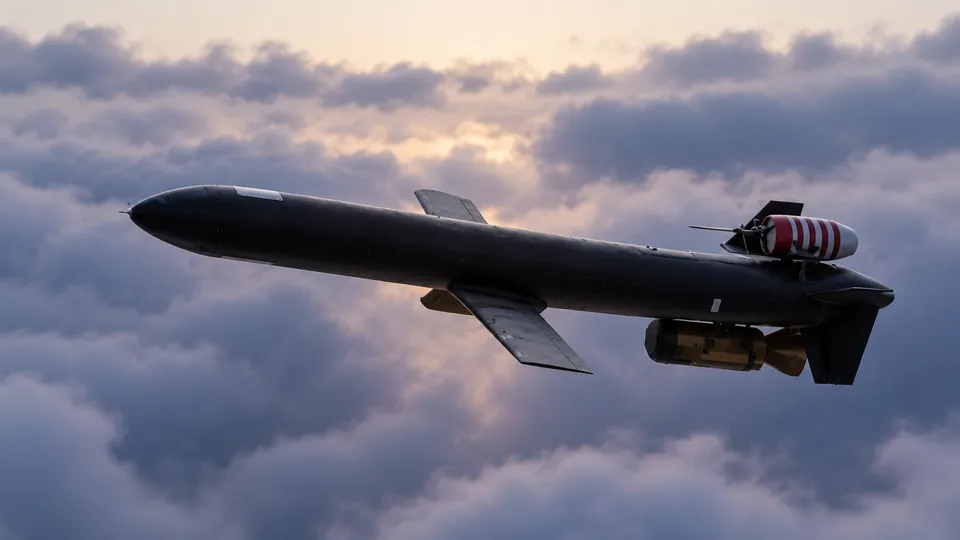
Since July, Russia has been battering Ukrainian cities with a new generation of jet-powered attack drones that fly at 600 kilometers an hour, a speed that has badly outrun the defenses that once worked against its slower models.
Hundreds of the turbojet Geran-4 and Geran-5 drones have hit Kyiv and other major cities even in broad daylight. They are a different class from the Shahed-136 drones Russia imported from Iran early in the war and the Geran-2s it built on their design. Those drones flew on piston engines at around 180 kilometers an hour, low enough and loud enough, with a sound like a motorcycle, that Ukrainian troops could shoot down more than 90 percent of them with vehicle-mounted machine guns, antiaircraft guns and short-range interceptor rockets.
That defender’s advantage flipped to the attacker’s when Russia began fielding the jet drones in large numbers in July. The Geran-5 is shaped like a missile rather than the older triangular design, flies at an altitude of six kilometers and carries a 90-kilogram bomb. Russia began developing turbojet-powered drones in May 2025.
The arithmetic is brutal. A drone moving at 600 kilometers an hour that is picked up five kilometers out leaves defenders 30 seconds to respond. Detected at a kilometer and a half, they have 12 seconds. The propeller-driven interceptor drones Ukraine has relied on can offset some of the speed gap by meeting a target head-on, but a fast drone can change course and attitude in moments, and it is almost invisible to the eye.
Such drones now arrive by the hundreds in a single wave, striking cities, military depots and infrastructure. Because there is little risk of being shot down, the strikes come in broad daylight, and surface-to-air missiles and fighter-launched missiles are effectively the only answers. Russia’s turbojet drone attacks grew from 350 in June to 2,800 in August, and daily life in the affected cities has come to a near standstill.
On Aug. 28, a Geran-4 detonated an ammunition depot in a village on the outskirts of Kyiv, setting off hours of secondary explosions. At least 38 people were killed, the deadliest attack in Ukraine this year, according to the South Korean newspaper Chosun Ilbo.
Serhii Beskrestnov, a defense technology adviser to President Volodymyr Zelenskyy, said Russia planned to produce 40,000 drones a year and that 60 percent of them would be jet-powered. Each costs about $80,000 and can reach targets 1,000 kilometers away, in effect a cheap cruise missile. The American Tomahawk and JASSM and the Anglo-French Storm Shadow cost $1 million to $2 million apiece. A Patriot PAC-3 missile able to hit the jet drones reliably costs roughly $3.87 million.
Ukraine is racing to close the gap, with four companies now developing or testing interceptor drones. On Wednesday, Mr. Zelenskyy and the manufacturer SkyFall released video of the new P1-SUN Jetkiller bringing down a Geran-5. A Ukrainian interceptor has been recorded destroying a Geran-5 moving at 264 miles an hour. The company published the interceptor’s specifications, a top speed of 370 kilometers an hour, a ceiling of nine kilometers and 15 minutes of flight time, but not its propulsion system, nor where and when the interception occurred, how fast the Geran-5 was actually moving at the time or how the drone approached it. Another firm is developing a jet-powered interceptor of its own, but recent prototypes have been hard to control past 400 kilometers an hour, and several crashed in testing.
Even a proven design would take time. Military experts said a successful shootdown did not mean Ukraine could mass-produce the interceptors and close the gap with Russia in under six months, the Associated Press reported. The small turbojet engines come from European manufacturers whose output falls far short of what Ukraine needs, and the designs still have to be tested and the crews trained.
The lesson is being read with unease in South Korea. At an Armed Forces Day ceremony at the Gyeryong military headquarters on Thursday, two of the target drones that the new Cheongwang laser air defense weapon was meant to shoot down failed mid-demonstration, officials blaming the wind when one drone’s optical fiber snapped and another never entered the permitted flight zone. In an Aug. 27 test, a domestically developed kamikaze drone fell into the sea four seconds after launch. All of those drones are propeller-driven.
North Korea already threatens the capital region with about 300 long-range artillery pieces. Add several hundred turbojet drones streaking the 40 kilometers to Seoul, and shaving the Cheongwang Block-I’s engagement time to one or two seconds does not settle the problem. Laser weapons demand enormous power and cooling capacity, and humidity and dust in the air degrade them further.