
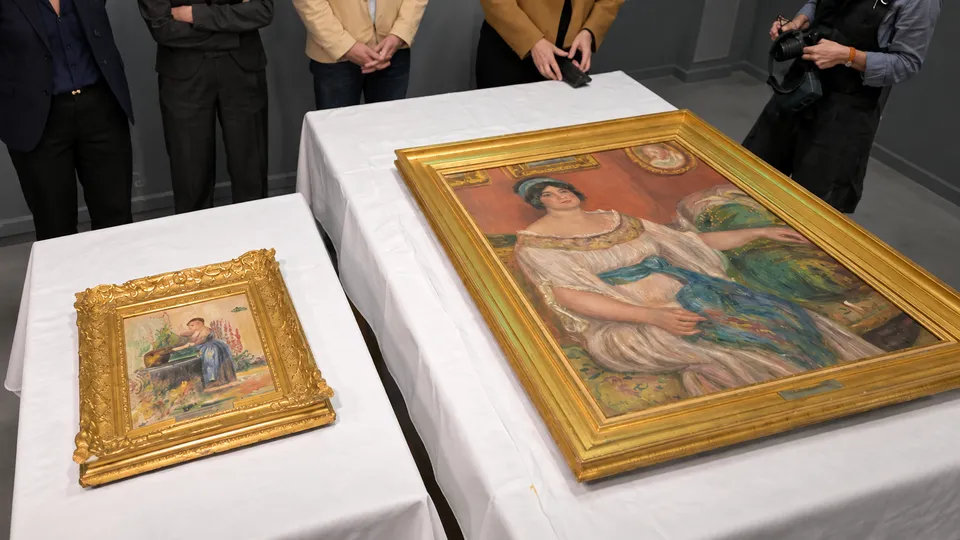
Pierre-Auguste Renoir lived out his last years in a house at Cagnes-sur-Mer, on the stretch of Riviera between Cannes and Nice, and died there in 1919. The house is now the Renoir Museum, small, and the town’s main attraction. On September 8, according to investigators, men came to it with an electric saw. They cut through the fence, got in at ground level and cut the clips that held four paintings in their frames.
Then the alarm went off.
Four minutes
Police were there four minutes later. That speed, the Marseille prosecutor Nicolas Bessone said, “apparently caused the perpetrators to panic.” Four paintings had been cut loose. Two went over the fence with the thieves: Madame Colonna Romano and Young Woman at the Well, worth about 4.2 million euros ($4.7 million) together, by Bessone’s valuation. The other two were Madame Pichon and Coco Reading, a portrait of the painter’s young son Claude. They were left in the museum garden.
“As they fled, they were unable to take all four paintings and abandoned two of them, which were later found in a protective sleeve,” Bessone said, as AFP and AP reported for Al Jazeera.
So the case turned on four minutes and a protective sleeve. The men had left something of themselves behind.

The state was already watching
DNA on the abandoned cover matched a 29-year-old man. According to the AP account published by PBS, he was already under investigation in a drug trafficking case, and police had been tracking his vehicle for that inquiry. The tracking showed that soon after the theft he and a 41-year-old man drove to the home of a third man. Investigators put the rest together from mobile phone location data and surveillance footage.
There is an old irony here. The thief who worries about museum guards seldom thinks about the narcotics squad, which had been building its own file on him for reasons unconnected to art. The state can be slow and clumsy and short of money, but it keeps records. In this case those records filled in what four minutes of alarm had left unfinished.
Under the staircase
The third man admitted, according to AP, that he took the paintings in after the theft and hid them behind a wall built under a staircase. On Friday police found them behind that false wall, in a private house, almost a month to the day after the raid. Neither had come through undamaged. The frame of Young Woman at the Well was slightly damaged. The canvas of Madame Colonna Romano was torn. Both need restoration, and AP reported that on Monday they were displayed at the Interdisciplinary Centre for the Conservation and Restoration of Heritage in Marseille.

Bryan Masson, the mayor of Cagnes-sur-Mer, spoke as a man speaks about his town, not about an inventory.
These two paintings are not simply works of art. They are part of our city’s history. Knowing they have been recovered is an immense relief.
Saint-Paul-de-Vence
The recovery was not the reason the arrests came when they did. On October 3, AP reported, surveillance saw the 29-year-old at the Fondation Maeght in Saint-Paul-de-Vence, a hill town a short way inland, which holds one of Europe’s largest collections of modern art. He then met a fourth man, who was known to police from art theft and forgery cases in 2001 and 2003. Six people were arrested on Wednesday. Bessone said the timing was driven by a “very strong suspicion that another heist was imminent.”
“We were very clearly looking at the repetition of a criminal scheme,” said Eric Antonetti, head of the judicial police in the Alpes-Maritimes.
The suspects deny that they were planning a second raid. Bessone answered with the dry understatement prosecutors save for these moments: he did “not believe the principal suspect visited that museum simply out of a love of art.”

The charges
The two men accused of the theft itself, aged 29 and 41, face preliminary charges that include theft by an organised gang and criminal association. AP reported that they were jailed pending further investigation and deny wrongdoing. The man who hid the paintings was charged with concealment, which Al Jazeera’s account calls organised handling of stolen goods. The fourth man, whom investigators say was approached about buying the works, told police he had seen photographs of them but did not immediately recognise them. AP says he was charged with concealment. Al Jazeera’s account adds participation in a criminal conspiracy. The third and fourth men were released under judicial supervision and may not leave France. The two others arrested were freed without charge.
A country that keeps being robbed
The Cagnes theft brought back memories of last year’s theft of the crown jewels from the Louvre, and with them renewed calls for more security and more money for French cultural sites. Christian Sainte, France’s national director of judicial police, said the country “is repeatedly targeted by organized criminal groups.” He counted 23 museum theft cases in 2025 and about 10 so far this year. Across Europe, institutions have started putting copies on display in place of originals, which amounts to admitting that the walls cannot always hold.
At Cagnes they held for four minutes, and that was enough. Two portraits stayed in the garden, a bag carried a man’s DNA, and the police arrived before the work was finished. The other two canvases spent a month behind a wall under somebody’s stairs. One of them is torn, and it now waits in Marseille for restorers to close the tear.