
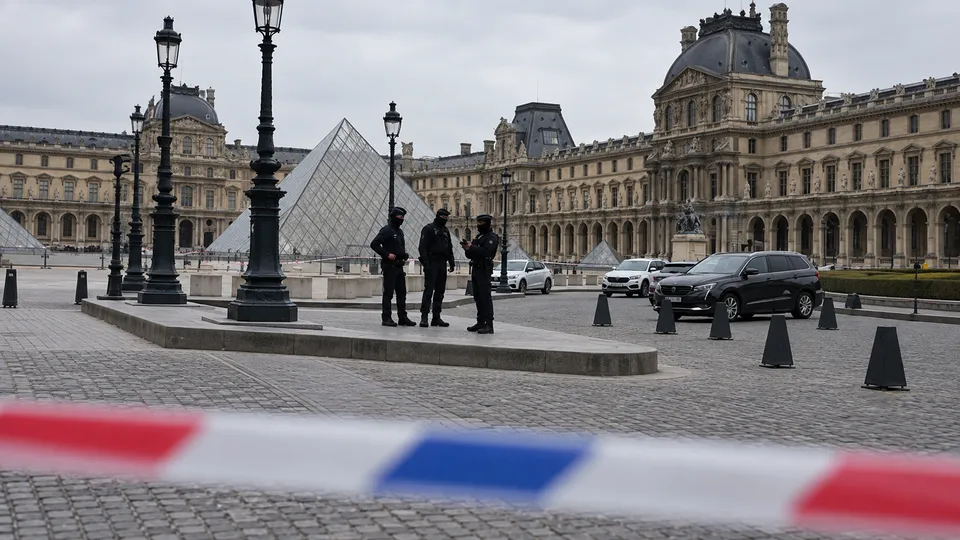
Europe’s museums are quietly pulling original treasures out of their cases and putting replicas in their place, reacting to a string of increasingly forceful robberies that Europol says has risen steeply since around 2022.
Visitors to the Louvre’s Galerie d’Apollon can now take in more than 60 meters of painted ceilings and sculpture, but not France’s crown jewels. The gallery reopened in July 2026, nine months after thieves made off with them in one of the most audacious museum robberies in recent memory, and the surviving gemstones have been moved elsewhere while the museum works out how to show them safely.
Jean-Yves Goriou, head of the EU Organised Crime Unit at Europol, said information shared by member states showed “a clear and steep increase in the number of museum robbery cases since around 2022/2023,” the BBC reported this week. The methods have turned rougher: display cases smashed with sledgehammers and axes, entrances blown open with explosives, firearms used to intimidate staff and visitors. In some cases, museum employees were assaulted or restrained.
As one museum security expert in Belgium put it to the BBC, “Every museum in the world is stressing right now.” Mr. Goriou offered a measure of sympathy: “Museums are most likely doing what they can, given budget constraints and the fact that they are, by design, open to the public.”
For a small museum, a single object can be the whole reason to visit. The Treasure of Villena, dozens of pieces of Bronze Age gold, silver, amber and iron hidden inside a vessel for some three millenniums before an archaeologist uncovered them in 1963, was stolen in August from the Spanish city’s museum. The Vix torque, a 480-gram gold necklace found in the burial chamber of a Celtic woman who died around 500 B.C., was the defining object of the Musee du Pays Chatillonnais in Burgundy before thieves took it from its case.
Two faithful gold copies of the torque already existed when it was stolen; one had even traveled to an exhibition elsewhere in France because the museum would not lend the original. Museums have long used replicas for objects too fragile or valuable to move, and the thefts have pushed some toward making the practice routine. This summer, Dominique Garcia, president of France’s National Institute for Preventive Archaeological Research, proposed wider use of copies in issuing a national security plan. France’s 33-point museum security plan took a different route, calling for the most vulnerable originals to be withdrawn from view until they can be shown more safely.
Some institutions had already acted. After a 2024 armed robbery at the Musee du Hieron in Burgundy, the director, Maud Siron, stopped showing the museum’s most valuable works altogether. The Musee Cognacq-Jay in Paris dropped a valuable pair of earrings from a planned exhibition, and the nearby Musee Carnavalet put a drawing and a rhinestone brooch into a 2026 show where a high-value jewel had been intended.
Authenticity, though, still sells. Guy Turton, director of the global audience strategy agency MHM, said seeing the original piece offers “the feeling that another human made, used or encountered the same object, sometimes centuries ago,” a connection that can feed attendance and ticket revenue. The evidence is visible on Great Russell Street in London, where the first batch of tickets for the British Museum’s rare loan of the nearly 1,000-year-old Bayeux Tapestry sold out within a day.
“If visitors expect an original and discover a replica without explanation, it can feel like a reduction in value,” Mr. Turton said. “If the museum is transparent about why a replica is being used and what it enables them to experience, it can add value.” Ellie King, director of the consultancy Crown Cultures and a researcher on visitor experience, said she suspects many people would accept a replica when they understand the original is being protected from theft. “It may be the story that an object presents which is more important,” she said.
For treasures that stay on view, the first change will be distance, thicker glass or more staff in the room. Britain’s Government Indemnity Scheme already requires locked, alarmed cases for portable valuables such as gold, silver and jewelry, and at least one meter’s separation for certain objects; a gallery holding indemnified works that cannot be properly staffed is allowed to close. “In observational research, we consistently see that visitors engage more deeply when they can approach an object, examine its detail and see it from different angles,” Mr. Turton said.
Lenders are watching, too. James Ferrer, a fine art and museums specialist at the global insurance broker Lockton, said insurers and cultural bodies are scrutinizing security around prominent loans, though he added: “We are there to help facilitate loans, not to present a barrier to stop loans from taking place.”
Mr. Turton pointed to the Rijksmuseum’s live restoration of Rembrandt’s The Night Watch, where the painting sits behind glass and visitors watch work that once happened out of sight. “If security creates greater physical distance, museums need to work harder through interpretation, transparency and experience design to preserve the sense of connection,” he said.