
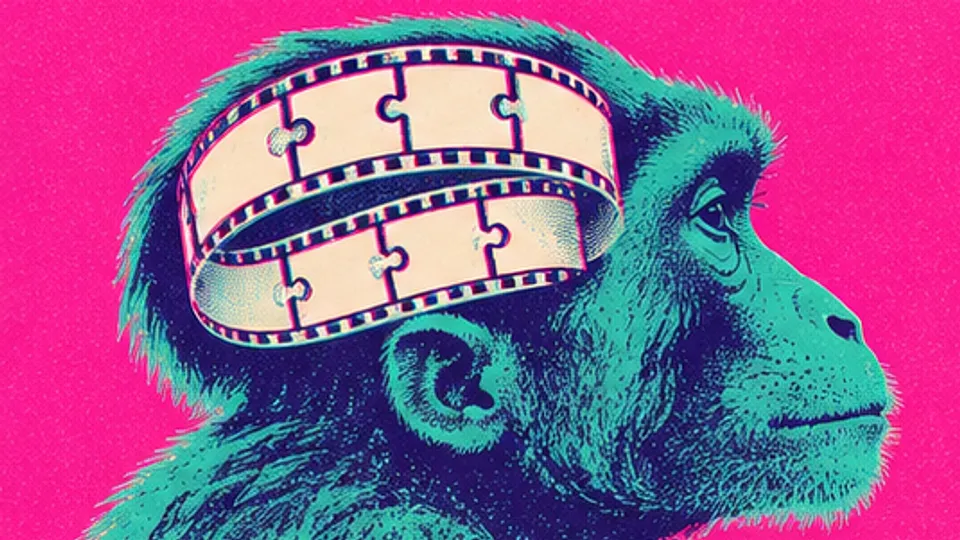
For science, two rhesus macaques with electrodes implanted inside their skulls watched 10-minute clips of Despicable Me, in English and again in Hungarian. The study is in JNeurosci, and Becky Ferreira wrote it up for 404 Media under the only headline it could have had: “Scientists Made Monkeys Watch Minions to Study Their Brains.”
The question underneath is a serious one. Your eyes don’t glide smoothly over a scene. They jump from point to point and stop briefly at each, and each stop is called a “fixation.” So at the mechanical level, vision is a stack of snapshots. What nobody fully understands is how the brain builds meaning out of the stack. The team, led by Vinay Raghavan of the City College of New York, frames it like this:
Primate vision relies on eye movements to sample the world, yet how the brain integrates high level meaning across these ‘snapshots’ remains a mystery.
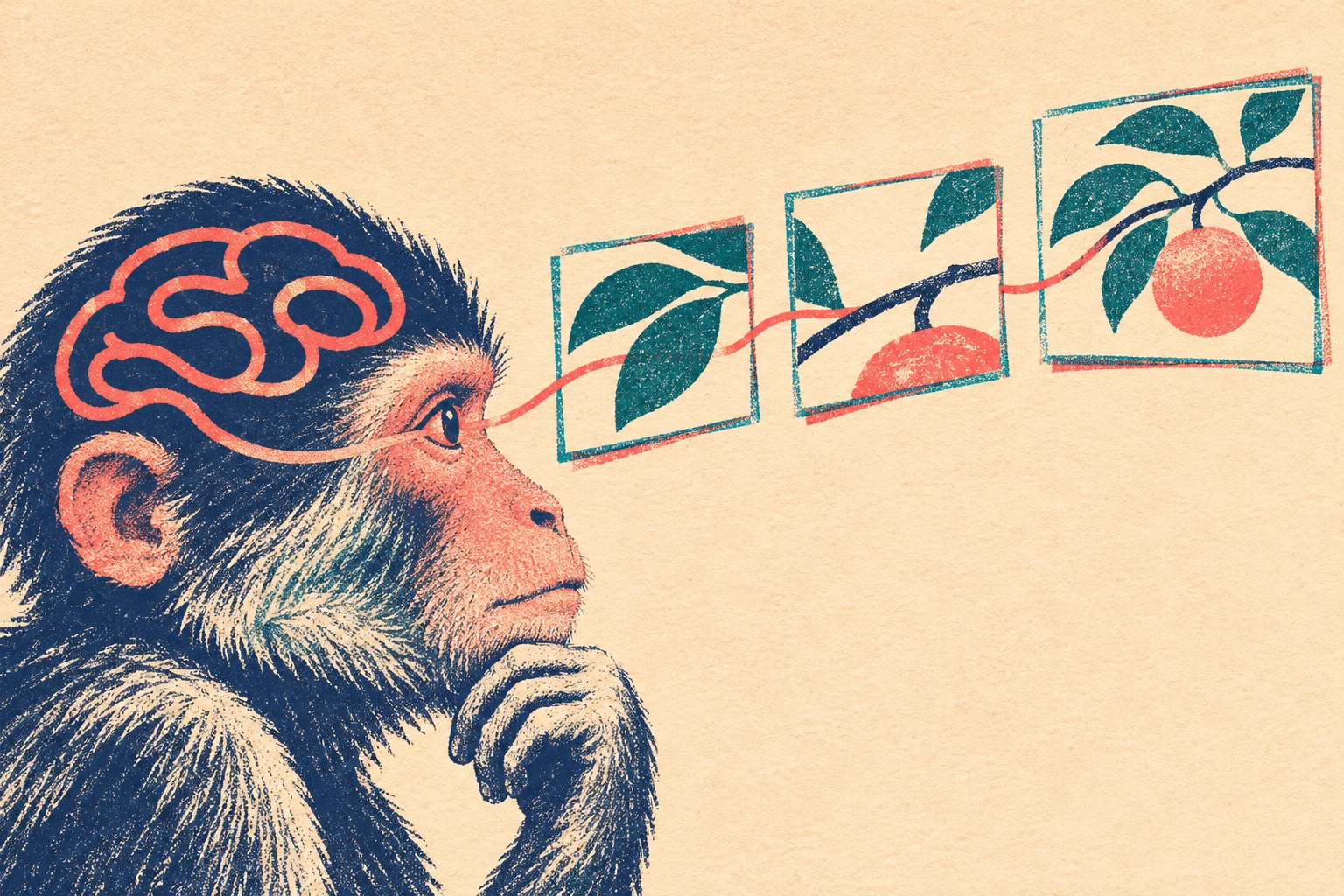
The traditional model, roughly, treats every fixation as independent: look, process, look again, start over. The researchers’ hypothesis, laid out in the preprint on bioRxiv, is that the brain predicts what the next glance will mean. If it does, there should be a neural signal tied to how much new meaning each glance brings, which they call “semantic novelty.” To measure that, they fed whatever sat at the centre of a viewer’s gaze into a deep neural network and scored how new each glimpse was in meaning compared with the ones before. Then they checked whether brain activity followed the score.
The audience
There were two groups of viewers. In the “scalp movie dataset,” dozens of people wore EEG electrodes and watched full-length films: The Big Sick, The Peanut Butter Falcon, Whiplash, Room, Me and Earl and the Dying Girl, The Tomorrow Man, Dom Hemingway, Life After Beth, Woodshock and The Comedian. The instructions were: “Participants were instructed to watch the movie as they would normally watch a movie.” Picture being told to relax and enjoy Whiplash with electrodes glued to your head. Sure.
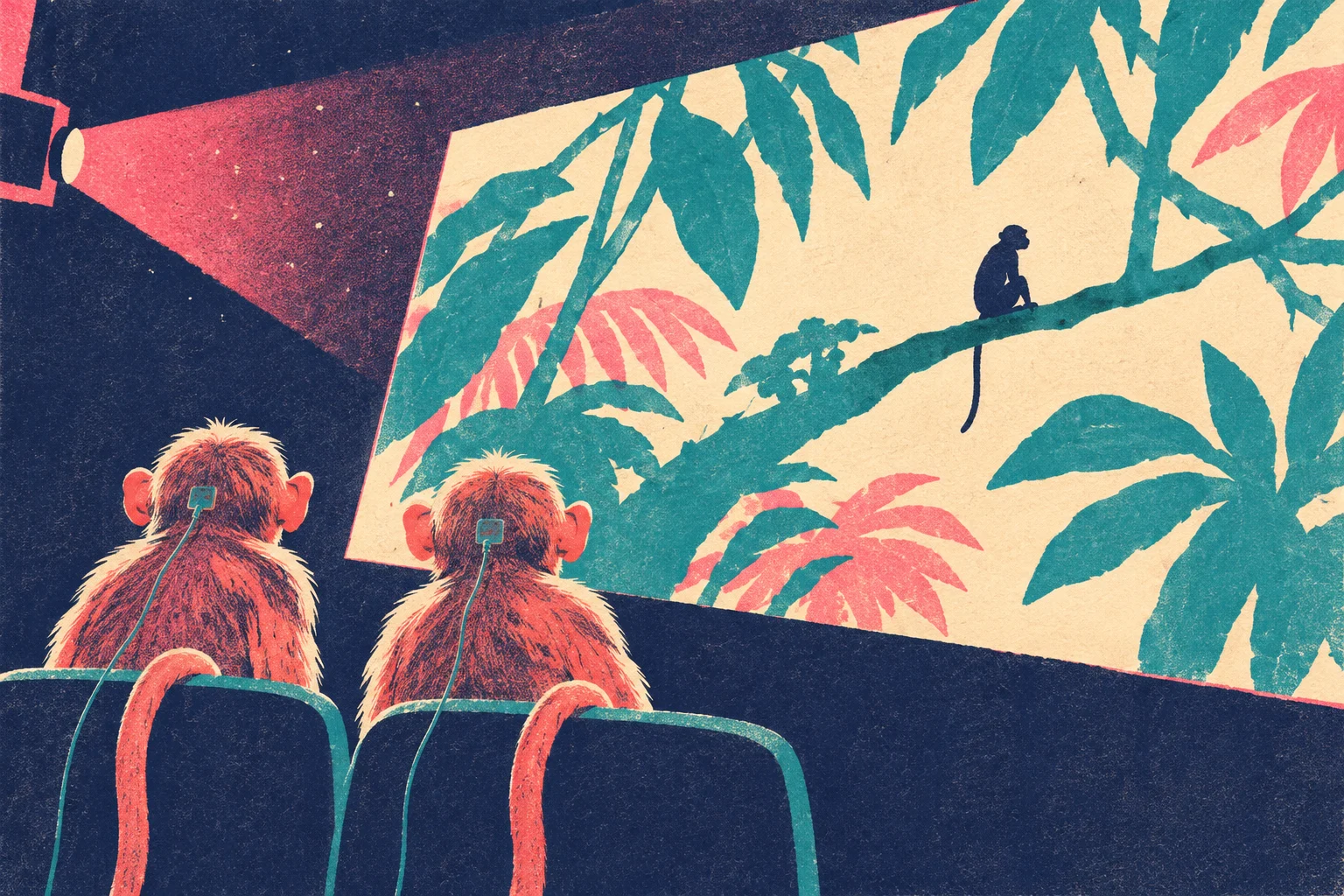
The “intracranial dataset” combined several human patients with the two macaques, all with electrodes inside the skull. They got shorter material: the Despicable Me clips, a 4.3-minute clip of the short film The Present, and three 5-minute clips of documentaries featuring macaques. If you have read about Utah researchers showing waterfalls to patients who already had electrodes in their brains, you know that people with electrodes already in place are a valuable audience in neuroscience. For an experiment like this, the monkeys are the extra bonus.
What the brains did
According to the paper’s listing on ResearchGate, the human EEG data covered 3.4 million saccades (a saccade is one of those jumps). Semantic novelty changed the brain’s response to fixations at the front and back of the head. It changed the responses tied to fixations but not the ones tied to saccades, and that is how the authors know the effect comes from the processing done at each stop. In frontal areas the signal appeared even before a saccade was finished. The deeper recordings showed fast, early responses when new meaning turned up, and only between fixations, according to the Society for Neuroscience press release.
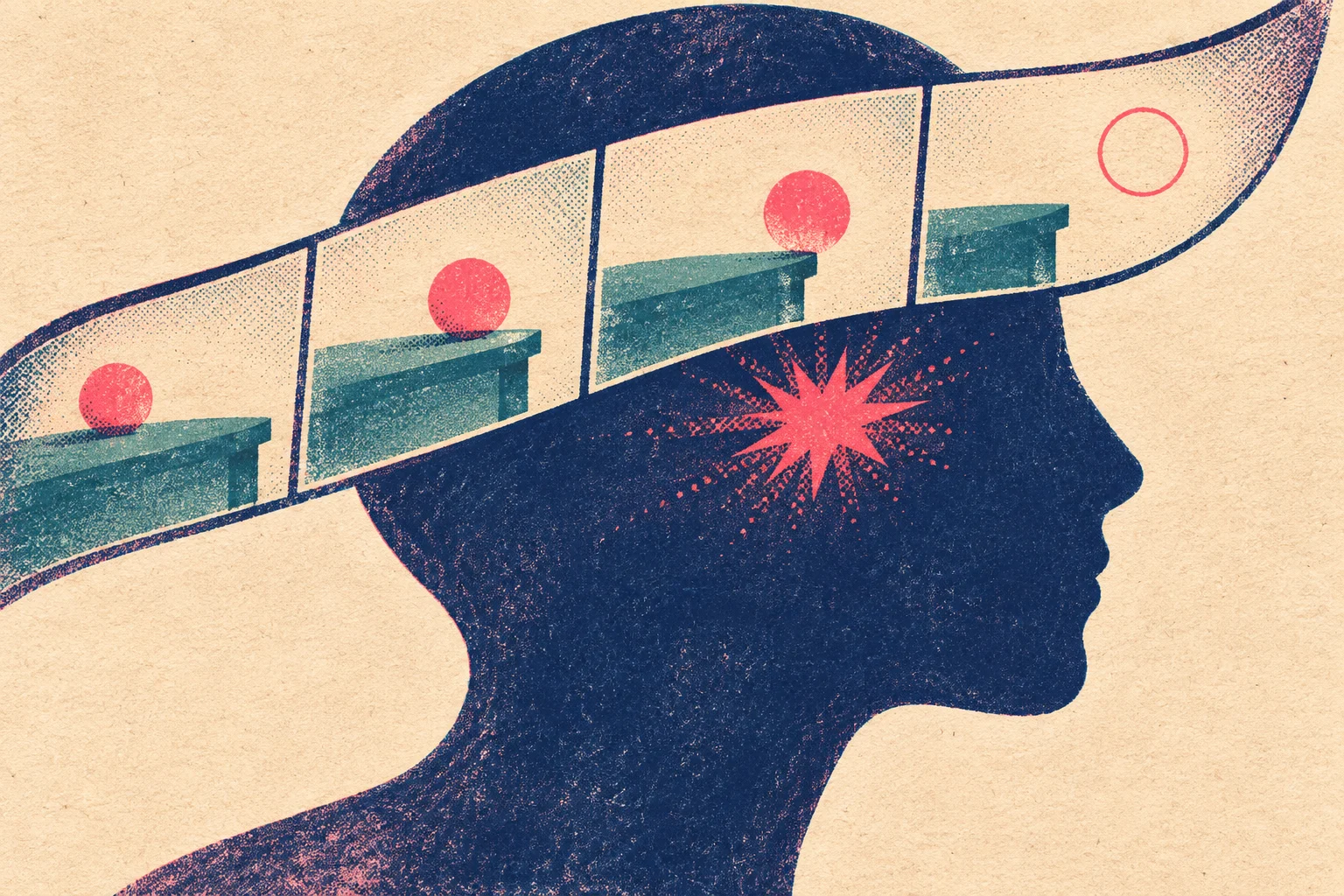
Much of this happened outside the visual cortex. Raghavan says that points to a more abstract system that may anticipate what comes next between glimpses, so the brain can build meaning quickly. The team’s summary is that “visual processing is not a series of independent glimpses, but a continuous process,” and that the results “challenge traditional vision models that treat fixations as independent snapshots and highlight the importance of considering the temporal dynamics of eye movements and the predictive nature of visual processing.”
Translation: before your eyes land, your brain has already guessed what they’ll find, and it reacts most when it guessed wrong.
There is also a commercial angle, as there always is now. The novelty score came from a neural network, and Raghavan’s pitch, in the release also carried by Medical Xpress, runs the other way too. A learning strategy may have “trained neural networks and the primate brain to produce a ‘semantic novelty signal,’” and the fact that the signal shows up in the brain “suggests that [we can implement this learning strategy] to train new vision models in AI.” So an AI measured the brain, and now the brain is offered as a way to train AI. The release lists the Army Research Office, NIH/NIMH and the Directorate for STEM Education as funders.
What the macaques made of the Minions, Ferreira writes, is where “we must confront the limitations of the knowable universe.” They did at least get documentaries about macaques afterwards.
Elsewhere
Thomas Snyder of New York University and Haagen Klaus of George Mason University looked at whether climate stress drove everyday violence in ancient Peru, publishing in Frontiers in Environmental Archaeology. It is a fair question, because the region’s mass sacrifices often coincided with El Niño disasters: at least 107 adult men were killed in six closely timed events at Huaca de la Luna around 550–600 CE, during a “mega-Niño,” and more than 140 children and 200 juvenile camelids were sacrificed at Huanchaquito-las Llamas around 1450 CE. But their meta-analysis of 1,633 individuals from the Lambayeque Valley, spanning 3,000 years before Europeans arrived, found “no strong evidence for an association between environmental factors and interpersonal violence.” Non-ritual violence was rare, at 1.6%, which works out to roughly 26 people.
In PLOS One, a team led by Laurent Davin of the Hebrew University of Jerusalem studied 154 Natufian clay figurines from three sites in Israel, made about 15,000 years ago. Among them are birds, a gazelle and two human forms. Some still carry children’s fingerprints, and in some cases the sequence of marks suggests “an adult passed on the figurine to a pre-pubescent child” partway through the modelling. The authors read the figurines as possible “mnemotechnic devices” for teaching children traditional beliefs and knowledge about birds.
In PNAS, Blaine J. Cole and Diane C. Wiernasz of the University of Houston drew on 34 years of data covering 3,285 colonies of the western harvester ant and found “negative senescence—increased survival and reproduction with greater age.” Individual workers age and die as usual. The paper’s title, “A replaceable soma,” explains the trick: the colony stays young because none of its ants are kept long enough to get old.