
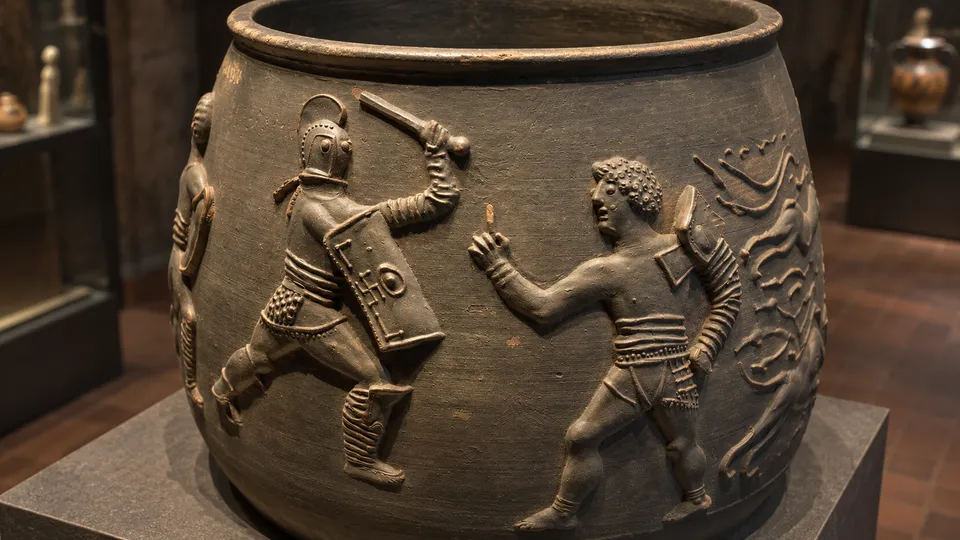
Of 22 Roman-era cremation burials sampled from Colchester, England, only one produced a childhood address that both chemical tracers agreed on: Italy or Spain. The remains belong to a man cremated and buried inside a vase decorated with gladiators, discovered in 1853 and known since as the Colchester Vase. The analysis, led by Durham University and published in Royal Society Open Science on November 4, 2026, is the first in Britain to run strontium and lead isotope measurements on the same set of Roman cremated remains, as Arkeonews reported.
Strontium and lead enter bone from food, drinking water and dust, and their isotope ratios — the proportion of one atomic weight of the element to another in a sample — vary with local bedrock. A growing skeleton locks in the ratio of wherever a person is living at the time; measure that ratio in a burial and compare it with a geological map, and you get a rough fix on childhood geography. The complication with cremation is that most bone is destroyed in the heat of a Roman pyre, along with the teeth researchers normally sample for this kind of work.
Reading an inner-ear bone
What survives is the petrous bone, the densest bone in the skull, which houses the inner ear. Its otic capsule hardens 16 to 18 weeks into gestation and stops remodelling within about two years of birth, so it keeps an early-childhood signal frozen for life. The outer petrous surface keeps growing until age 12 to 15, giving a second, later reading. Durham’s team measured strontium in both zones but trusted lead readings only from the outer surface: too many otic-capsule samples were not fully calcined, raising the risk that the result reflected centuries of post-burial chemistry rather than anything from the person’s life.
| From | To | How |
|---|---|---|
| Petrous bone (forms before birth, densest bone in the skull) | Survives cremation (most other bone is destroyed) | |
| Survives cremation (most other bone is destroyed) | Otic capsule sampled (early-childhood signal, strontium only) | |
| Survives cremation (most other bone is destroyed) | Outer surface sampled (adolescent signal, strontium and lead) | |
| Otic capsule sampled (early-childhood signal, strontium only) | Compared to known geology (local Colchester/Essex range vs. elsewhere) | |
| Outer surface sampled (adolescent signal, strontium and lead) | Compared to known geology (local Colchester/Essex range vs. elsewhere) | |
| Compared to known geology (local Colchester/Essex range vs. elsewhere) | Local verdict | |
| Compared to known geology (local Colchester/Essex range vs. elsewhere) | Non-local verdict |
Across the 22 individuals, strontium ratios ranged from 0.70848 to 0.71267, with a median of 0.70994 — a narrow band matching the chalk and clay under Colchester and southern Essex. Six people fell outside it. Five had higher ratios, pointing toward older rock of the kind found in Wales, Scotland or south-west England; one, labelled COL_17, had a lower ratio consistent with chalk country in north Essex, or, just as plausibly, the Mediterranean.
Lead ratios flagged a different, mostly overlapping set of outsiders. Four individuals — COL_1, COL_12, COL_18 and COL_19 — had lead signatures inconsistent with British ore, in what the authors say is the first application of lead isotopes to Roman-period remains from Britain at all. Only one of those four, COL_18, also showed a non-local strontium reading. The other three had strontium values indistinguishable from the Colchester locals: their skeletons told two different stories for two different stretches of life, a Mediterranean childhood by lead grafted onto what reads as ordinary local water and food by the time the strontium signal was set.
| Burial | Strontium verdict | Lead verdict | Likely reading |
|---|---|---|---|
| COL_18 (the vase) | Non-local, higher ratio | Non-local, matches Italy/Spain | Childhood spent in the Mediterranean |
| COL_1 | Local range | Non-local | Mediterranean childhood; later life matches Colchester |
| COL_12 | Local range | Non-local | Mediterranean childhood; later life matches Colchester |
| COL_19 | Local range | Non-local | Mediterranean childhood; later life matches Colchester |
| COL_20 | Non-local, higher ratio | Excluded, container contamination | Older-rock region by strontium; lead unreadable |
| COL_17 | Non-local, lower ratio | Local range | Chalk geology; north Essex or Mediterranean, ambiguous |
Reading lead off an 1,800-year-old skeleton has an obvious hazard: lead coffins. Five of the 22 burials had been cremated or stored in pewter ossuaries or a lead-lidded glass vessel, and their bone lead concentrations ran from 123 to 3,029 parts per million, against a natural, non-anthropogenic ceiling the researchers put at 0.87 ppm. The isotope ratio of that contaminating lead — a 207Pb/206Pb value of 0.845 to 0.849 — matched known British ore sources, confirming the contamination came from the container, not the person’s own life, and the team excluded those five results from the mobility analysis. One of the five, COL_20, is also one of the six strontium outliers, so its childhood geology is still readable even though its adult lead history is not.
Three more people — COL_11, COL_13 and COL_16 — had lead concentrations of only 0.4 to 0.6 ppm, unusually low even by local standards. That could mean a rural upbringing away from the lead-polluted water and cookware of Roman towns, or it could mean growing up entirely outside the empire’s lead-saturated economy. The isotope data cannot say which.
Who was in the vase
The vase itself was made from local Colchester clay between AD 160 and 200, not imported as once assumed; a 2024 study in Britannia by Glynn Davis and colleagues showed the names cut into its gladiator and animal-hunt scenes — Memnon, Valentinus, Secundus, Mario — were incised before firing, meaning the pot recorded a specific contest rather than being bought off a shelf.

The man cremated inside was older than 40 when he died. John Taylor, the antiquarian who found the vase in Colchester’s western cemetery in 1853, donated it to what is now Colchester Castle Museum, where it remains on display. Nothing ties him physically to the four named fighters on its surface, and cremation erases most evidence of a violent trade anyway. Davis doubts he was a gladiator himself, suggesting instead a lanista — a trainer — or a wealthy backer of the games. “There must be an intimate connection with the deceased,” Davis told reporters. “They could well have sponsored the games. Or they were an absolute sports nut. For whatever reason, they saw the fight and thought, ‘I want a memento of that.’”
Gladiatorial spectacle travelled with Rome’s armies and administrators well beyond Italy — contests are attested from provincial Britain to Bodrum on Turkey’s Aegean coast — and Colchester, Roman Camulodunum, had Britain’s only archaeologically confirmed circus. Archaeologymag reported that of the full set of 22 burials, three carried Mediterranean signatures spanning Italy, Spain and Lebanon, while 13 matched a childhood spent in or around Colchester itself. Interviewed by The Times, as GB News reported, Durham isotope technician Joanna Moore, who led the study, said cremation strips away the usual evidence: “There’s no teeth left usually, which is what we like to use if we’re going to look at a skeleton and see where they’ve come from.” Of the vase burial specifically, she said the chemistry pointed away from home: “The strontium is telling us he’s not from Colchester.”
Durham’s team has not yet run the same combined strontium-lead protocol on cremation cemeteries elsewhere in Roman Britain. York, with its legionary fortress, or London, with its port, would be the obvious next sites to test whether a confirmed migrant rate of roughly 1 in 22 — or the higher count the ambiguous low-lead cases suggest — holds anywhere else, and whether a better extraction method can rescue the otic-capsule samples that were too poorly calcined to trust for lead this time.