
Two counts of defamation, each pleading at least $10 billion in damages, add up to a stated claim of at least $20 billion. That is what Donald Trump’s lawsuit against Dow Jones, News Corp and Rupert Murdoch asked for over a Wall Street Journal story about a 2003 birthday letter for Jeffrey Epstein. On October 31, U.S. District Judge Darrin Gayles in Miami dismissed the case for the second time in six months, this time with prejudice, which in federal civil procedure means the complaint cannot be refiled in that court under any amended theory. The recovery: zero. The number to watch next is whatever Dow Jones asks for in attorneys’ fees, due within 30 days, under Florida’s anti-SLAPP statute.
What actual malice requires, and why ‘nowhere close’ kept being true
Trump is a public figure, so the suit had to clear the bar set in New York Times Co. v. Sullivan (1964): a plaintiff must show the publisher knew the statement was false or acted with reckless disregard for the truth. Negligence does not count. A failure to investigate, by itself, does not count either — the standard set out in Harte-Hanks Communications v. Connaughton (1989) carves out a narrower category, “purposeful avoidance of the truth,” which is what Trump’s lawyers had to plead facts to support, not merely assert in adjectives. Gayles’s April 2026 order found the original complaint came “nowhere close.” He gave Trump until April 27 to amend it.
The underlying story, published by the Journal on July 17, 2025, described a letter bearing Trump’s name in an album compiled for Epstein’s 50th birthday in 2003, framed by what the paper described as a hand-drawn outline of a naked woman and signed off with “Happy Birthday — and may every day be another wonderful secret.” Trump called it fake the next day and filed suit in the Southern District of Florida on July 18, naming Murdoch, Dow Jones, News Corp chief executive Robert Thomson, and the two bylined reporters, Joseph Palazzolo and Khadeeja Safdar, as defendants.
The amended complaint added four allegations, and none of them was a fact the court could use
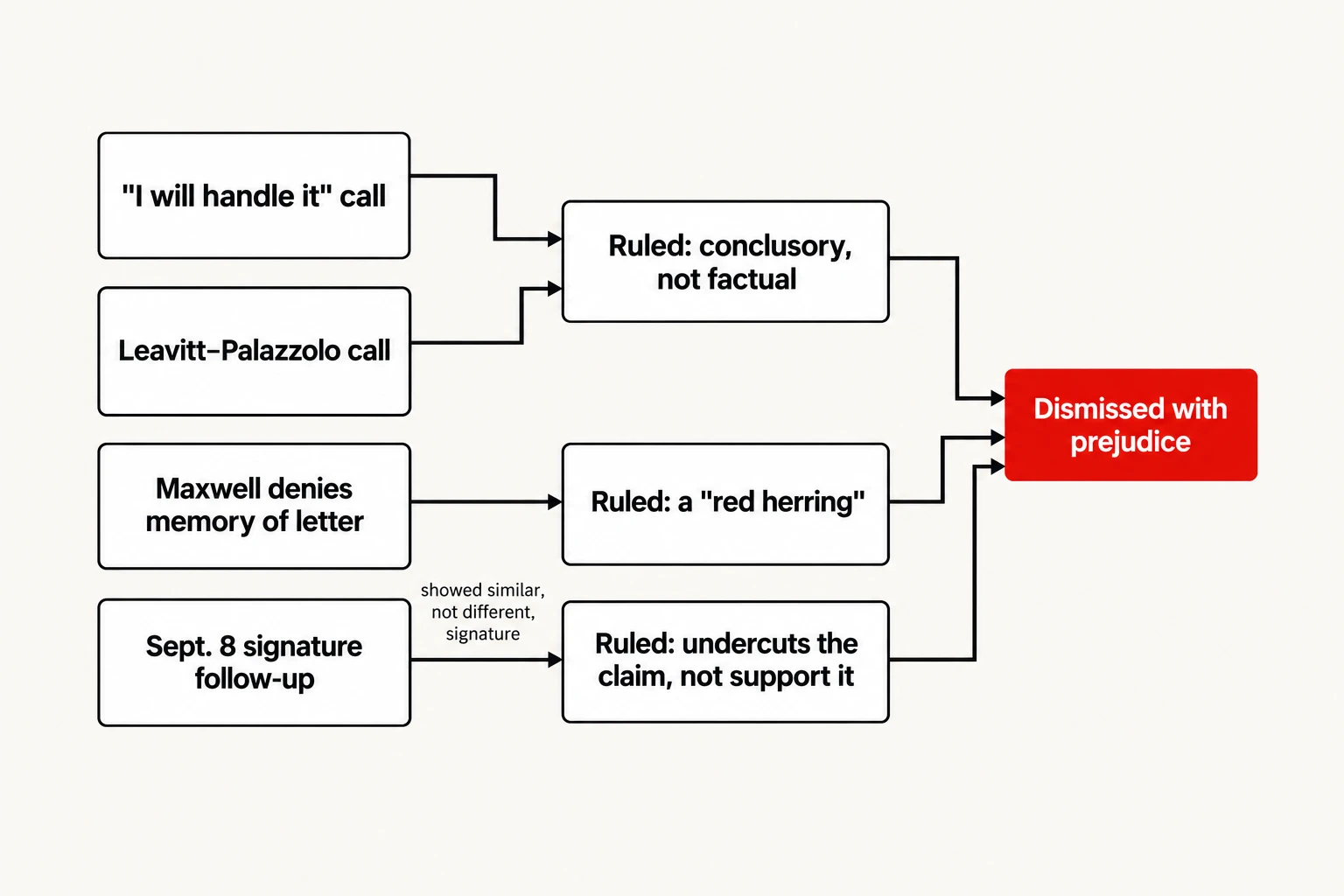
Trump’s team refiled within the April 27 deadline, adding material aimed squarely at the gap Gayles had identified. The amended filing claimed Murdoch told Trump “I will handle it” on a pre-publication call, which Trump’s lawyers read as a promise to kill the story. It added a claim that then-press secretary Karoline Leavitt phoned reporter Palazzolo directly to dispute the letter’s premise. It cited Ghislaine Maxwell’s statement to a Deputy Attorney General that she did not remember Trump submitting a letter, arguing the paper should have weighted that denial more heavily. And it attacked a September 8, 2025 follow-up Journal article that examined the signature after congressional investigators released the unredacted birthday book.
| From | To | How |
|---|---|---|
| "I will handle it" call | Ruled: conclusory, not factual | |
| Leavitt–Palazzolo call | Ruled: conclusory, not factual | |
| Maxwell denies memory of letter | Ruled: a "red herring" | |
| Sept. 8 signature follow-up | Ruled: undercuts the claim, not support it | showed similar, not different, signature |
| Ruled: conclusory, not factual | Dismissed with prejudice | |
| Ruled: a "red herring" | Dismissed with prejudice | |
| Ruled: undercuts the claim, not support it | Dismissed with prejudice |
Based on Order of U.S. District Judge Darrin Gayles, reported by Reason's Volokh Conspiracy
The 20-page order, as laid out in legal analysis published on the Volokh Conspiracy, took each addition apart. The claims that defendants “knew or should have known” the letter was fake were, per the court, conclusory — the kind of language a complaint has to back with specific facts to survive under the Eleventh Circuit’s 2025 ruling in Reed v. Chamblee, which bars exactly this style of pleading. Maxwell’s non-memory was a “red herring”: if she had nothing to contribute, skipping her added no evidence of avoidance. The September 8 piece, which the order found showed similarities rather than differences between Trump’s known signature and the one on the letter, cut against the malice claim rather than for it. And the court found that the Journal had reached out before publication to Trump’s own team, the Justice Department, the FBI, and others named in the birthday book, including Les Wexner and Alan Dershowitz — the kind of outreach that, under Harte-Hanks, is evidence against reckless disregard, not for it.
Gayles also rejected the theory, repeated in both complaints, that the paper should have dropped the story once Trump denied writing the letter. Letting any public figure’s denial function as a veto over coverage, the order said, would amount to a First Amendment problem of its own: it would let officials block negative reporting simply by issuing a statement. The Journal’s article, Gayles noted, had reported that denial — “informed readers that President Trump decried the Letter as a fake” — which the court treated as evidence the paper gave the opposing account its due, not as evidence it ignored one. Al Jazeera’s report quotes the order’s characterization of the whole effort as “grasping at straws,” attempting to “manufacture” flaws in investigative reporting that, on the court’s reading, had done the opposite of what reckless reporting looks like.

The money that is actually in play now runs the other direction
Dismissal with prejudice forecloses amendment in that court; Trump’s team has told CNBC it will appeal to the Eleventh Circuit, where the same 2025 Eleventh Circuit precedent on conclusory pleading will apply again. Separately, the order leaves Dow Jones free to move for attorneys’ fees and costs under Florida’s anti-SLAPP statute within 30 days of the ruling — a motion, not an award; the amount, if any, is still to be litigated. There is a precedent for what that can look like: in January 2024, a New York judge ordered Trump to pay the New York Times and two of its reporters a combined $392,638 under that state’s anti-SLAPP law after dismissing his suit over the paper’s 2018 Pulitzer-winning tax-records series, a case the judge said the revised statute was “specifically designed to apply to.” Dow Jones’s public response to the October 31 ruling was three words: “We’re pleased with the court’s decision.”
Trump’s spokesperson’s statement was longer: he will “continue to press forward in his powerhouse lawsuit against the Wall Street Journal and all of the other defendants,” and intends to hold outlets “accountable” for what he calls “Fake News and smears.” Measured in dollars actually collected, that record so far is one-sided and runs against him.
The table shows the pattern: settlements have come from companies with a pending regulatory favor to protect — Paramount settled the month its $8 billion merger with Skydance needed Federal Communications Commission sign-off — while suits litigated to a judgment on the actual-malice standard, against CNN, the Times and now the Journal, have produced no damages and, twice, an order to pay the other side’s lawyers. The BBC case is the one still running, with Trump due to answer the BBC’s lawyers under oath by December 11 or risk losing a $10 billion claim by default. Whether that one settles, like Paramount, or gets tested against Sullivan, like the Journal, is the next data point in the same series.