
On November 24, the Financial Crimes Enforcement Network, the Treasury bureau that runs the country’s anti-money-laundering reporting system, posted a notice that it was “investigating a cybersecurity incident that resulted in unauthorized access to a limited subset of its systems” and had taken some of them offline as a precaution, according to the notice reported by The Hacker News. The same week, the Treasury Department’s Chief Information Officer, Sam Corcos, whose job includes overseeing cybersecurity for the department, was merging pull requests into Legatum, a Civilization VI clone he has been building with AI coding agents, including one titled “Music by era, the Aztecs’ own music, the sea, and gunpowder-age battle sounds,” filed after the FinCEN notice went up, as 404 Media reported.
Corcos joined Treasury as a special adviser in March 2025 through DOGE and became CIO near the start of Trump’s second term. He is also the cofounder of Levels, an a16z-backed glucose-monitoring startup, and has positioned himself inside the administration as an advocate for fast AI adoption in government, including a push to put AI “throughout” login.gov. None of that is disqualifying on its own. What is unusual is the arithmetic of his attention during a week his own bureau disclosed an intrusion: Legatum’s GitHub repository, samcorcos/legatum, shows pull requests merged on diplomacy UI, unit icons and AI opponent balance running right through the FinCEN disclosure, each one, per the project’s README, produced “largely with AI coding agents” — Claude and OpenAI’s Codex — with art generated through ChatGPT’s image models.

Legatum is explicit about what it is: a readme notice states it “is not affiliated with, endorsed by or derived from” Sid Meier’s Civilization, Take-Two or Firaxis, and that “Civilization” is used only to name the genre. The commits are not autonomous busywork run in the background. One recent change log entry quotes Corcos directing the model directly: “I like Chariot archers for egypt, their current special unit is lame,” he told Claude, according to 404 Media’s review of the repository. When the economist Alex Tabarrok questioned the project on X, Corcos replied that “the computers are doing it on their own,” and that it was “mostly Opus 5.5 orchestrating a bunch of iterative loops,” in a post on X. The commit history, with its line-item feedback on Aztec theme music and Egyptian unit design, reads less like an autonomous agent and more like a product manager with an unusually patient intern. The columnist Catherine Rampell asked who pays for the Claude tokens burned on the project, and whether it is Treasury’s bill; Corcos has not answered.
GitHub users noticed the mismatch before any reporter wrote about it. Two issues were opened directly on the Legatum repository: “Stop making vibe coded video games and do your job Sam Corcos,” filed as issue #210, and “A bug in Sam Corcos brain,” filed as issue #211. As of 404 Media’s reporting, Corcos had not closed or deleted either one. He has form here: this fall he was accused of deleting GitHub comments on the U.S. Web Design System that flagged accessibility-compliance problems in an automated testing tool his office was pushing.

What FinCEN actually lost, and what it hasn’t said
FinCEN’s own account of the incident is thin on specifics. It has not named which systems were accessed, said how long the intrusion lasted, or identified a suspect. Reporting on the timeline suggests the breach was live well before the public notice: filing providers reported failures in automated batch submissions to FinCEN’s Secure Direct Transfer Mode starting November 18, six days before the cybersecurity disclosure. To cover affected filers, FinCEN issued Order FIN-2026-R002 on November 24, extending the deadline for Bank Secrecy Act reports, beneficial-ownership filings and FinCEN ID updates originally due between November 18 and December 29 to December 30 — an order that, notably, cites a “service disruption” rather than the breach itself. Treasury says it is working with the FBI, the Cybersecurity and Infrastructure Security Agency and outside forensic examiners to scope the intrusion; a FinCEN official told Reuters investigators have so far found no evidence that the Bank Secrecy Act database or beneficial-ownership registry was reached.
The FinCEN notice landed hours after the New York Times reported, via Dustin Volz, Tyler Pager and Julian Barnes, that hackers had breached an unclassified open-source-intelligence system shared by the CIA, the National Geospatial-Intelligence Agency and the Office of the Director of National Intelligence, as covered by TNW. Classified material was reportedly untouched. Investigators suspect the tool was Artex, an open-source AI penetration-testing framework published in July by a Chinese developer going by Autumn-27. Artex carries no model of its own; it wires AI agents from GPT, Claude, DeepSeek or similar models into a loop that scans a target network, probes for weaknesses, escalates privileges and exfiltrates data with minimal human steering — the same category of tool, run the same way, that built Legatum’s Egyptian chariot archers, per the FBI’s advisory covered by Forbes.
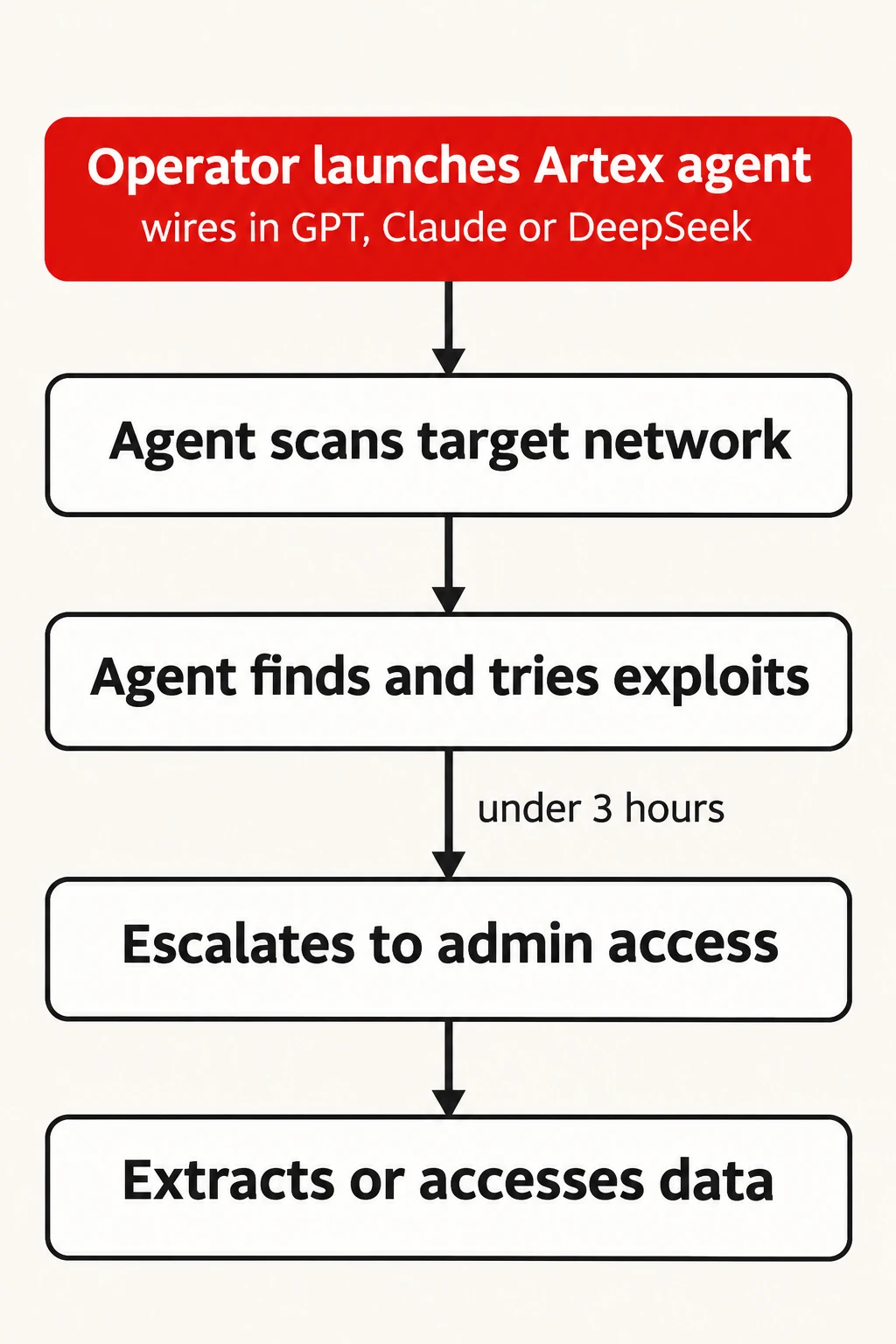
| From | To | How |
|---|---|---|
| Operator launches Artex agent (wires in GPT, Claude or DeepSeek) | Agent scans target network | |
| Agent scans target network | Agent finds and tries exploits | |
| Agent finds and tries exploits | Escalates to admin access | under 3 hours |
| Escalates to admin access | Extracts or accesses data |
Based on FBI advisory, Nov. 13, 2026
The FBI’s 13-page advisory, published November 13, says Artex has been weaponized since at least August against banks, government agencies, defense contractors and law firms, and has reached administrator-level access in under three hours in some attacks. Researchers had found more than 1,600 exposed Artex consoles on the open internet by early November despite the original developer pulling the GitHub repository in October; Microsoft has tied a related October campaign to Storm-0940, a group it describes as China-state-aligned. Whether Artex touched FinCEN specifically is unconfirmed — investigators told the Times only that early signs, including the tool’s signature, point toward China, and a shared tool does not prove a shared attacker, since Artex forks have also surfaced in unrelated breaches at the European Commission and at Bitrise this month.
FinCEN’s breach is the third disclosed federal intrusion in a week: the FBI is separately investigating an apparent breach of the National Crime Information Center, the nationwide database police use for warrants and stolen-property checks, first reported around November 20–21; FBI Director Kash Patel confirmed an active investigation without naming a suspect. That overlaps with a reshuffle at the top of federal cyber policy: President Trump fired national cyber director Sean Cairncross on November 19 after a run of outages hit air travel, banking and NSA communications, briefly installing Pentagon CIO Kirsten Davies as acting director before Director of National Intelligence Jay Clayton took the acting role days later while Davies awaits Senate confirmation, according to Axios.
A CIO already on a short leash over AI
Corcos’s game-building is not his first friction over AI policy at Treasury. Treasury Secretary Scott Bessent reassigned him away from the department’s AI policy portfolio this summer, according to Politico, after he held conversations with executives at OpenAI and Anthropic without giving the White House full visibility. Corcos reportedly “portrayed himself as an industry ally and warned that other government officials, reacting to fears over the latest AI models, were attempting to impose a burdensome licensing regime that would hamper innovation.” A Treasury spokesperson told Politico he “remains involved in providing policy guidance on issues within his area of expertise.” He kept the CIO title, and with it, nominal responsibility for the department’s cybersecurity, which is how a person barred from talking to AI labs about AI policy ended up running an AI lab’s models against a video game’s unit balance while a bureau he oversees went dark.
Corcos’s most recent tweet argues it is “reasonable to ask employees what they are working on,” posted as federal workers braced for orders to report their task lists. His own GitHub commit log answers the question for him: fixing mid-game wall graphics, adding Aztec music, tuning Rome’s AI to stop making peace too early. FinCEN has not said what, if anything, the intruder who prompted its shutdown actually took.