
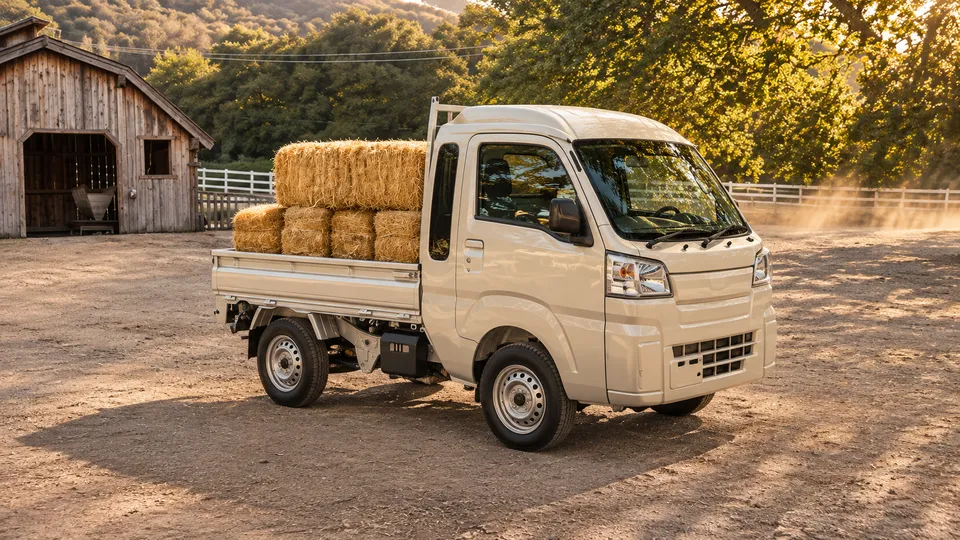
Toyota is capping a truck’s top speed at 25 miles an hour, and the cap is the product, not a limitation on it. As Business Insider reported, Toyota announced on November 10 that it will revive its discontinued Scion brand to sell the KEI-01, a Japanese-style kei truck, through a fleet-only pilot starting in the second half of 2027. The vehicle’s governed speed is the mechanism that makes the whole project legal and cheap to certify: stay at or under 25 mph and a four-wheeled vehicle under 3,000 lbs GVWR qualifies as a low-speed vehicle under 49 CFR 571.500, Federal Motor Vehicle Safety Standard No. 500, which asks for headlamps, turn signals, seatbelts and mirrors — not the frontal, side and rollover crash tests that every car and pickup doing highway speeds must pass. One mph over 25, and the KEI-01 would need the full FMVSS suite, a new crash-tested body structure, and years of additional engineering.
The vehicle itself is a 660cc three-cylinder engine with a continuously variable transmission, selectable four-wheel drive with an auto mode and a push-button lock, a bed rated for 600 lbs, and a footprint of just over 11 feet long and under 5 feet wide, according to Toyota’s press release. It is built on the Daihatsu Hijet Jumbo platform, a truck that sells in Japan for around $9,000. Kei vehicles — a regulatory class capped at a 660cc engine and defined dimensions, not a marketing term — make up roughly one-third of Japan’s new-vehicle market, NBC News reported, and the average kei car there costs between $6,000 and $11,000. The steering wheel will stay on the right side; Toyota’s engineering, not the law, is why.
A brand built to sidestep its own rulebook
Toyota is not changing the 25-year rule that currently governs direct kei imports — the rule that lets enthusiasts bring in old Japanese kei trucks once they age out of needing to meet US crash standards at all. It is building a new truck inside a different exemption, the low-speed-vehicle one, that already exists for golf-cart-adjacent vehicles like the LSVs resort towns use. Toyota will assemble the KEI-01 at Toyota Motor Manufacturing Indiana starting in the second half of 2027, backed by a $34 million investment and about 50 new jobs — a rounding error next to the plant’s usual output, which signals this is a pilot, not a new mass-market line. Sales will run through a small set of existing Toyota dealers rebadged “Scion by Toyota,” reviving a brand Toyota killed in 2016, and initially only to fleet buyers — construction, farm and municipal operators, the same customers who buy UTVs. Toyota has not published a price.

Why now: the $25,000 car is five models deep
The average new vehicle sold in the US for $51,109 in October, a record, up 1.3% from September’s $50,460 and the third straight month above $50,000, according to Kelley Blue Book’s October report, published by Cox Automotive. Full-size pickups, the category Toyota is implicitly undercutting, averaged $67,912, up 1.4% year over year. In 2017, 36 new-vehicle models sold for under $25,000; this year, Cox Automotive counts five, PBS NewsHour reported.
The decline tracks who is buying. Households earning more than $150,000 a year now account for 43% of new-car sales, up from 30% in 2019, while households under $75,000 have fallen from 37% to 26% of sales over the same period, according to Cox Automotive data reported by NewsNation. A sub-$25,000, 25-mph pickup that can’t legally go on a highway is a strange answer to that squeeze — it solves a rulebook problem, not an income one — but it is the cheapest thing with four wheels and a bed that any automaker has announced building in the US in years.
Three ways to build a cheap small truck, three different prices
Toyota is not alone in betting under the full-size truck. Ford’s electric Fathom starts at $28,350 before a $1,595 destination fee, with retail preorders opening in early 2027 and deliveries late that year, according to Edmunds. Slate Auto, the startup whose stripped-down electric truck rews has covered as it opened its first showroom, prices its base model at $24,950. Telo’s MT1, despite being pitched alongside these as a small truck, starts at $41,520 for its standard-range version and runs to $46,019 for the dual-motor model, Autoblog reported — closer to the industry’s $51,109 average than to Slate’s price.
President Trump has pushed publicly for exactly this kind of vehicle since a trip to Japan in October 2025. “I have just approved TINY CARS to be built in America,” he wrote on Truth Social that December, adding they would be “inexpensive, safe, fuel efficient and, quite simply, AMAZING!!! START BUILDING THEM NOW!” He had earlier called the Japanese segment “really cute” at a White House briefing. The post did not change any regulation — kei-class crash and emissions rules were never federally approved for import, and Toyota’s answer routes around that question entirely by building to the existing LSV standard rather than asking Washington to recognize Japan’s kei rules. Whether Trump’s attention changes anything beyond the announcement’s timing is not something the record shows yet.
What the record does show is a truck with no published price, a sales channel limited to commercial fleets, and a US plant investment of $34 million — smaller than the marketing campaign most automakers run for a mainstream model launch. The number to watch is the one Toyota hasn’t given: what the KEI-01 costs once Scion dealers start writing invoices, and whether Toyota ever lets it past the fleet gate to the retail buyers currently choosing between a $24,950 Slate, a $28,350 Fathom, and nothing at all under $25,000 with a Toyota badge on it.