
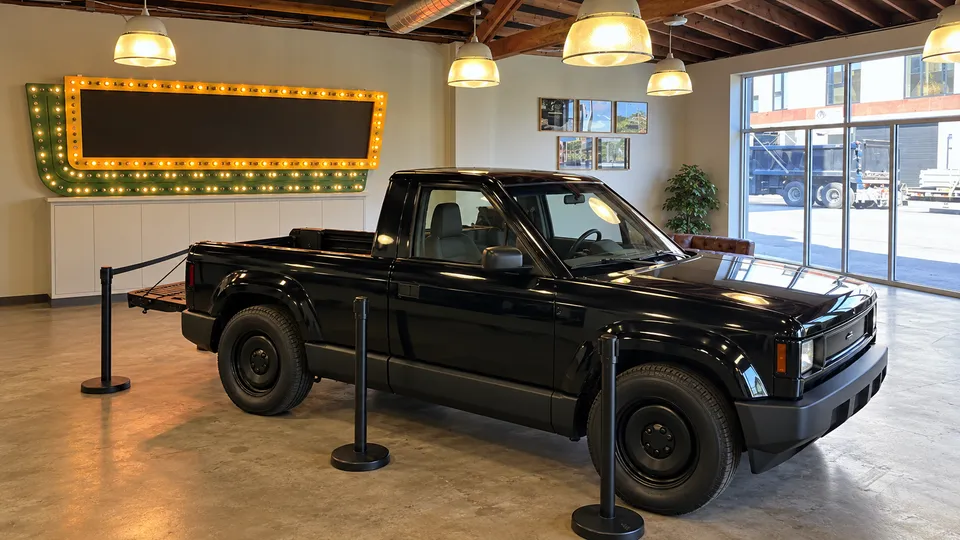
Slate Auto, the electric-truck startup backed by Jeff Bezos, has opened its first showroom, and the star of the floor is not quite the real thing. Visitors who arrived hoping to size up the company’s $25,000 pickup found a single hand-built prototype, its bed cordoned off and production still to begin, Ars Technica reported on Tuesday.
Eric Bangeman, the Ars Technica writer who made the visit, had hoped to compare two trucks and hunt for uneven panel gaps and creaky chassis. Instead he got one truck, finished in a black wrap rather than the base gray, with only the driver’s door open to shoppers. It was bigger than he expected, roughly the footprint of a Hyundai Santa Cruz, and the folded-down tailgate “felt reassuringly sturdy” when he leaned on it. The five-foot bed looked about as durable as any other pickup’s.
The panels sat flush and the doors closed snugly, though Mr. Bangeman conceded a prototype hand-built to be poked by reporters and the public would naturally show well. Inside, the fit was stripped back on purpose: crank windows, physical climate controls, a phone holder and a small screen for the gauges. The seats were supportive, but the recline lever on his seat didn’t work at all.

Beyond the standard Blank Slate pickup body, the company plans two SUV kits, the Squareback and the Fastback, plus an open-air kit, all sold through its Slate Garage customization program. A company representative identified by Ars Technica as Purdy said the pickup was outselling the alternatives. “Most customers are going with the truck configuration,” he said. “And then they’re customizing their trucks in the Slate Garage.”
The harder test lies ahead. Slate’s assembly line in Warsaw, Ind., is still running prototypes, and the company hopes to start building production models “soon,” Purdy told Mr. Bangeman. The plant, a former printing facility, will turn out a truck that Slate says will come standard with 150 miles of range, according to the company’s chief executive, Chris Barman.
Getting one handsome prototype to a showroom is the easy part. Consistent panel gaps, watertight seals and doors that line up with their fenders, truck after truck off a moving line, is the work that will decide whether the promise survives the showroom floor.