
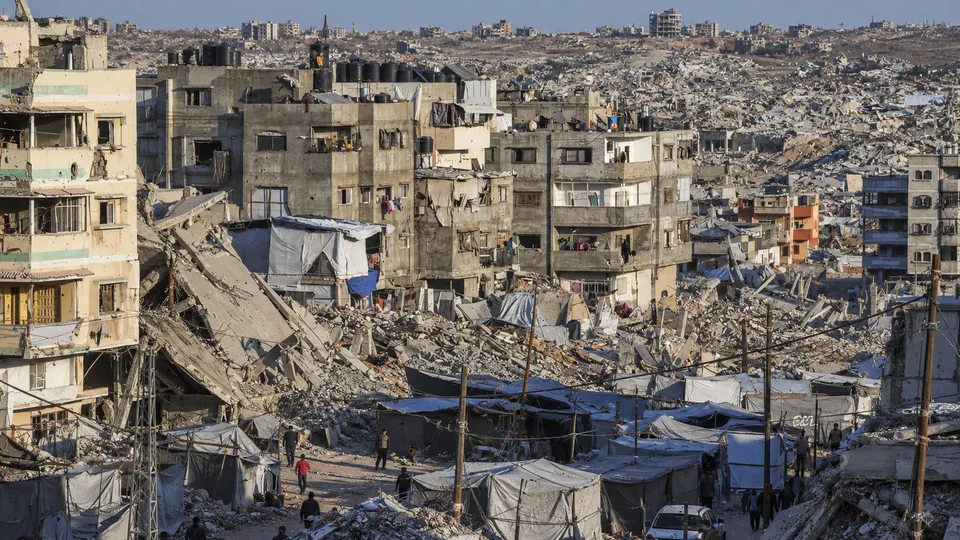
Wars have anniversaries the way illnesses do. Somebody has to name the day, and the day is always the one it began. In Gaza that day is 7 October 2023, when the Hamas-led attack on Israel opened a war that is now three years old. That is long enough, it might be said, for a war to stop being an event and become the weather.
Reporting from Gaza City for Al Jazeera, Maram Humaid writes of an enclave “transformed beyond recognition” by Israel’s sustained air and ground assault. Homes, whole neighbourhoods and the services that kept people alive have been destroyed or badly damaged. Gaza’s Ministry of Health counts more than 74,245 Palestinians killed. About two million people have been displaced, most of them more than once.
A ceasefire was announced in October 2025. The ministry says 1,462 people have been killed since it took effect. On the anniversary itself, Israeli strikes hit Gaza again, and Palestinian officials reported at least two dead, Arab News reported. For most of the war Israel rejected the ministry’s tolls. Its military now believes about 70,000 Gazans were killed, according to the Times of Israel.
The tent
In September the United Nations found that 94 percent of people urgently needed shelter and basic household items, and that 65 percent of households were living in tents or makeshift shelters. Many had no bedding, no lighting, no kitchen things and no sanitation. In early August, 91 percent of the households assessed faced moderate to high water insecurity, up from 84 percent in June. Gaza has no working electricity grid. Hospitals, bakeries and families all depend on generators, which in turn depend on fuel, oil and spare parts that are always running short. Ruined roads and broken networks make it harder to travel, to call someone or to reach a clinic. Humaid describes routines “reorganised around survival.”
The final damage assessment by the European Union, the UN and the World Bank, published on 20 April, counted more than 371,000 housing units destroyed or damaged. It priced recovery at $71.4 billion over a decade, $26.3 billion of it in the first 18 months. Families still shelter in buildings that may fall.
The market
The economy can be read in a handful of numbers. UNCTAD, the UN’s trade and development agency, reported in September that 92 percent of economic establishments had been damaged or destroyed since October 2023, and that unemployment stood at 78 percent. GDP per person was $212 in 2025, about 17 percent of its 2022 level. Agriculture and industry are each producing 6 percent of what they produced in 2022. Construction is at 1 percent, in a place that needs rebuilding more than almost anywhere on earth. Prices remain around 200 percent above their pre-war level, according to the UN, and restrictions at the Israeli-controlled crossings have made things worse. UNCTAD now puts recovery needs at about $71.5bn and expects that figure to rise.
Rami al-Zaygh, an economic researcher, said the war “pushed society back decades”. Old trades have come back and people have invented new work out of whatever is left. Cash itself has become scarce, so families living on humanitarian cash aid pay with e-wallets and digital transfers. Paper money has disappeared and the debt that replaced it is only a number on a phone screen.
A reflection, not a finding: rulers count a war’s progress in territory, while the people under them count it in the price of flour.
The classroom and the ward
UNICEF says nearly 98 percent of Gaza’s schools have been damaged or destroyed. As of April 2026, about 700,000 children aged 4 to 17 had lost almost three years of in-person schooling, and around 200,000 had no access to education of any kind. Those who learn at all mostly do so in tents and temporary rooms. The Palestinian Ministry of Education warns that children are losing basic skills and that the gap is widening into a threat to a whole generation.
The World Health Organization says all 36 of Gaza’s hospitals have been damaged. Nineteen function, and none at full capacity. Shortages of medicines, equipment, diagnostics and fuel have disrupted cancer care, dialysis and treatment for chronic disease. About 12,400 patients have been evacuated for treatment abroad since October 2023, and tens of thousands more still need care that Gaza cannot give them. In September the WHO warned that crowding, poor shelter and failing water and sanitation raise the risk of outbreaks. It asked for steady humanitarian access, medicines and equipment, repairs to health facilities and more evacuations.
The line
The ceasefire drew a boundary, the “Yellow Line”, marking where Israeli forces are deployed, and it has reportedly been pushed deeper into populated areas. The Euro-Med Human Rights Monitor estimated in September that Israeli control and restrictions now cover about 70 percent of Gaza, leaving more than two million people in less than 30 percent of the Strip. Rafah once sheltered more than a million displaced people. The Israeli operation there in May 2024 displaced more than 800,000, according to the UN. Today almost all of Rafah except Mawasi Rafah is under Israeli control. On 29 September Euro-Med warned that the expansion makes forced displacement permanent, with no guarantee that anyone will return. From the air, the ground they left behind has been counted building by building.
Who governs
Hamas has ruled Gaza since 2007. In July it announced that it would hand administration to the National Committee for the Administration of Gaza, a technocratic body. The handover has not happened. The UN Human Rights Office recorded at least 12 attacks on police between January and May 2026, which killed 53 people, including 35 officers. The Palestinian Centre for Human Rights says the attacks left a security vacuum filled by kidnappings, attacks on property and the looting of aid. Al-Monitor reports that Israeli intelligence believes Hamas still has about 30,000 armed fighters, roughly as many as before the attack.
In April, after the reconstruction bill was published, a group of UN experts said the assessment “is shockingly silent on the most obvious conditions required for any reconstruction in Gaza”. They argued that rebuilding cannot succeed unless the occupation ends. Six months later the bill has grown, the line has moved and the tents are still standing.